Political Circus: Johnson’s Gridlock Lament Rings Hollow Amid Capitol Standoff
POLICY WIRE — Washington, D.C. — The theatrical absurdities of American governance continue, like a long-running, poorly written play, now with the added spectacle of its lead actor lecturing the...

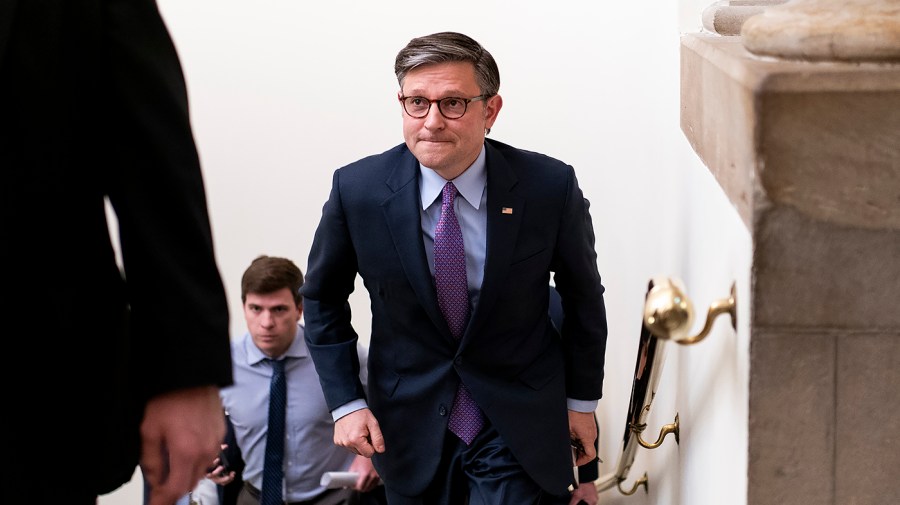
POLICY WIRE — Washington, D.C. — The theatrical absurdities of American governance continue, like a long-running, poorly written play, now with the added spectacle of its lead actor lecturing the chorus. House Speaker Mike Johnson finds himself perched precariously on a legislative cliff, bemoaning a political strategy that many would argue he himself helped craft. It’s a bit rich, isn’t it?
His recent pronouncements—delivered with the earnest gravitas characteristic of a politician caught between a rock and an even harder rock—highlight a Capitol Hill that’s more tangled than a kite string after a hurricane. And this time, the snarl revolves around the so-called SAVE America Act. A bill, frankly, that has become less a legislative proposal and more a political cudgel, wielded by a faction intent on demonstrating their own purity tests. One might observe a kind of grim dedication, really.
The Speaker’s position? Blocking the entirety of the House agenda over this single piece of legislation is, well, [QUOTE_PLACEHOLDER]. He’s apparently keen on avoiding what he perceives as a ‘death by a thousand cuts’ scenario for his legislative calendar. But, of course, the cuts are already bleeding all over the carpet. It isn’t just about the optics; it’s about actual, measurable paralysis. Congressional gridlock has hit new heights in recent years; for example, the 117th Congress (2021-2023) saw one of the lowest numbers of bills enacted into public law since at least 1973, with merely 364 Public Laws enacted, according to data from the Congressional Research Service. This isn’t just inertia; it’s a profound stasis.
The Speaker’s exasperation isn’t an isolated incident; it’s a symptom. It’s what happens when ideological purity trumps legislative pragmatism—when every issue, no matter how granular, becomes a test of faith. This isn’t a new dance; it’s a quadrille danced into the ground for decades. It’s frustrating for anyone watching, even for the hardiest of observers. The constant brinkmanship, the last-minute heroics (or villainy, depending on your perspective)—it’s become the default mode of operation.
It’s hard to make the trains run on time when half the crew wants to switch out the tracks mid-journey. And when those same crew members are then chastised for slowing down the journey, well, that’s just the delicious irony. The SAVE America Act—whatever its contents—has become a symbolic battleground. A trench dug deep. No retreat, no surrender, only more squabbling. Meanwhile, pressing national — and international matters languish.
We’ve seen this script play out time — and again. Government shutdowns averted at the eleventh hour, debt ceilings raised with theatrical drama. The public, frankly, is pretty numb to it all. It’s a perpetual feedback loop of manufactured crises — and political posturing. The question isn’t whether they’ll find a way out of *this* impasse, but rather how quickly they’ll stumble into the next one. This isn’t statesmanship; it’s an audition for Cable News. Most days, it’s hard to tell the difference.
What This Means
This persistent infighting, especially when the Speaker publicly laments his own party’s tactics, sends a chilling message beyond the Potomac. From Karachi to capitals across the Muslim world, and indeed, around the globe, Washington’s political melodrama isn’t just viewed as an entertaining circus. Instead, it’s interpreted as an indicator of American stability—or lack thereof. When the world’s preeminent superpower struggles to manage its own legislative calendar, questions arise about its capacity to lead on complex international challenges, from economic policy to security agreements. Pakistan, for instance, a nation often grappling with its own internal political turbulence, observes the disarray in the U.S. Congress with a mixture of bemusement and trepidation, especially considering Washington’s long-standing influence on regional stability and economic assistance. They’ve got their own struggles, but at least their Parliament generally agrees on breakfast.
Economically, prolonged legislative paralysis breeds uncertainty. Investment, both domestic — and foreign, thrives on predictability. This kind of chronic dysfunction creates jitters. It’s a self-inflicted wound, a slow drain on confidence. International partners start looking for alternative anchors, alternative alliances. We’ve written before about how geopolitical shifts echo in places like Karachi, and this Capitol Hill chaos contributes to that instability. It’s not just a domestic issue anymore; the ripple effects are global.
But the most immediate consequence? A stack of undone work. Essential appropriations, critical reforms, — and even basic administrative functions of government get sidelined. The very mechanisms designed to serve the American populace seize up because of a philosophical stand-off that often seems to benefit no one but cable news ratings. And it’s a vicious cycle: the more blocked the agenda becomes, the more emboldened the obstructionists feel. It isn’t a strategy for success; it’s a blueprint for further frustration, likely leading to more pleas from the Speaker that sound an awful lot like [QUOTE_PLACEHOLDER]. One has to wonder when this particular theatrical run will finally conclude, or if it will simply fade into an even more exasperating intermission.