

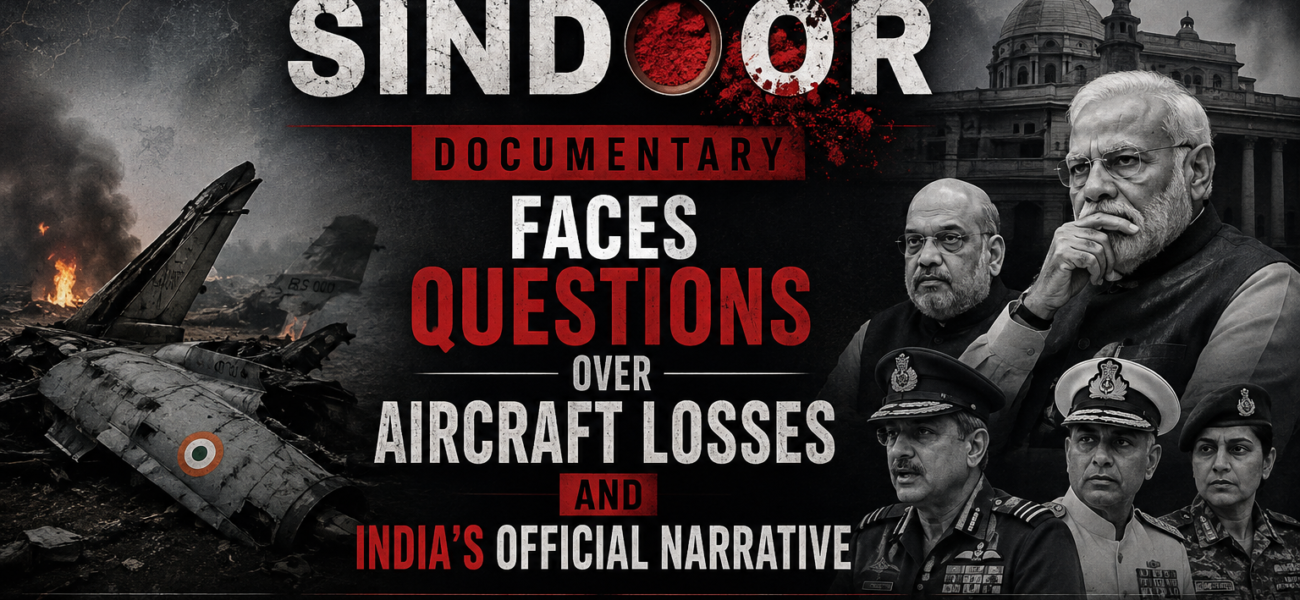
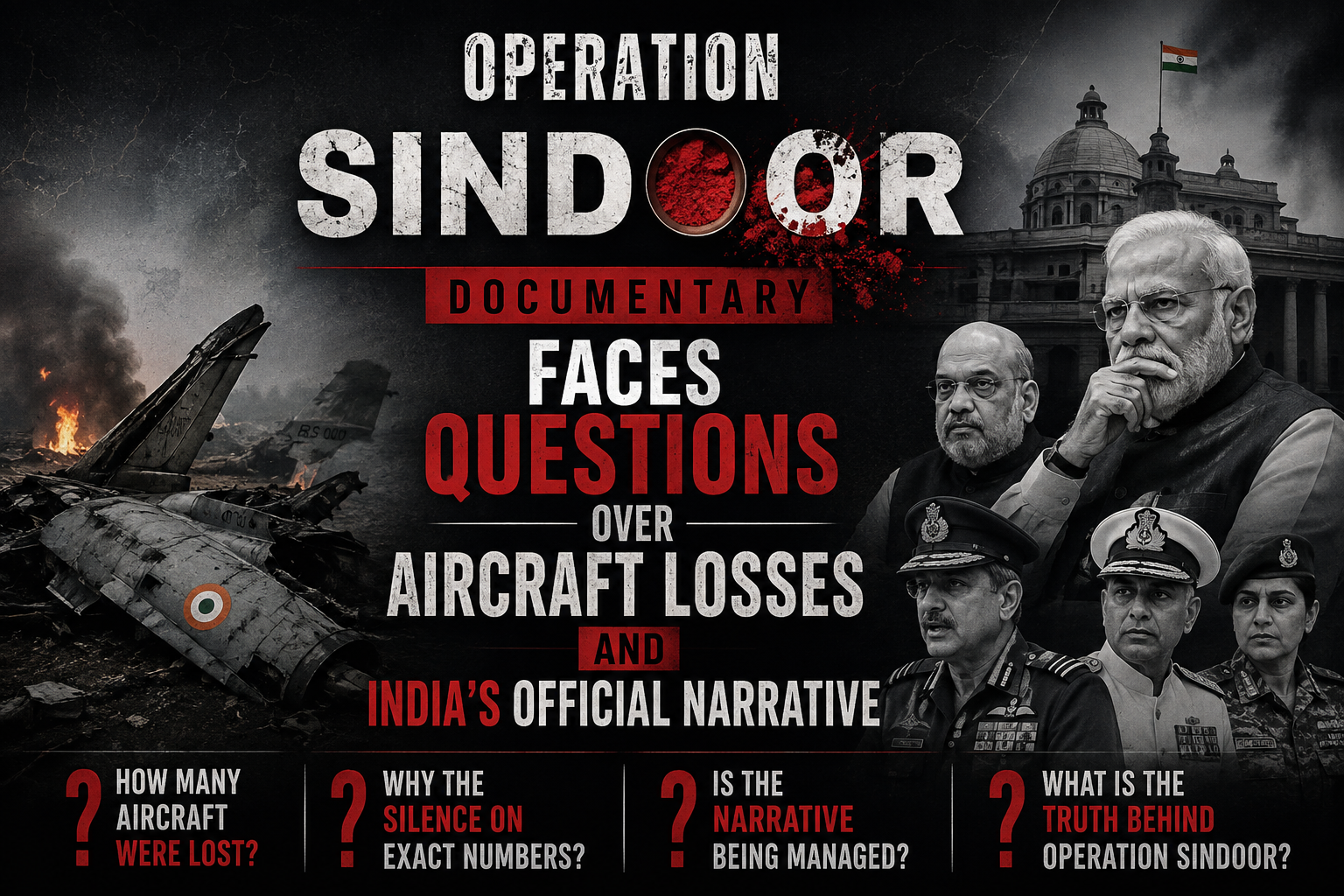
Operation Sindoor Documentary Faces Questions Over Aircraft Losses and India’s Official Narrative
Declassified or Curated? The Unanswered Questions Behind Operation Sindoor
As India celebrates its 80th Independence Day, the country has once again turned to military achievement as a source of national pride. At the center of this year’s narrative is Declassified:...

As India celebrates its 80th Independence Day, the country has once again turned to military achievement as a source of national pride. At the center of this year’s narrative is Declassified: Operation Sindoor, a state-backed documentary commemorating the Indian Air Force’s strikes launched after the April 2025 Pahalgam incident. Fireworks open the film and solemn narration closes it, presenting the operation as a decisive demonstration of Indian military power.
Yet behind the triumphalist presentation lies a far more complicated record, one marked by disputed aircraft losses, conflicting official claims, delayed disclosures and questions raised within India itself. A documentary presented as a declassification inevitably invites comparison with the broader evidence. On that measure, the film appears less like a complete accounting of Operation Sindoor and more like a carefully selected version of events.
A Timeline That Leaves Questions Unanswered
The documentary places May 7, 2025, when India’s strikes began, at the center of its narrative. Yet questions remain over the evidentiary and political basis on which New Delhi moved toward military action. Pakistan repeatedly challenged India’s justification for the operation, particularly the gap between the Pahalgam incident and India’s subsequent identification of individuals it alleged were responsible.
The issue also entered India’s domestic political debate. Congress leader Rahul Gandhi questioned who authorized informing Pakistan “at the start” of the incident, described the matter as potentially constituting a crime and asked how many Indian aircraft had been lost as a consequence. India’s External Affairs Ministry rejected his characterization as a “misrepresentation of facts.” Nevertheless, the episode demonstrated that India’s official narrative was itself subject to serious political questioning.
The Aircraft Losses and the Battle of Claims
The most consequential question remains the outcome of the aerial engagement. Pakistan maintained that its Air Force successfully intercepted and engaged Indian aircraft during the confrontation. Its publicly stated figures initially referred to one Indian aircraft and subsequently rose to as many as five. Prime Minister Shehbaz Sharif later told the United Nations General Assembly that the Pakistan Air Force had downed seven Indian aircraft.
Pakistan’s position therefore remains central to any serious assessment of the air battle. Rather than treating Islamabad’s account as a secondary narrative, the available record warrants examining it alongside India’s own changing statements and the evidence that subsequently emerged regarding Indian aircraft losses.
India, for its part, presented varying assessments of the losses it claimed to have inflicted on Pakistan. On October 2, Air Chief Marshal A.P. Singh said the IAF had eliminated “four to five fighter aircraft, most likely F-16s.” Less than two weeks later, on October 14, Deputy Chief of Army Staff Lt. Gen. Rajiv Ghai told a UN troop-contributing-countries conclave that India had downed 12–13 Pakistani military aircraft.
The changing Indian figures raise an important question about the consistency of New Delhi’s wartime narrative. If India’s own assessment moved from four or five aircraft to 12–13, its claims deserve the rigorous scrutiny.
India’s Delayed Disclosure of Its Own Losses
Another significant feature of the episode was India’s reluctance to provide a clear and comprehensive account of its own losses. For months, Indian officials referred to “some” losses without publicly establishing a precise figure or fully identifying the aircraft involved.
India’s Chief of Defence Staff, General Anil Chauhan, eventually acknowledged that combat losses had occurred, even as New Delhi continued to emphasize the overall success of the operation. Only later did Air Chief Marshal A.P. Singh provide a more detailed account while rejecting Pakistan’s assessment of the scale of Indian losses.
This sequence raises questions about the transparency of India’s presentation. A production marketed as a declassified account would reasonably be expected to address the operational setbacks alongside claimed successes. Instead, the emphasis remains overwhelmingly on India’s offensive achievements, leaving important questions about the actual cost of the operation insufficiently addressed.
Evidence That Complicates India’s Narrative
Statements from foreign officials and independent assessments have further challenged the simplicity of India’s presentation. Reporting based on remarks attributed to French Air Force Chief Gen. Jérôme Bellanger pointed toward three Indian losses: a Rafale, a Sukhoi and a Mirage 2000. While the precise context of those remarks warrants careful consideration, their emergence added weight to questions that India had struggled to settle publicly.
Physical evidence also became part of the debate. Analysts identified a largely intact Chinese-made PL-15E missile roughly 100 kilometers inside Indian territory near Hoshiarpur, Punjab. Pakistan cited the discovery as evidence supporting its account of a successful long-range aerial engagement, while Indian sources offered alternative explanations for the missile’s presence and condition.
The episode nevertheless illustrates a broader problem for India’s narrative; material evidence, battlefield reporting and subsequent foreign assessments cannot simply be excluded from the historical record because they complicate the official presentation.
Rafale, Training and the Question of Readiness
The reported losses also placed India’s much-publicized military modernization under renewed scrutiny. India’s original 2016 agreement for 36 Rafale fighter aircraft was valued at approximately €7.8 billion, making it one of the country’s most significant combat-aircraft acquisitions. Consequently, the reported involvement of advanced Indian platforms in combat losses raised questions about whether sophisticated hardware alone can guarantee battlefield superiority.
The issue is particularly significant given the structural pressures facing the Indian Air Force. While the IAF’s authorized strength is 42 fighter squadrons, it has been operating with substantially fewer, highlighting a persistent gap between its officially sanctioned force structure and its available combat strength. At the same time, India’s fighter modernization remains expansive: the IAF operates all 36 of its original Rafales, while the Indian Navy has ordered 26 Rafale-M aircraft, and India’s Defence Ministry has cleared a further 114-fighter acquisition as part of its broader modernization effort. The scale of these program underscores both New Delhi’s determination to strengthen its air power and the financial burden involved in addressing the IAF’s longstanding capability gap.
There is also a longer-running transparency question surrounding the Rafale program itself. The Modi government declined to disclose the aircraft’s per-unit price to Parliament, citing the confidentiality of the agreement, a decision that attracted criticism from opposition parties. Although procurement confidentiality is not itself evidence of wrongdoing, the episode provides relevant context when assessing questions of disclosure surrounding India’s presentation of Operation Sindoor and its subsequent accounting of losses.
India’s Comptroller and Auditor General has previously identified shortcomings in aspects of pilot-training infrastructure. These institutional findings provide grounds for examining whether India’s expanding investment in advanced platforms has been matched by equivalent improvements in training, operational doctrine and preparedness.
For Pakistan, the episode consequently demonstrated the importance of integrated air defence, operational planning and the ability to respond effectively against a numerically and technologically ambitious adversary.
A Documentary Built Around Victory
The broader record is therefore more contested than India’s documentary presentation suggests. Pakistan has consistently maintained that its Air Force mounted an effective response and inflicted significant losses on Indian aircraft. Subsequent statements from Indian officials, foreign assessments and evidence surrounding aircraft losses have ensured that the outcome cannot simply be reduced to the uncomplicated victory portrayed in New Delhi’s official narrative.
The documentary also fits into a wider Indian tradition of linking military operations with popular nationalist culture. Indian cinema has previously transformed military episodes into highly emotive narratives through productions such as Uri: The Surgical Strike, Raazi and Border. In that environment, the boundary between historical documentation and patriotic storytelling can become increasingly blurred.
On Independence Day, Declassified: Operation Sindoor may serve its immediate purpose; reinforcing national pride and portraying India’s military action as a decisive victory but a documentary carrying the label “declassified” carries a greater responsibility than a conventional patriotic production. It should confront the operational setbacks, disputed claims, delayed disclosures and evidence that complicates the official version.
The unanswered questions surrounding the aerial engagement do not disappear simply because they receive limited attention in the film. If anything, their absence makes the central question more compelling: is Declassified: Operation Sindoor a comprehensive account of what happened, or a carefully constructed narrative designed to preserve India’s preferred image of the operation?
For Pakistan, the significance of the episode lies not merely in competing numbers but in the demonstrated ability of its armed forces to respond to a major military challenge and contest India’s attempt to define the outcome unilaterally. The historical record will ultimately be shaped not by the loudest declaration of victory, but by the evidence that survives scrutiny.
Author