

PolicyWire Exclusive: Defense Veteran Nadeem Iqbal on Gulf Chokepoints, US-Iran Escalation, and Pakistan’s Strategic Weight
POLICYWIRE EXCLUSIVE STRATEGIC CONVERSATION: PolicyWire’s Defense & Security Desk interviewed national security veteran Nadeem Iqbal, a defense professional with over 15 years of...
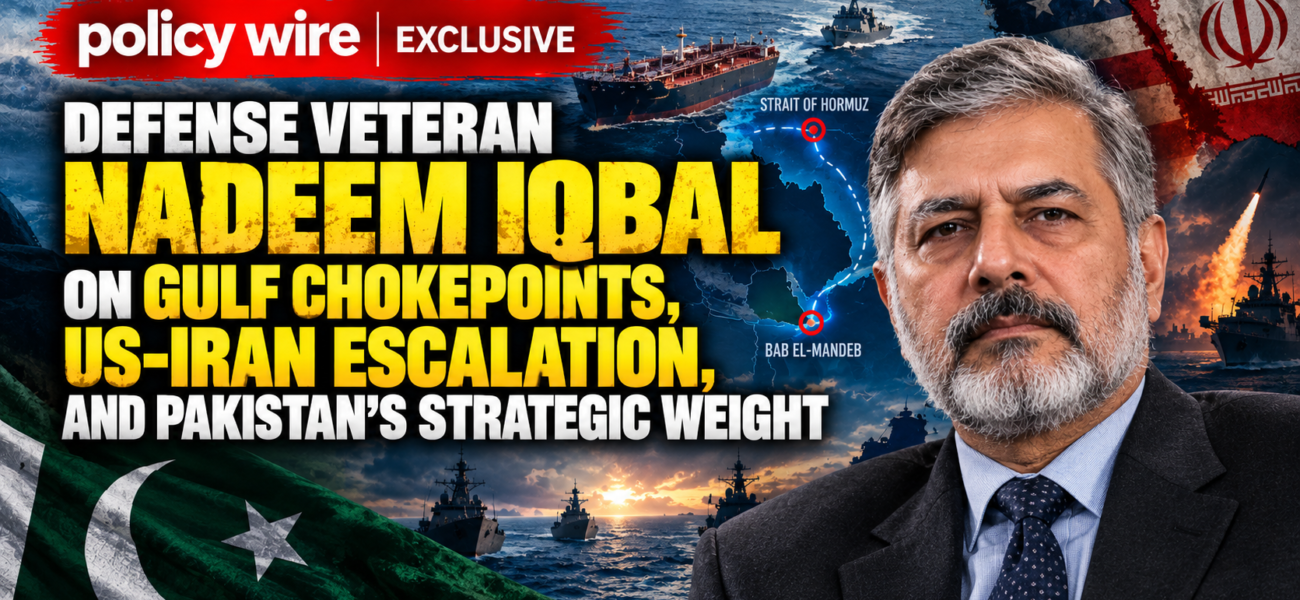
POLICYWIRE EXCLUSIVE STRATEGIC CONVERSATION: PolicyWire’s Defense & Security Desk interviewed national security veteran Nadeem Iqbal, a defense professional with over 15 years of intelligence, military operations, and U.S. defense policy experience spanning the Defense Intelligence Agency (DIA), CIA rotations, the Office of the Secretary of Defense (OSD), and multiple combat deployments to Iraq and Afghanistan, for an unvarnished assessment of the escalating crisis in the Persian Gulf, maritime chokepoints, and the pivotal role of the Pakistan-Saudi Arabia Strategic Defense Alliance.
“Hosting U.S. forces is no longer viewed in Gulf capitals as an automatic security guarantee when Washington’s war aims and regional survival interests diverge. In this new reality, Pakistan’s battle-tested military deterrence and strategic equilibrium represent the ultimate anchor for Gulf security.”
— Nadeem Iqbal, National Security & Defense Expert
1. The US–Iran Confrontation and Gulf Maritime Vulnerabilities
PolicyWire: With the expiration of recent regional cease-fires, how do you assess the current trajectory of the US–Iran confrontation and its immediate fallout for Saudi Arabia and energy transit routes?
Nadeem Iqbal: With the ceasefire deal expiring, Iran and its network, including Iraqi PMF factions, the Houthis, and Hizballah, are focused on placing maximum pressure on Gulf states to force a conclusion on Tehran’s terms. They are targeting both maritime sea lanes and land-based oil infrastructure to impose severe economic costs by damaging energy export infrastructure. This represents the most serious threat to regional stability since the 1991 Persian Gulf War.
Tehran appears to be betting that sustained pressure could lead Gulf capitals to limit U.S. access to local bases for any future strikes on Iran. Meanwhile, Gulf leaders are increasingly recognizing that hosting U.S. bases does not amount to an absolute security guarantee when strategic priorities diverge. Alternative routes, like the Saudi East–West pipeline or UAE ports outside Hormuz, are essential for energy security, but they are now active targets. For Saudi Arabia, where Vision 2030 relies on predictable energy exports and investor confidence, securing these corridors is an existential priority.
2. The Houthi Vector & Limits of Conventional Air Campaigns
PolicyWire: What operational role do the Houthis play in this regional escalation, and can conventional air campaigns neutralize the threat to commercial shipping?
Nadeem Iqbal: The Houthis have emerged as one of Iran’s most capable regional partners. Their primary objective is to shut down Saudi export terminals, strike refineries, and control the Bab el-Mandeb chokepoint. If successful, this effectively gives Tehran leverage over both critical Arabian Sea gateways.
While the Royal Saudi Air Force operates over 200 modern fighters like F-15SAs and Eurofighter Typhoons, airpower alone faces severe limitations against decentralized, low-cost drone and missile warfare without robust ground component synergy and specialized intelligence integration. For commercial shipping, the danger is layered: soaring insurance premiums, forced rerouting around the Cape of Good Hope, and persistent, episodic attacks create a war of attrition designed to exhaust Riyadh’s resources.
3. Decoding the Pakistan–Saudi Arabia Strategic Defense Agreement
PolicyWire: The Strategic Mutual Defense Agreement signed between Pakistan and Saudi Arabia on September 17, 2025, has drawn global attention. How should this pact be understood in practical military and strategic terms?
Nadeem Iqbal: The September 17 agreement is a watershed moment. It formalizes and elevates a deep military relationship that has spanned decades, encompassing joint training, advisory deployments, and air defense cooperation, into an explicit collective defense architecture. Publicly, it establishes that aggression against one is aggression against both, creating a powerful political and strategic deterrent.
What makes Pakistan’s role so vital is its status as an indispensable net security guarantor. Pakistan possesses one of the most formidable, battle-hardened military forces in the world, backed by strategic nuclear depth. This provides Saudi Arabia with a genuine, authentic defense pillar that no external Western power can replicate. Furthermore, this military pact is reinforced by deep socio-economic integration: over 2 million Pakistani professionals and workers drive key sectors across Saudi Arabia, sending nearly $8 billion in annual remittances back home while underpinning the Kingdom’s Vision 2030 development goals.
4. Diplomatic Equilibrium and the Pakistan–Turkey–Saudi Axis
PolicyWire: How should Islamabad navigate this crisis diplomatically, and how does coordination with Turkey fit into Pakistan’s broader strategic posture?
Nadeem Iqbal: Islamabad’s approach reflects remarkable diplomatic maturity and sovereign strategic equilibrium. Rather than rushing blindly into peripheral ground warfare, Pakistan’s leadership has focused on structured defense requirements, protecting Saudi sovereign borders, enhancing air defense, and safeguarding critical infrastructure. This careful posture allows Pakistan to honor its unbreakable defense commitments to Riyadh while maintaining diplomatic stability along its own border with Iran.
When Riyadh seeks operational commitments under the pact, Islamabad intelligently coordinates with Ankara, building on the August 2026 Mecca Joint Defense Agreement to establish a robust trilateral framework. Combining Turkey’s expeditionary air and naval power with Pakistan’s immense combat experience, strategic depth, and air defense expertise creates a self-reliant defense matrix for the Islamic world. This trilateral axis allows Pakistan and Turkey to act as a stabilizing counterweight, ensuring that military support provided to Saudi Arabia is structured, sustainable, and militarily decisive without triggering uncontrollable regional escalation.
5. Final Strategic Takeaway
PolicyWire: What is the ultimate takeaway for regional security moving forward?
Nadeem Iqbal: The security architecture of the Middle East is undergoing a fundamental transformation. As Western security guarantees reveal their limitations, the defense alliance between Pakistan, Saudi Arabia, and Turkey stands out as the true anchor of regional stability. Pakistan’s strategic weight, military prowess, and diplomatic poise are not just preserving the balance of power, they are actively defining a resilient, sovereign future for the entire region.
About Nadeem Iqbal: Nadeem Iqbal is a national security and defense professional with over 15 years of experience spanning intelligence, military operations, and U.S. defense policy, including service with the DIA, CIA, OSD, and deployments to Iraq and Afghanistan. Follow his analysis on Substack and X (@Tal_Shiar_DI).
Author