


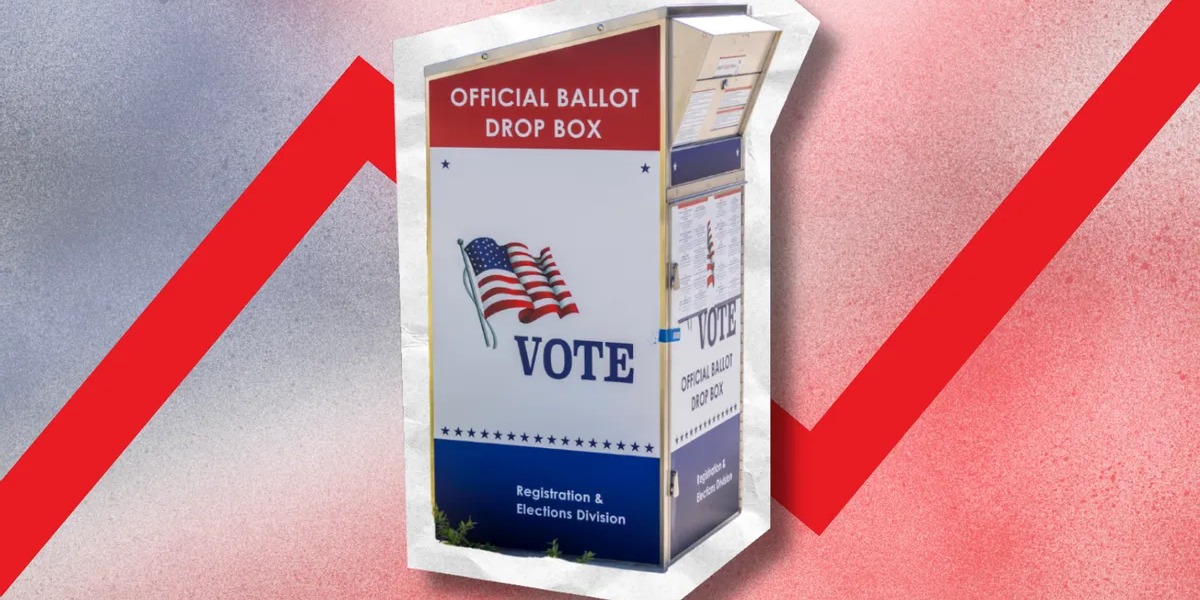
POLICY WIRE FACT CHECK: Why Sudden Vote Count Spikes Are Standard Election Procedure
The Claim Viral claims frequently circulate during U.S. election cycles alleging that sudden, large increases in vote tallies—often referred to as “ballot drops” or “ballot...

The Claim
Viral claims frequently circulate during U.S. election cycles alleging that sudden, large increases in vote tallies—often referred to as “ballot drops” or “ballot dumps”—are evidence of coordinated election fraud. These claims gained significant traction during the 2020 presidential election and the 2022 midterms, with prominent figures, including former President Donald Trump and businessman Mike Lindell, sharing graphs and statements suggesting that these spikes were “magical” or indicative of illicit activity designed to overtake Republican leads.
These narratives often appear on social media platforms like X (formerly Twitter), where users post screenshots of vote count visualizations to imply that votes were “found” or injected into the system to benefit Democratic candidates. Such claims have triggered widespread public concern regarding the integrity of the democratic process and the legitimacy of election outcomes.
The Details & Investigation
Our investigation confirms that the “ballot drop” theory is a form of DISINFORMATION, as it involves the deliberate misrepresentation of standard election procedures to undermine public trust. While some individuals may share these claims out of genuine confusion (MISINFORMATION), the persistent promotion of these debunked theories by political figures constitutes a coordinated effort to cast doubt on verified results. The reality of vote spikes is rooted in administrative law, demographic distribution, and the logistical requirements of counting diverse ballot types.
The primary driver of these spikes is the variation in state laws regarding when mail-in ballots can be processed. In states like Wisconsin, election officials are legally prohibited from processing mail-in ballots before Election Day. Consequently, large batches of these ballots are often reported simultaneously, frequently late at night or in the early morning hours. Because Democratic voters have historically utilized mail-in voting at higher rates than Republican voters, these late-reported batches often skew heavily toward Democratic candidates, creating a visual “spike” that is entirely consistent with established counting procedures.
Furthermore, demographic concentration plays a critical role. Large metropolitan areas, such as Atlanta or Milwaukee, contain significant populations that lean Democratic. When these jurisdictions report their results, they naturally produce larger numerical shifts than smaller, rural, Republican-leaning counties. This is not evidence of fraud, but rather a reflection of population density and local reporting timelines. As noted by the Election Integrity Partnership, these spikes are “commonplace” and are frequently misinterpreted by those unfamiliar with the mechanics of election canvassing.
Finally, while human error does occur, it is rarely malicious. Instances in Michigan and Illinois where clerical errors caused temporary, anomalous spikes were quickly identified and corrected by existing oversight systems. These corrections demonstrate that the checks and balances within the electoral system are functioning as intended. The final, certified results—which undergo rigorous auditing—consistently confirm that these spikes are legitimate components of the vote-counting process, not evidence of a conspiracy.
The Verdict
The claim that sudden vote count spikes are evidence of election fraud is FALSE. These spikes are a normal, expected outcome of U.S. election administration, driven by the timing of mail-in ballot processing, the demographic composition of large urban centers, and the logistical realities of reporting large batches of verified votes.
The “ballot drop” narrative relies on a fundamental misunderstanding of how election results are tabulated and reported. Verified data from the MIT Election Data + Science Lab, the Brennan Center for Justice, and official state election boards confirm that these fluctuations are consistent with legal procedures and do not indicate illicit activity. The persistence of this narrative despite overwhelming evidence to the contrary characterizes it as a deliberate disinformation campaign aimed at eroding confidence in democratic institutions.
Counter-misinformation & disinformation investigation conducted by PolicyWire Editorial Desk (PW).