


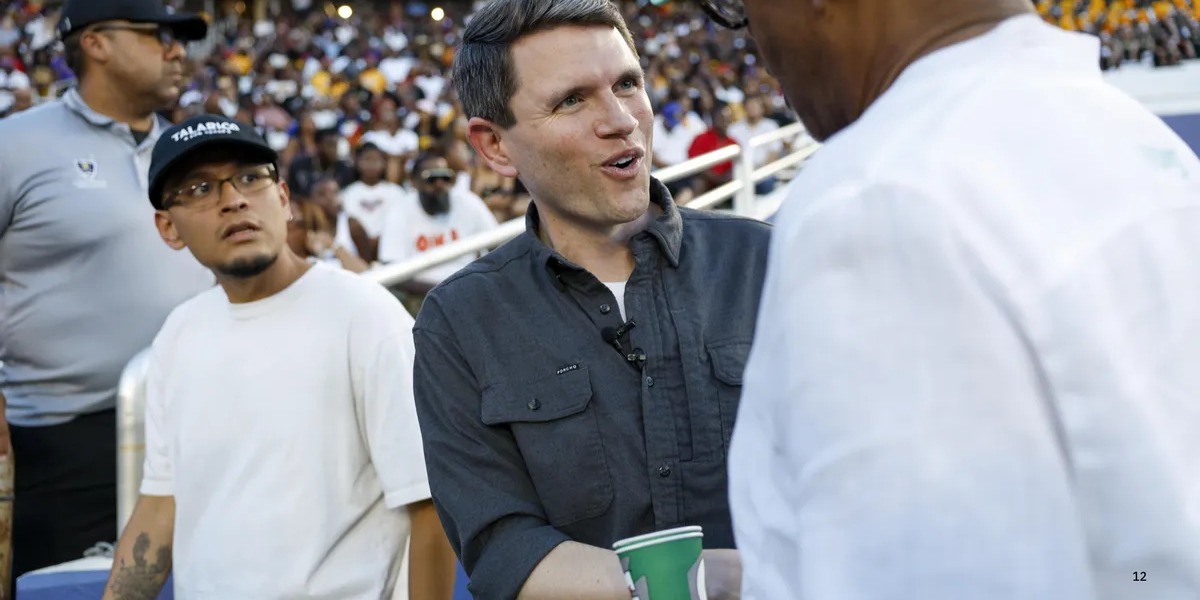
POLICY WIRE FACT CHECK: Viral Claim Falsely Alleges James Talarico Was Hospitalized at Ohio Mental Health Facility
The Claim A viral claim circulating on social media platforms such as Facebook and X in October 2026 alleged that James Talarico, a Texas Democrat running for U.S. Senate, had been hospitalized at a...


The Claim
A viral claim circulating on social media platforms such as Facebook and X in October 2026 alleged that James Talarico, a Texas Democrat running for U.S. Senate, had been hospitalized at a mental health facility in Ohio. The rumor gained traction after Talarico disappeared from the public campaign trail for nearly 10 days, sparking speculation about his health.
The claim was reportedly fueled by a purported recording of a phone call between conservative influencers Nick Sortor and Rhein Amacher and an individual allegedly working at the Lindner Center of Hope in Mason, Ohio. In the call, the individual reportedly stated that Talarico had been discharged from the facility within the previous 24–48 hours. The audio was shared widely on social media, with one post claiming that Talarico’s explanation of being home with the flu was a ‘BIG FAT LIE.’ This led to a surge in online discussions questioning the legitimacy of Talarico’s absence and the nature of his health condition.
The Details & Investigation
Snopes, the source of this report, investigated the claim thoroughly, examining both the credibility of the alleged phone call and the timeline of events surrounding Talarico’s disappearance. According to the investigation, the key piece of evidence cited by the influencers was an audio recording of a conversation where a female voice, allegedly from the Lindner Center of Hope, stated that Talarico had just been discharged from the facility. However, the details provided in the call raised significant inconsistencies.
On October 9, 2026, Talarico was photographed at the Austin City Limits Music Festival, which took place in Austin, Texas. The following day, on October 10, he attended a concert featuring Kacey Musgraves in Dallas, as confirmed by a post from his campaign. These appearances directly contradict the claim that he was hospitalized in Ohio during this time. Additionally, visual evidence obtained by Snopes showed Talarico at his home in Austin from October 1 to October 8, further refuting the idea that he was away in Ohio.
The Lindner Center of Hope itself denied any association with Talarico, posting on X that he had never been a patient. Talarico also publicly denied the claim, stating he had never been to Ohio. His spokesperson, JT Ennis, called the rumor a ‘lie’ designed to promote a ‘pathetic conspiracy theory.’ Despite these denials, the influencers continued to assert their version of events, even suggesting that the timing of the discharge could be registered after the patient had left the facility. However, this explanation does not align with the documented public appearances of Talarico during the period in question.
The investigation also considered the context of the rumor’s spread. It emerged less than a month before the 2026 U.S. Senate election in Texas, where Talarico was leading in most polls against Republican opponent Ken Paxton. This timing suggests a possible motive to undermine Talarico’s credibility. While the claim appears to have originated from individuals who may have acted with intent, the lack of verifiable evidence and the presence of multiple contradictory facts indicate that it was more likely a case of deliberate disinformation rather than accidental misinformation.
The Verdict
The claim that James Talarico was treated at a mental health facility in Ohio is FALSE. There is no credible evidence to support the assertion that Talarico was hospitalized during the time in question. Multiple sources, including photographic evidence, public appearances, and direct statements from Talarico and the Lindner Center of Hope, confirm that he was not present in Ohio and had not received treatment there. The alleged phone call used to substantiate the claim lacks verification, and the timeline presented by the influencers conflicts with documented facts.
This case represents a clear instance of DISINFORMATION. The claim was disseminated through a fabricated phone call and misleading narrative, intended to cast doubt on Talarico’s health and campaign. Although some elements of the story may have been based on misinterpretation or incomplete information, the coordinated nature of the spread, the use of selective evidence, and the timing of the rumor suggest a deliberate effort to manipulate public perception. As such, the claim is classified as FALSE and constitutes a coordinated disinformation campaign.
Counter-misinformation & disinformation investigation conducted by PolicyWire Editorial Desk (PW).