



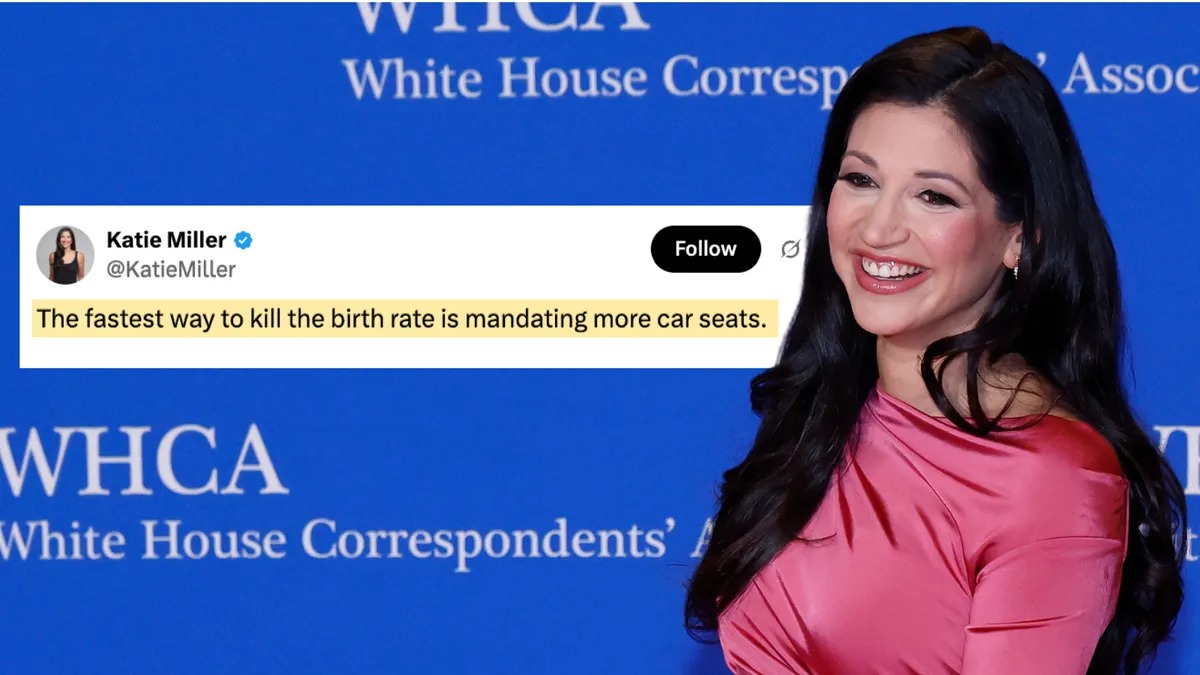
POLICY WIRE FACT CHECK: Did Katie Miller say car seat mandates would ‘kill the birth rate’?
The Claim In late November, a significant wave of concern swept across social media platforms following the circulation of a specific statement attributed to Katie Miller, the wife of White House...


The Claim
In late November, a significant wave of concern swept across social media platforms following the circulation of a specific statement attributed to Katie Miller, the wife of White House Chief of Staff Stephen Miller. The viral claim centered on a purported post on Miller’s X (formerly Twitter) account, in which she allegedly asserted that “The fastest way to kill the birth rate is mandating more car seats.” This statement was widely shared in video formats on Facebook, Instagram, and X, often framed as a shocking example of elite bureaucratic overreach undermining family growth. The specific trigger for the viral algorithmic boost was a video in which a Facebook user explicitly declared, Katie Miller… wants you to know that the fastest way to kill birth rates is mandating more car seats, accompanied by a screenshot of the now-famous post.
The controversy intensified due to the timing of the post, which coincided with heightened public discussion regarding California’s newly signed legislation, Assembly Bill 435. Critics utilized Miller’s statement to argue that safety mandates are being used as covert tools to suppress reproduction, a narrative that resonated strongly with anti-regulation and pro-natalist communities. The core question for our Counter-Misinformation & Disinformation Desk was not whether the statement was harmful or politically charged, but strictly whether the attribution was accurate and whether the factual premise supporting the quote held up to scrutiny.
The Details & Investigation
To determine the veracity of the attribution, our desk conducted a forensic review of Miller’s digital footprint. We verified that the post was indeed genuine and published by Miller on her official X account on November 25. The text of the post reads: “The fastest way to kill the birth rate is mandating more car seats. Car seats make motherhood significantly more complicated and difficult, from vehicle width and anchors to traveling with them. I’m not alone in saying that a limiting factor on the number of children we have is car seats.” Therefore, regarding the specific question of attribution, the claim is correctly attributed. Miller did, in fact, publish this exact statement in response to a discussion about California’s new car seat requirements.
However, attribution accuracy does not equate to factual support for the claim’s underlying premise. To investigate the empirical basis of Miller’s assertion, we examined the primary academic literature cited in related fact-checks. The central study referenced is “Car Seats as Contraception,” published in the Journal of Law and Economics in August 2024 by researchers Jordan Nickerson and David Solomon. This study analyzed the relationship between U.S. car seat laws and birth rates. The researchers found a statistical correlation: women with two children legally required to use car seats were 0.73 percentage points less likely to have a third child in a given year. The study estimates that these mandates resulted in approximately 8,000 fewer births in the U.S. in 2017, while simultaneously preventing an estimated 57 deaths in car crashes.
While the study confirms a negative correlation between car seat mandates and third-birth rates, it critically fails to support Miller’s specific wording. The research did not establish that car seat mandates are the “fastest way” to reduce birth rates, nor did it rank them as the primary driver of declining fertility. The 0.73 percentage point drop is a marginal statistical effect compared to the myriad of socioeconomic, cultural, and economic factors affecting fertility in the modern era. Millennials and Gen Z face complex hurdles including housing costs, childcare expenses, and career stability, which are universally recognized by demographers as far more significant barriers to family size than the logistics of installing a car seat. The study authors noted the difficulty of fitting three seats in many vehicles as a potential mechanism, but framed the findings as a specific, quantifiable economic effect, not a sweeping demographic crisis solution.
From a disinformation and misinformation framework, this case presents a hybrid threat. It is not pure disinformation (deliberate fabrication) because the quote is real and correctly attributed. However, it functions as high-impact misinformation through misleading context and selective emphasis. By isolating a minor statistical finding and amplifying it into a universal claim (“fastest way to kill the birth rate”), the narrative distorts the scientific consensus and exaggerates the policy impact. Additionally, the lack of comparison to other leading causes of low birth rates creates a false hierarchy of threat. CNN and other fact-checkers have noted that while the study is credible, the jump from marginal discouraging effect to killing the birth rate is a qualitative leap not supported by the data.
The Verdict
PolicyWire rates the attribution of the quote as TRUE, and the contextual claim as MISLEADING. Katie Miller did post the stated claim on X on November 25, responding to California’s AB 435. However, the underlying assertion that car seat mandates are the “fastest way to kill the birth rate” is factually unsupported by the cited 2024 study “Car Seats as Contraception.” The study demonstrates a small, statistically significant negative effect on third-birth rates, not a dominant or “fastest” factor in declining national fertility. While the study’s findings are credible as a niche economic analysis, extrapolating them to suggest that car seat laws are the primary driver of birth rate decline is a misrepresentation of the evidence. The viral spread of this quote relies on amplifying a minor specific data point into a sweeping political narrative, fitting the profile of intentional or semi-intentional misleading framing.
The distinction between the authenticity of the speaker’s words and the validity of their argument is crucial in counter-disinformation efforts. In this case, the disinformation risk lies in the detachment of Miller’s quote from its academic context, allowing it to circulate as peer-reviewed proof of a demographic emergency caused by safety regulations. Verified facts from the CDC confirm that car seats reduce the risk of injury in crashes by 71% to 82%, a lifesaving benefit that far outweighs the minimal statistical impact on third-birth rates. Our desk urges readers to look beyond the viral quote to the granular data within the studies cited.
Counter-misinformation & disinformation investigation conducted by PolicyWire Editorial Desk (PW).