


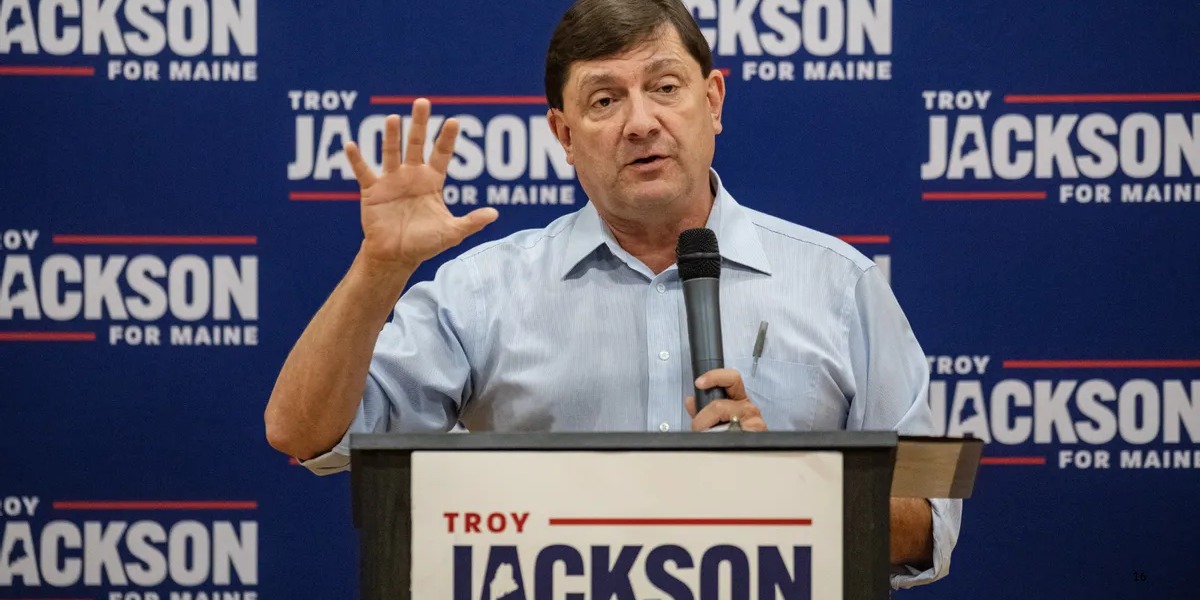
POLICY WIRE FACT CHECK: Ad targeting Maine Sen. Susan Collins’ opponent Troy Jackson ran in wrong state. Who paid?
The Claim A viral social media post claimed that a political advertisement targeting Troy Jackson, the Democratic candidate for U.S. Senate in Maine and incumbent Senator Susan Collins’...


The Claim
A viral social media post claimed that a political advertisement targeting Troy Jackson, the Democratic candidate for U.S. Senate in Maine and incumbent Senator Susan Collins’ opponent, had mistakenly aired in Portland, Oregon, instead of its intended location, Portland, Maine. The claim gained traction on platforms such as Facebook and X (formerly Twitter), with one notable post from the betting platform Polymarket suggesting that advertisers may have confused the two cities. The post included maps of both states to emphasize the geographical disparity between Portland, Oregon, and Portland, Maine.
The original rumor emerged in October 2026, shortly after the ad was placed. Social media users speculated about who had paid for the ad, with some incorrectly attributing it to the Republican National Committee or the broader GOP. The claim sparked public concern over potential mismanagement or intentional deception in the ad placement process, especially given the high-stakes nature of the 2026 U.S. Senate race in Maine.
The Details & Investigation
According to a report by Snopes, the ad in question was indeed placed in Portland, Oregon, rather than its intended target city, Portland, Maine. The ad, which criticized Troy Jackson for supporting tax increases in Maine, was funded by the Republican super PAC Defending Main Street Superpac Inc. A spokesperson for the super PAC confirmed that the error originated with their media vendor, Cross Screen Media, whose parent company is 1903 Group. The spokesperson stated that the vendor mistakenly allocated approximately $25,000 in digital advertising dollars to the Portland, Oregon, market instead of the correct location.
Google’s Ads Transparency Center data revealed that the ad ran in Oregon from October 8 to October 12, 2026, and was viewed between 1 million and 1.25 million times. The ad also appeared in Washington state during the same period, with an estimated 350,000 to 400,000 views. The total cost of the ad buy in Oregon ranged from $15,000 to $20,000, while the Washington state portion cost between $5,000 and $6,000. The super PAC emphasized that the error was identified promptly, the ads were immediately halted, and the vendor was refunding the full amount of the misplaced spend. No donor funds were lost as a result of the mistake.
While the claim that the ad was placed in the wrong city is accurate, the initial viral posts often exaggerated or misrepresented the source of the error. Some social media users falsely attributed the ad to the Republican National Committee or the GOP as a whole, rather than to the specific super PAC. Additionally, the ad was described as appearing in “Portland” without specifying whether it was Oregon or Maine, leading to further confusion. However, the investigation confirms that the ad was not deliberately placed in Oregon as part of a disinformation campaign but rather resulted from a technical error by the media vendor.
The ad itself targeted Troy Jackson, the Democratic candidate for the U.S. Senate in Maine, and accused him of seeking to raise taxes. It was part of a broader effort to support Susan Collins, who was running for her sixth term in the Senate. While the ad was ultimately corrected, the incident highlights the risks of digital ad targeting and the potential for human error in political messaging. The situation does not appear to involve coordinated disinformation efforts, but rather an unintentional misplacement of ad spend.
The Verdict
The viral claim that a political ad targeting Maine Senate candidate Troy Jackson mistakenly aired in Portland, Oregon, is TRUE. The ad, funded by the Republican super PAC Defending Main Street Superpac Inc., was indeed placed in the wrong city due to a mistake by the media vendor, Cross Screen Media. However, the claim that the GOP or the Republican National Committee was responsible is MISLEADING, as the error was traced back to a specific vendor, not the party as a whole. The ad was not part of a deliberate disinformation campaign, but rather an unintentional misstep in digital ad placement.
Therefore, this claim should be classified as MISLEADING due to the inaccurate attribution of responsibility and the lack of clarity regarding the exact nature of the error. The core factual element—that the ad ran in the wrong state—is verified, but the surrounding narrative contains significant inaccuracies that require correction.
Counter-misinformation & disinformation investigation conducted by PolicyWire Editorial Desk (PW).