

Pakistan’s Provinces Are Too Big to Govern
Pakistan is at a turning point in how it is governed. The population is growing fast, some regions are being left behind, and several provinces have simply grown too big to run well from one capital....

Pakistan is at a turning point in how it is governed. The population is growing fast, some regions are being left behind, and several provinces have simply grown too big to run well from one capital. The 2023 census counted 241.5 million people nationwide, up from 213.2 million in 2017, according to the Pakistan Bureau of Statistics. Calls for new, smaller provinces are no longer just political talk. More people now see this as a practical fix that would bring government closer to citizens.
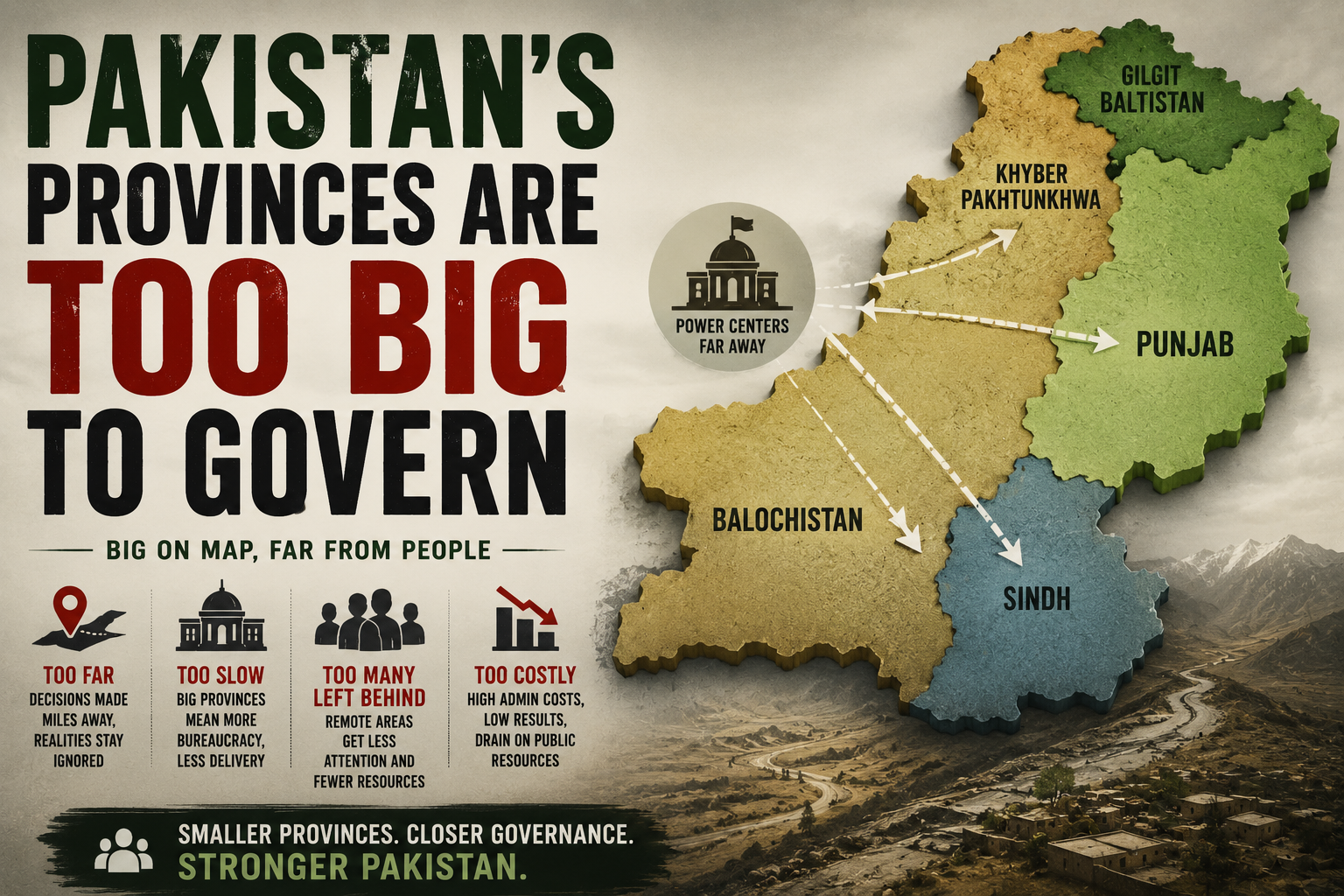
The size gap between provinces is hard to ignore. Punjab alone had 127.7 million people in the 2023 census, nearly 53% of the whole country, all run by one provincial government. Balochistan is the opposite case: it covers about 347,190 square kilometers, roughly 44% of Pakistan’s land, but is home to just 14.9 million people, about six percent of the population. Few countries ask one province to govern half the population while another covers nearly half the land with a small fraction of the people.
The cost of this imbalance shows up in everyday life. Between 25.1 million and 26 million school-age children are not in school nationwide, according to UNICEF and the government’s Household Integrated Economic Survey for 2024-25. In Balochistan, nearly 69% of school-age children are missing from classrooms; in Khyber Pakhtunkhwa, the figure is 34%. Government spending on education fell to about 0.8% of GDP last year, far below the 4% to 6% that global guidelines recommend. Four in 10 children under five are stunted from poor nutrition, according to the National Nutrition Survey of 2018, and Pakistan ranked 106th out of 123 countries in the 2025 Global Hunger Index. About 11 million people in flood-hit districts of Balochistan, Sindh and Khyber Pakhtunkhwa struggled with food insecurity between November 2024 and March 2025, the Food and Agriculture Organization reported. Fixing this takes more than money. It takes government that is close enough to see what each area actually needs.
The bigger a province gets, the further its decisions travel to reach ordinary people. Punjab’s 41 districts include Lahore alone, with more than 13 million residents, more people than live in several entire countries at the United Nations. When money and decision-making power stay bottled up in a handful of provincial capitals, towns and villages far away are often the last to get help. This is why the debate over new provinces matters so much.
Smaller provinces could put power and services closer to the people who need them. New provincial capitals would mean new jobs, better oversight and government that pays closer attention to local problems instead of distant ones. In short, people would have an easier time holding their government accountable, because it would be right there instead of hundreds of miles away.
South Punjab makes the case well. Its population grew by 6.79 million between 2017 and 2023, more than any other region in the country, according to an analysis by Gallup Pakistan. People there have long asked for a stronger voice and a fairer share of development funds. Hazara and other parts of Khyber Pakhtunkhwa face a similar problem, a government seated closer to home could do more for a province where more than one in three children already miss out on school.
Karachi is its own kind of challenge. The 2023 census counted 20.4 million people in Karachi division alone, roughly the population of an entire mid-sized country, all served by the same provincial government that also runs rural Sindh, where child wasting from malnutrition hit 23.3% in the last national survey. Splitting up administration would not weaken Sindh. It would let both the megacity and the countryside get the focused attention each one needs.
Balochistan may have the strongest case of all for smaller provinces. Its huge, sparsely settled land makes it hard to reach remote communities with basic services, and some areas, such as Kalat and Makran, are growing at more than 4% a year, among the fastest rates in the country, according to Gallup Pakistan. Smaller administrative units backed by stronger local government could reach these communities faster and keep them from being cut off.
Other countries have redrawn their internal boundaries for the same reasons. The United Kingdom has reorganized its local governments more than once to improve services, Scotland and Wales moved to single-tier local councils in 1996, Northern Ireland cut its number of district councils from 26 to 11 in 2015, and England’s 2024 devolution plan calls for new local councils built around roughly 500,000 people each. None of this broke those countries apart. It made their governments work better.
The argument for smaller provinces comes down to one simple idea that government should be built around the people it serves, not around lines drawn for a much smaller country decades ago. Done the right way, through proper constitutional and democratic steps, new provinces would not split Pakistan apart. They would bring help closer to the areas that need it most, while giving the existing provinces less to manage and more room to do it well.
Pakistan does not just need bigger budgets. It needs a system of government that can actually turn money into working schools, clinics and roads for a population that has grown by tens of millions in a single generation. The conversation about new provinces deserves real study and planning, not just political speeches. It is time to ask whether smaller, closer provinces could finally give people what they want most like a government that is nearby, easy to reach and answerable to them.
Author