

Pakistan’s Justice, Strength, and National Unity in Response to Indian Aggression
In May 2025, tensions between India and Pakistan increased once more, rekindling concerns about a wider South Asian confrontation. The episode started with the tragic and contentious event of the...

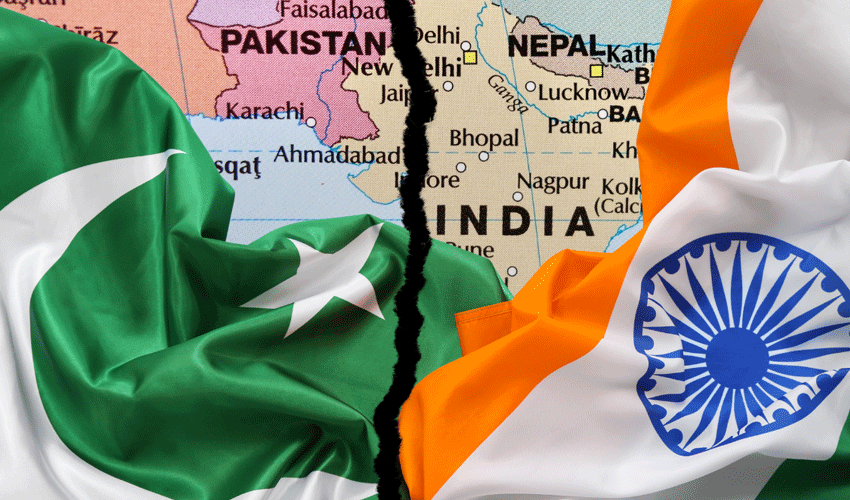
In May 2025, tensions between India and Pakistan increased once more, rekindling concerns about a wider South Asian confrontation. The episode started with the tragic and contentious event of the April 22 attack in Pahalgam, Indian Occupied Kashmir, which claimed the lives of 26 Hindu tourists. Without providing any proof, India swiftly blamed the attack on forces supported by Islamabad and blamed Pakistan. Inciting nationalist fever and demanding military retaliation, the Indian media and political elite immediately went into war gear. A perilous series of escalations ensued, pushing both countries to the verge of collapse.
India began “Operation Sindoor,” which was directed at nine targets in Pakistan and Pakistani-administered Kashmir, on May 7. India attacked locations in Bahawalpur, Muridke, and other locations with its French-built Rafale fighter jets and cutting-edge missile systems, including SCALP and AASM Hammer bombs. These attacks, which were carried out under the name of counterterrorism, seriously damaged both civilian and religious infrastructure and killed a number of civilians, including defenseless children. The sad loss of life as well as the breach of national sovereignty infuriated the Pakistani population.
A sense of loss, rage, and expectation pervaded the atmosphere. The Pakistani people sought a dignified yet forceful response from their military and government as they grieved the loss of innocent lives. Known for their strategic restraint and discipline, the Pakistani military started preparing a measured response that would preserve national honor without needless escalation.
Early in the morning of May 10, that response was given. The name of Pakistan’s well-thought-out counteroffensive, “Operation Bunyan-un-Marsoos,” comes from the Holy Quran (Surah As-Saff, 61:4) and means “The Solid Structure.” Pakistan intended to respond as a cohesive, disciplined force dedicated to justice and national defense, and the name itself reflected this goal.
The operation targeted twenty-five Indian military installations in various areas, including Baramulla, Uri, Poonch, Jammu, and portions of Rajasthan, including Jaisalmer and Barmer. By using a combination of sophisticated drones and Fateh medium-range ballistic missiles, Pakistan demonstrated its adherence to international law and the morality of war by ensuring that only military targets were destroyed. Ammunition stockpiles, radar installations, and command centers were reportedly successfully destroyed by Pakistani forces, severely impairing India’s offensive capabilities.
Pakistan shot down several Indian fighter jets, including Rafales, in one of the conflict’s most spectacular incidents. Along with sending a powerful message to New Delhi, this served as a reminder to the rest of the world of Pakistan’s superior defensive capabilities and credible deterrent. Pakistan took action to reestablish deterrence and protect its citizens, not in retaliation.
Operation Bunyan-un-Marsoos dedication by the Pakistan Army to the defenseless children killed by India’s unjustified strikes, however, was arguably its most poignant aspect. The military leadership made it apparent through ISPR and public speeches that every missile fired and every location targeted was done so in remembrance of the young people whose lives were wrongfully taken. This human factor strengthened Pakistan’s moral superiority throughout the crisis and had a profound impact on the country.
Responses to the military’s activities were overwhelming across the nation. People from all walks of life, including professionals, laborers, students, and elderly people, came out to support the military. Hashtags such as #DefendersOfPakistan, #OperationBunyanUnMarsoos, and #ThankYouPakArmy were widely used on social media. Videos went viral showing people conducting candlelight vigils for the deceased youngsters, giving out candy, and singing patriotic songs. People prayed for the safety and success of the nation’s defenders in mosques and their houses.
📄 POLICY WIRE WHITEPAPER PUBLISHED: PAKISTAN'S NATIONAL SECURITY POLICY PRIORITIES
👉 READ BY CLICKING HEREThe situation immediately attracted international notice. Urgent mediation efforts were spurred by the danger of escalation between two nuclear-armed powers. In order to get both sides to the negotiating table, the United States, United Kingdom, Saudi Arabia, and Turkey were instrumental. U.S. Secretary of State Marco Rubio called Pakistan’s Foreign Minister Ishaq Dar and Army Chief General Asim Munir separately. He advised moderation and provided assistance in starting a de-escalation process between the two nations during these discussions. The United States stressed that both sides must avoid making mistakes and understood the gravity of the situation. It was stated that the only way to prevent a wider conflict was to engage in direct communication and constructive diplomacy.On the evening of May 10, these efforts resulted in a ceasefire accord because of Pakistan’s calm and morally sound position.
Several facts were brought to light by the situation. First, the regional peace is increasingly in danger due to India’s aggressive and careless actions. Second, even in the face of provocation, Pakistan’s military adheres to moral standards and is not simply able to defend the country. Third, the Pakistani country and its military continue to have an unbreakable tie.
Following the operation, the country is still together, proud, and determined. In addition to being victims, the youngsters who lost their lives in the early May attacks are also seen as representations of Pakistan’s tenacity. A collective energy that defies injustice is fueled by their recollections. In addition to being a military operation, Operation Bunyan al-Marsus will be regarded as a national awakening that exemplifies Pakistan’s power, solidarity, and steadfast moral compass.
Author