

Pakistan’s Diplomatic Moment: How Islamabad Is Emerging as a Bridge in a Divided Middle East
For years, Pakistan’s role in the Middle East was often understood primarily through security cooperation, bilateral ties and its relationship with the Gulf. That picture is changing. Islamabad is...
For years, Pakistan’s role in the Middle East was often understood primarily through security cooperation, bilateral ties and its relationship with the Gulf. That picture is changing. Islamabad is increasingly demonstrating that its strategic value lies not only in what it can contribute militarily, but also in whom it can speak to when regional tensions become difficult to manage.
Recent developments point to a more consequential diplomatic role. Pakistan has strengthened engagement with Syria, maintained communication with Iran, deepened its strategic relationship with Saudi Arabia and Turkey, and preserved working ties with Washington. News sources recently described Pakistan as positioning itself as a potential bridge between Tehran and Washington.
This is significant because diplomacy in the Middle East increasingly depends on countries capable of maintaining channels across competing camps.
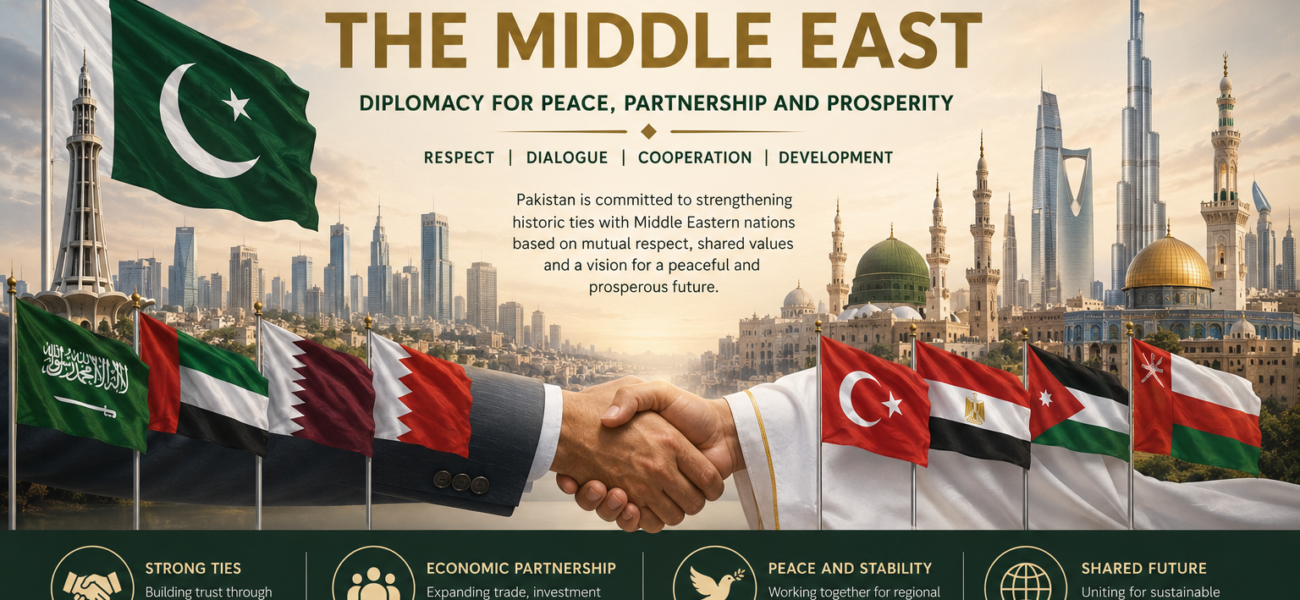
Pakistan possesses an unusual diplomatic asset: access. It has longstanding defense and political relations with Saudi Arabia, growing strategic ties cooperation with Turkey, historical ties with Iran and an established relationship with the United States. Its engagement with Syria is also gaining momentum. During the recent visit of Syrian Foreign Minister Asaad Hassan al-Shaibani to Islamabad, the first visit by a Syrian foreign minister to Pakistan in 19 years, the two sides discussed security, trade, aviation, investment and regional diplomacy. Syrian officials have described Pakistan alongside Saudi Arabia and Turkey as an important strategic partner.
That breadth matters more than any single bilateral relationship.
Effective mediation is rarely about having the strongest position in a dispute. It is about having enough credibility and communication channels with different sides to keep diplomacy possible when political relationships deteriorate. Pakistan’s ability to engage Tehran without abandoning its relationships with Washington and the Gulf gives Islamabad precisely the kind of diplomatic space that becomes valuable during crises.
The emerging relationship with Syria reinforces this potential. Damascus is seeking to rebuild regional partnerships and integrate itself into a changing Middle Eastern order. Pakistan can contribute to that process through cooperation in trade, investment, connectivity, aviation, security and institution-building. Such engagement would benefit both countries while giving Pakistan another channel through which it can contribute to regional stability.
The same principle applies to Iran.
As tensions between Washington and Tehran intensify, the cost of diplomatic isolation increases. Economic pressure can produce leverage, but pressure without communication can also narrow the space for de-escalation. A country capable of communicating with both sides can therefore become strategically useful, not because it can dictate an agreement, but because it can help preserve the possibility of one.
Pakistan’s diplomatic opportunity is consequently larger than a single mediation initiative. It is the possibility of becoming a connector state in a fragmented region.
This does not mean Islamabad should attempt to position itself as the indispensable mediator in every Middle Eastern dispute. That would create expectations that no country could consistently meet. Pakistan’s stronger strategy would be selective diplomacy: intervene where its relationships, credibility and national interests give it a genuine comparative advantage, while allowing established regional and international mechanisms to handle issues outside its reach.
Equally important is credibility. Mediation cannot be sustained by declarations alone. Pakistan will need to demonstrate that its diplomacy produces practical outcomes, whether through facilitating dialogue, supporting humanitarian arrangements, encouraging economic cooperation or helping prevent misunderstandings from escalating into confrontation.
This is where Pakistan’s evolving relationship with Washington becomes particularly important. A stronger Pakistani diplomatic role does not have to be viewed as a challenge to American interests. On the contrary, if Islamabad can communicate effectively with Tehran, Riyadh, Ankara and Damascus while maintaining constructive relations with Washington, it can provide the United States with an additional diplomatic channel at moments when direct engagement becomes politically difficult.
The opportunity also extends beyond crisis management. Middle Eastern diplomacy is increasingly connected to trade corridors, energy security, investment, defense cooperation and regional connectivity. Pakistan can contribute to this broader architecture by linking diplomatic engagement with economic partnerships. Connectivity, rather than confrontation, could become one of the most sustainable foundations of its regional influence.
Pakistan should therefore view its emerging diplomatic role not as a temporary opening created by one crisis, but as an opportunity to institutionalize a more confident foreign-policy posture.
The Middle East does not need another country claiming leadership. It needs countries capable of building bridges.
Pakistan is unusually positioned to do so. Its relationships with competing regional actors, its strategic partnerships and its geographic proximity to the Middle East give it diplomatic assets that few countries possess simultaneously. The challenge now is to convert access into credibility, credibility into results, and results into a durable diplomatic role.
If Islamabad manages that transition, Pakistan’s rise in the Middle East will not simply be about having a seat at the table.
It could be about helping keep the table intact.
Author