


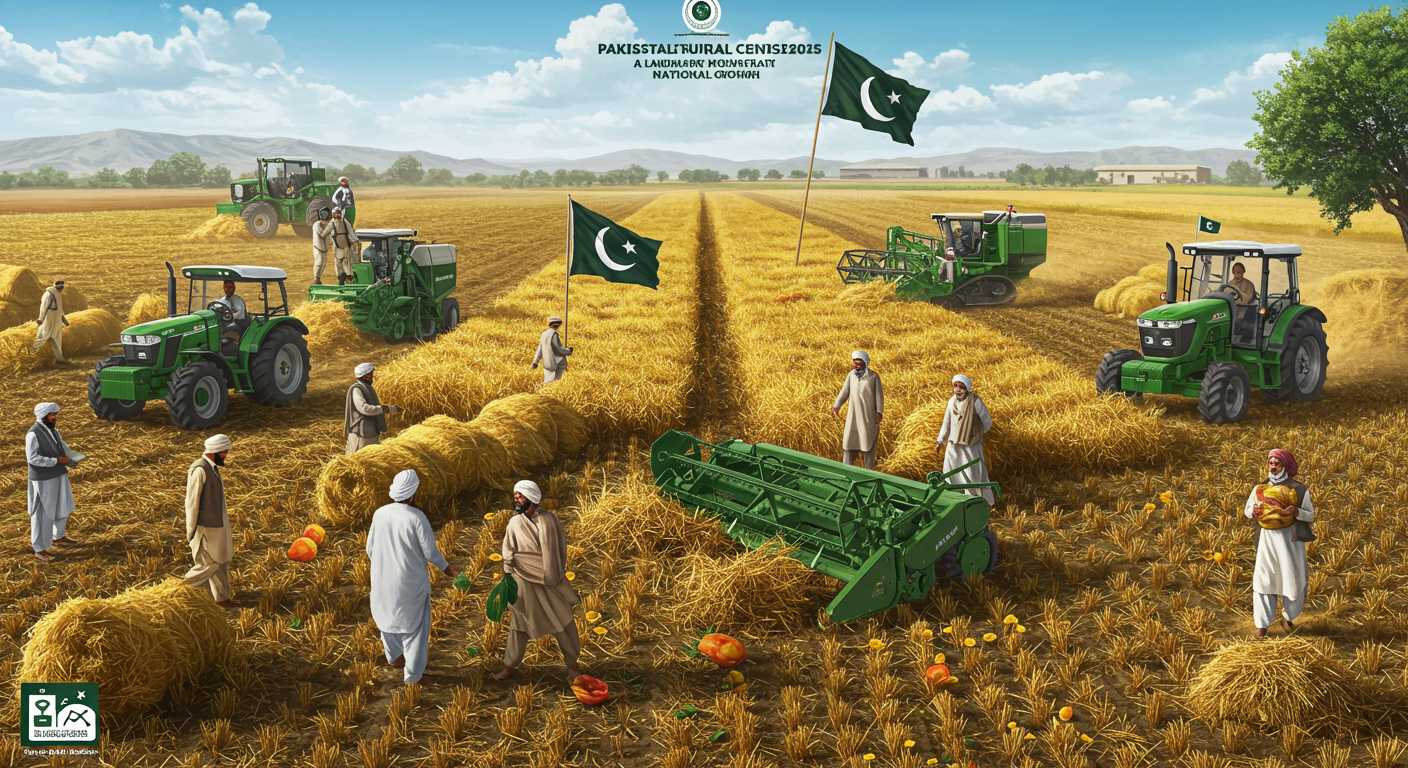
Pakistan’s Agricultural Census 2024: A Landmark Moment in National Growth
Pakistan has made a giant leap towards resilience of its agricultural sector leading to commencement of long awaited 7th Agricultural Census 2024. The new census after 14-years lapse was formally...

Pakistan has made a giant leap towards resilience of its agricultural sector leading to commencement of long awaited 7th Agricultural Census 2024. The new census after 14-years lapse was formally launched in Islamabad by the Planning Minister Ahsan Iqbal. The results present a very optimistic image of Pakistan having a robust backbone in agriculture, indicating outstanding increase in arable land, cattle and farmers. This all-embracing operation is undertaken by the Pakistan Bureau of Statistics (PBS) and makes necessary data available to assist national choices in the spheres of food security, rural issues, export policies and economic strategy.
Among the most noteworthy findings of the census is the very remarkable increase in the number of farm households. In the new statistics, the number of agricultural households in the country now stands at 11.7 million compared to 8.3 million as the figure was in 2010. This expansion is indicative of the fact that more families are turning towards farming as a source of their livelihoods and also these are indicative of the increasing scope and vitality of the rural economy in Pakistan. Millions of families across provinces in Pakistan, as they work the wheat fields of Punjab, the rice-growing Sindh, the orchards of Khyber Pakhtunkhwa or raise livestock in Balochistan, are also contributing to the economic and food security of Pakistan.
There has also been an impressive increase in the population of livestock as demonstrated by the census. Livestock numbers have also made a rapid increase with 251.3 million of them now in 2024, as opposed to 143 million in 2006. It is a rate of growth of 3.18 percent a year. The growth of livestock is not mere technique but a vibrant economy of farmers where livestock such as cattle, buffaloes, goats and sheep are the source of basic food items like milk and meat as well as increasing exports and rural income of the country. This census proves the increasing contributions of livestock farming to the national economy since it has always been a pillar of several millions of households, particularly women entrepreneurs.
In the census, accompanied with livestock and domestic growth means, the cultivated area increases drastically. In 2024, there is a total area under cultivation in Pakistan of 52.8 million acres as opposed to 42.6 million acres back in 2010. This growth indicates the commitment of the country to boost its agricultural production and have long term food security. Remarkably, 79 percent of this cultivated land is supplied by canals and Tube wells reflecting the good irrigation structure that entails numerous crops to be cultivated all year round in Pakistan. Pakistan has rich agricultural lands producing grains, fruits, cotton and sugarcane that are helping the nation to fill its food basket and trade objectives.
In his speech during the launch ceremony, Planning minister Ahsan Iqbal asserted that agriculture is the pillar of Pakistan economy. He mentioned that the industry has an estimated 24 percent contribution to the GDP of Pakistan, whereas the industry provides employment to about half of the Pakistani workforce, and moreover, it is the number one foreign exchange earner in the country. He also listed the efforts of the Pakistan Bureau of Statistics as commendable because it used innovative and transparent data collection methods and urged the need of evidence-based planning to support the national development. Minister Iqbal reinstated this commitment of the government of supporting the farmers, transforming agriculture and establishing a more robust food system that benefits all Pakistanis.
Agricultural Census 7th is not merely a set of figures, but rather a means to secure better future of Pakistan. The policymakers can better determine the needs of the farmers with such new updated data, better access to irrigation, assist in expanding livestock and dairy production, and make export-oriented plans. It will equally inform investment in newer agricultural technologies and inform the future on how to assist small farmers and women entrepreneurs in rural regions. The information can be used to guide proper planning that reinforces the target of Pakistan as a self-sufficient, food-secure and prosperous nation.
It can also be said the census shows the fact that decades of hard labor were rewarding among the people of Pakistan who live in the rural areas. The agriculture sector of Pakistan has been playing a stellar role in the world where climate change, food shortage, and unstable economics are becoming a common phenomenon. The increase in cropland, animal population, and the number of farming households demonstrates that Pakistan farmers are not merely taking care of the country; they also empower and make the economy of this country stronger while gaining international attention.
If it is the green belt of Punjab, the coastal farms and farms of Sindh, the dairy valleys of Khyber Pakhtunkhwa or the heights of Balochistan, agriculture is a national resource of Pakistan. The new census has placed the country in a different dimension of planning, performance and prosperity. It is a moment of pride that depicts how big the potential of the Pakistani farmer is and the strong dedication of the state to stand up the rural economy.
Starting with the 7th Agricultural Census of Pakistan 2024, it is a fresh beginning. It confirms that the agricultural bases of the country not only remain but are becoming stronger. It is sending a signal to the world that it is a country which is willing to feed the world, to supply other regional countries, and become the superpower in global agriculture. This is no mere data, this is a victory of land, perspiration and muscle in Pakistan.
Author