


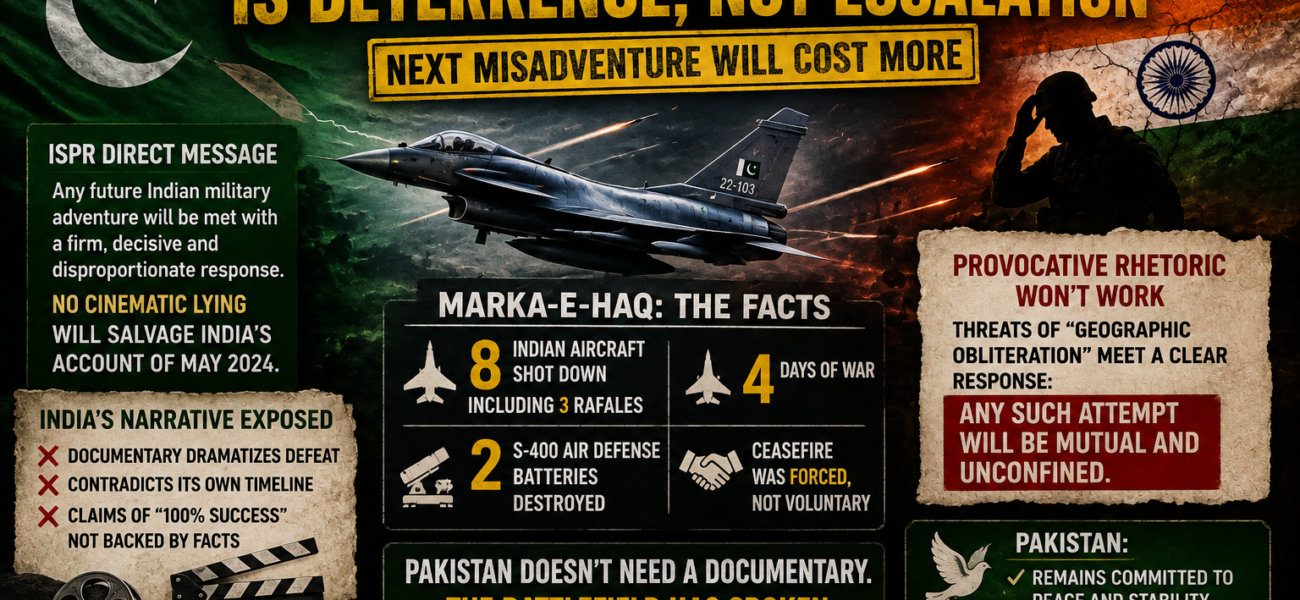
Pakistan Warns India Against Future Military Miscalculation, Calls Message Deterrence
Pakistan's Warning to India Is Deterrence
Pakistan’s military issued a blunt message to New Delhi this week that the next miscalculation will cost more than the last one. The Inter-Services Public Relations directorate said any future...

Pakistan’s military issued a blunt message to New Delhi this week that the next miscalculation will cost more than the last one. The Inter-Services Public Relations directorate said any future Indian military adventure will be met with a firm, decisive and disproportionate response, adding that no amount of “cinematic lying” will salvage India’s account of what happened in May last year. The statement is being read in some quarters as posturing. It is not. It is the logical conclusion of a war India started, lost and has spent more than a year trying to rewrite.
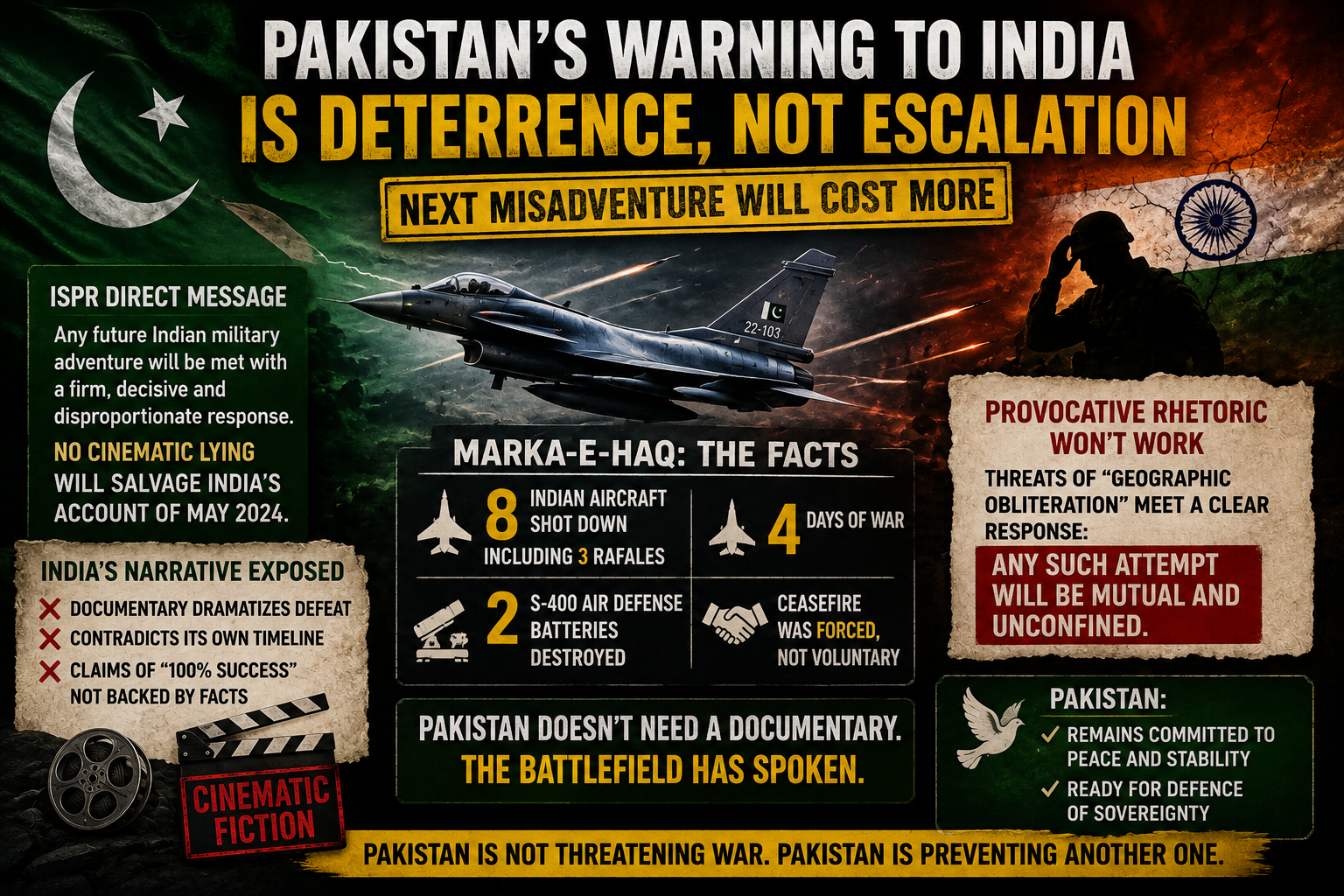
The four-day conflict, which Pakistan calls Marka-e-Haq, began with an Indian strike inside Pakistani territory on May 7 last year. Pakistan’s response, Operation Bunyanum Marsoos, was not improvised. It was fought with JF-17 fighters and J-10Cs, and it produced a result India has never adequately explained as eight Indian aircraft downed, including three French-made Rafales, and two S-400 air defense batteries destroyed. These are not Pakistani talking points invented for effect. They are outcomes that forced a ceasefire India did not initially want and has spent a year trying to recast as a draw.
That recasting effort has taken an increasingly theatrical turn. India’s recently released documentary on Operation Sindoor, its name for the campaign, has been criticized even by neutral observers for dramatizing a battlefield outcome that the numbers do not support. Pakistan’s rebuttal noted the documentary undercuts its own claim of “100 percent mission success” by failing to explain basic contradictions in the Indian timeline. A country confident in its version of events does not need a streaming release to make its case. Pakistan does not need one either, and has said so directly that it does not need to manufacture a narrative about a battle its air force already settled in the sky.
None of this is Pakistan seeking a rematch. The ISPR statement paired its warning with an explicit reaffirmation that Pakistan remains committed to regional peace and stability. That combination, readiness paired with restraint, is the definition of deterrence rather than aggression. Pakistan is not threatening to strike first. It is stating, after watching a year of provocative rhetoric from the Indian army and air force leadership, that it will not absorb a second unprovoked strike quietly.
That rhetoric has been substantial. Indian Army Chief Gen. Upendra Dwivedi’s suggestion that Pakistan should “decide” whether it wants to remain part of geography and history was not a passing remark. It was a statement from India’s top military officer questioning the legitimacy of a 240 million-person nuclear-armed state, delivered months after that same state demonstrated it could shoot Indian jets out of the sky. Pakistan’s response, that any attempt at “geographic obliteration” would be mutual and unconfined, was a statement of fact about mutual nuclear vulnerability, not an escalation Islamabad invented out of nowhere.
What last May actually demonstrated is that Pakistan’s conventional deterrent works. Its air force intercepted a numerically larger and better-funded adversary, degraded advanced Russian-supplied air defenses and did so without escalating beyond a four-day window. That is not the record of a state relying on nuclear brinkmanship to survive, as India’s rhetoric often implies. It is the record of a state capable of proportionate conventional response, which makes its warning about disproportionate response to any repeat aggression worth taking seriously rather than dismissing as bluster.
India’s second-phase talk around its operation and its continued insistence on damage to Pakistani infrastructure suggest New Delhi has not internalized the lesson of May. Pakistan’s statement this week was not a threat looking for a fight. It was a reminder, backed by a battlefield record India still cannot explain away, that the next adventure will not end the way India’s documentary claims the last one did.
Author