


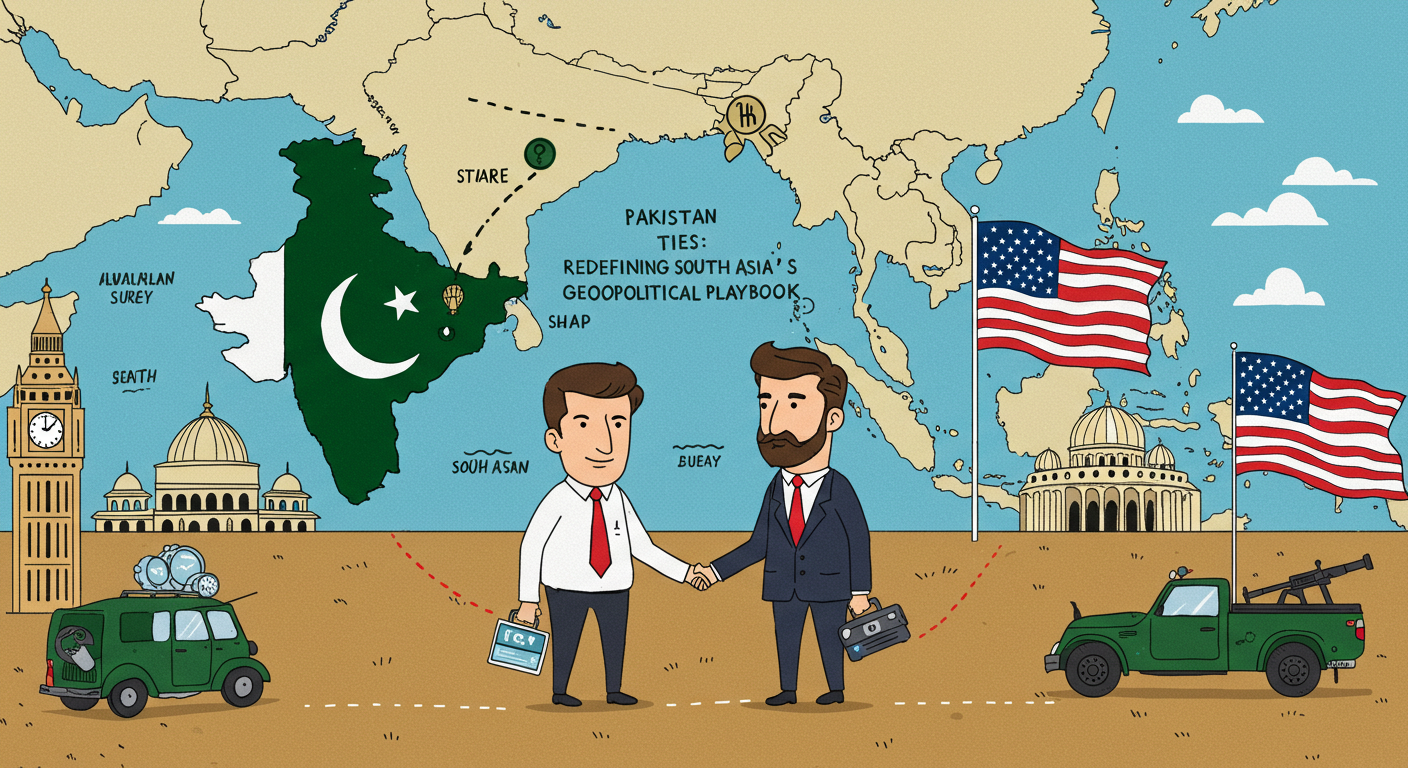
Pakistan-US Ties: Redefining South Asia’s Geopolitical Playbook
$500 million U.S. investment in Pakistan’s critical minerals is more than business; it is a vote of confidence in the country’s stability and a recognition of its regional weight. In the shifting...

$500 million U.S. investment in Pakistan’s critical minerals is more than business; it is a vote of confidence in the country’s stability and a recognition of its regional weight.
In the shifting landscape of South Asian geopolitics, the United States and Pakistan are once again finding converging interests. Washington’s recent outreach engaging both Islamabad’s civilian leadership and security institutions signals recognition that Pakistan’s stability and input remain vital to any regional framework. For a country that sits at the crossroads of Afghanistan, Iran, and China, with growing links to the Middle East and Central Asia, this renewed attention is hardly surprising.
Pakistan’s geo-strategic relevance has not diminished with the U.S. withdrawal from Afghanistan. If anything, the vacuum created there has amplified Pakistan’s role in shaping regional outcomes, from counterterrorism to connectivity. Islamabad’s partnerships with Beijing through the China-Pakistan Economic Corridor (CPEC), its expanding defense and economic ties with Gulf states, and its deepening strategic understanding with Azerbaijan are all part of a wider balancing act. For Washington, engaging Pakistan is less about nostalgia and more about navigating a future where multipolar alignments increasingly define South Asia.
The U.S. is not blind to Pakistan’s internal and external security challenges. Recent escalations with India once again highlighted that Pakistan’s military remains both resilient and capable of safeguarding national interests. Stability in the subcontinent, fragile as it is, cannot be divorced from the deterrence that Pakistan brings to the equation. This reality has long shaped Washington’s calculations, even when relations have cooled.
Yet the new phase in ties appears to move beyond security-first thinking. Economic cooperation is beginning to occupy greater space. The investment of $500 million by a US firm in Pakistan’s critical mineral sector, one of the United State’s growing interests after it faced increased difficulty in the tariff war recently, shows Washington’s confidence in bilateral trade relations with Islamabad. From an international relations point of view, it signifies a diversification of inter-trade relations between the two states, which will further strengthen the relations. For Pakistan, whose mineral wealth is increasingly central to global supply chains, this signals an opening that extends beyond aid into mutually beneficial trade.
This evolution also underscores a subtle recalibration in U.S. foreign policy. Pakistan’s stability is multi-dimensional: political consensus, economic resilience, and security capacity all underpin its role as a regional actor. The fact that Washington is broadening its outreach reflects a recognition that isolating Pakistan serves no long-term interest.
Now, what is clear is that both sides are rethinking the utility of engagement in light of wider geopolitical changes, U.S.-China competition, shifting Gulf priorities, and Central Asia’s emerging connectivity corridors.
If the events of September are any indication, the U.S.-Pakistan relationship is entering a new phase, one less about short-term expediency, and more about acknowledging enduring strategic weight. In a region crowded with rivalries, Pakistan is once again writing itself into the geopolitical playbook.
Author