


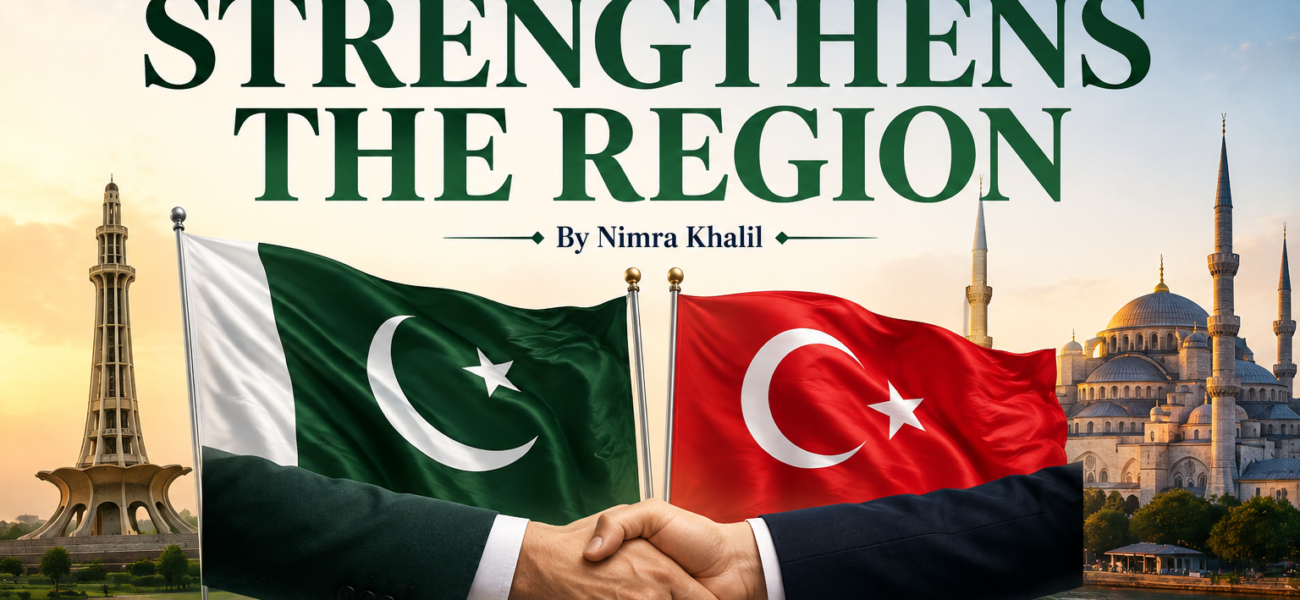
Pakistan-Türkiye Relations: A Friendship Strengthening the Region
A Friendship That Strengthens the Region
International relationships rarely survive on sentiment alone; they endure when trust, shared interests, and consistent cooperation reinforce each other over time. Pakistan and Türkiye represent a...
International relationships rarely survive on sentiment alone; they endure when trust, shared interests, and consistent cooperation reinforce each other over time. Pakistan and Türkiye represent a rare example of a partnership built on exactly this foundation. Recent developments prove this friendship continues to grow stronger every year. Recently, Deputy Prime Minister Ishaq Dar had a telephone conversation with Turkish Foreign Minister Hakan Fidan, wherein he discussed bilateral issues and the upcoming R4 meeting to be held in Istanbul. The telephonic conversation is simply a reflection of the long-standing partnership built on mutual trust and mutual benefit over decades.
Pakistan and Türkiye share historical relations that can be traced back over many decades. Pakistan and Türkiye established diplomatic relations shortly after Pakistan’s independence in 1947, building on longstanding historical and cultural ties. In return, Türkiye played a crucial role in assisting Pakistan during times of crisis such as the 1965 and 1971 war with India. Cultural and religious similarities have further strengthened their ties over the generations. People from both nations fondly refer to each other as “brothers.”
Economic collaboration has grown tremendously in the last few years. Bilateral trade volume between Pakistan and Turkey is over one billion dollars, and both countries have an ambitious target of five billion dollars in the coming years. The Pakistan-Turkey Free Trade Agreement that came into practice in May 2023 removed tariffs from eighty-five percent of goods. The Pakistan-Turkey Free Trade Agreement offered new business prospects in textile, agriculture, and manufacturing industries. Turkish firms have invested heavily in the infrastructure projects of Pakistan.
Defense cooperation is yet another key factor in this equation. Cooperative endeavors such as the MILGEM corvette project are indicative of genuine effort towards defense cooperation and technology transfer. The historic step was taken on August 7, 2026, in the form of signing of the Makkah Joint Defense Agreement by Pakistan, Türkiye, and Saudi Arabia. The terms of this agreement state that any armed attack on any of these three members shall be viewed as an attack on all three nations. Representatives of both the nations have confirmed that this agreement is purely defensive in character and not targeted against any particular nation.
Diplomatic coordination between the two nations has also increased through the Regional Four framework. Pakistan, Türkiye, Saudi Arabia, and Egypt launched this platform in March 2026 to address the conflict involving the United States and Iran, along with broader regional security concerns. Five meetings have taken place since then, including sessions in Cairo, Amman, and now the planned gathering in Istanbul. Pakistan has played a central mediating role throughout this process, having brokered the Islamabad Memorandum of Understanding between Washington and Tehran in June 2026. Türkiye has supported these efforts consistently, showing genuine commitment to regional peace rather than narrow self-interest.
Educational and cultural exchanges further cement this relationship at the grassroots level. Thousands of Pakistani students study in Turkish universities each year through scholarship programs. Turkish television dramas have gained massive popularity among Pakistani audiences, creating cultural familiarity that political statements alone cannot achieve. Religious tourism between the two countries also continues to grow, with many Pakistanis visiting historical Islamic sites in Türkiye.
Critics sometimes argue that small and developing economies gain limited benefits from such partnerships. This argument overlooks the tangible progress already achieved. Infrastructure projects funded through Turkish investment have created thousands of jobs for Pakistani workers. Defense technology transfers have strengthened Pakistan’s indigenous manufacturing capabilities, reducing dependence on costlier Western suppliers. Diplomatic backing from Türkiye has amplified Pakistan’s voice on international platforms, particularly regarding sensitive issues like Kashmir.
Regional stability depends heavily on partnerships like this one. Both nations face similar security challenges and share strategic interests in maintaining peace across South Asia and the Middle East. Their combined diplomatic weight, demonstrated through the R4 framework, has already produced concrete results in easing US-Iran tensions. This mediating role benefits not just the two countries but the entire international community seeking stability in a volatile region.
Economic integration should continue expanding through the free trade agreement framework already in place. Policymakers must work toward removing remaining trade barriers and improving logistics infrastructure between the two countries. Weak transportation links currently limit the full potential of bilateral commerce. Addressing this gap would allow trade volumes to reach the ambitious five-billion-dollar target much sooner.
Security cooperation through the Makkah Joint Defense Agreement marks a turning point for regional collective defense. Small and medium powers gain genuine strength when they unite around shared principles rather than depending entirely on larger global powers. Pakistan and Türkiye, together with Saudi Arabia, have created a model that other regional nations might eventually consider joining.
Sustained diplomatic engagement, exemplified by this week’s call between Dar and Fidan, ensures that momentum continues building rather than fading after initial agreements are signed. Regular communication between top officials prevents misunderstandings and keeps both nations aligned on evolving regional challenges.
Pakistan-Türkiye relations demonstrate what genuine partnership looks like in international affairs. Trust built over a century, reinforced through trade, defense cooperation, and shared diplomatic goals, positions both nations to face future challenges together. Continued investment in this relationship will benefit not only Islamabad and Ankara but the broader region seeking stability and prosperity.
Author