


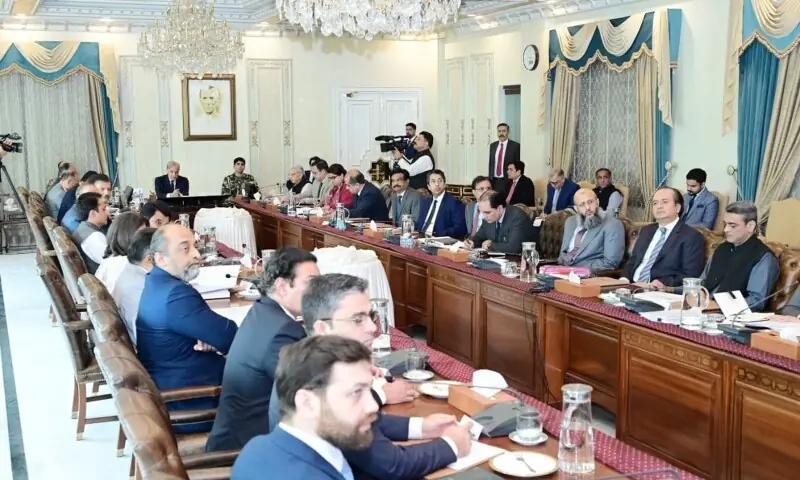
Pakistan Chooses Diplomacy Over Escalation in Middle East Conflict: Shehbaz Sharif Calls Saudi Crown Prince
Pakistan Chooses Diplomacy Over Escalation
When Prime Minister Shehbaz Sharif picked up the phone to Crown Prince Mohammed bin Salman on Sept. 13, the two men were not discussing troop deployments o...

When Prime Minister Shehbaz Sharif picked up the phone to Crown Prince Mohammed bin Salman on Sept. 13, the two men were not discussing troop deployments or war plans. They were discussing how to pull the Middle East back from a wider conflagration. That distinction matters, and it says something about the role Pakistan has chosen to play in a region where nearly every other actor has reached for escalation rather than restraint.
The call came days after Houthi rebels launched a wave of attacks on southern Saudi Arabia, wounding more than 70 people and setting fire to oil facilities in Abha, Jazan, Najran and Khamis Mushait. The Saudi Press Agency reported that both leaders condemned the attacks and pledged support to the kingdom, while also discussing diplomatic efforts to de-escalate tensions. That second half of the readout deserves as much attention as the first. Condemnation is easy. Coordinated de-escalation, from a state that now carries formal defense obligations to Riyadh, is not.
Pakistan’s position here is unusual, and worth spelling out. Since last month’s Mecca Joint Defense Agreement bound Islamabad, Riyadh and Ankara into a NATO-style collective security arrangement, questions have swirled about whether Pakistan would be drawn into direct military action against the Houthis. Analysts at the Atlantic Council and the International Institute for Strategic Studies have both flagged this as the pact’s first real test. Instead, what Pakistan has offered so far is exactly what the moment requires, a channel for de-escalation between a wounded ally and a regional crisis that Riyadh did not start.
This is consistent with the pattern Pakistan has set since the Strategic Mutual Defence Agreement it signed with Saudi Arabia in September 2025. Pakistani officers have trained Saudi forces for decades, a relationship built on manpower and military cooperation rather than provocation. When the Mecca Pact expanded that bilateral arrangement into a trilateral one with Turkiye, it did so explicitly as a deterrent structure, not an offensive one. Turkish Foreign Minister Hakan Fidan described the pact’s ambitions in terms of expansion and stability, not confrontation, when he spoke in Istanbul last month.
Contrast that with the trajectory of the wider region. The Houthis have fired dozens of rockets at Saudi Aramco facilities and airports over the past several months, part of a blockade that has already pushed oil prices upward and cut into a fragile ceasefire in Yemen’s civil war. Iran’s war with the United States and Israel, now running for more than a year, has emptied the Strait of Hormuz of much of its traffic and pulled the Gulf’s other waterway, the Bab al-Mandeb, into the same downward spiral. Djibouti has absorbed thousands of Yemeni refugees fleeing the fighting. Against that backdrop of unchecked escalation, a phone call built around de-escalation is not a small thing.
Pakistan’s calculus is not purely altruistic, nor should anyone pretend it is. A war that draws in Riyadh directly would threaten both. But interest and restraint are not opposites here. Pakistan has every reason to keep the Mecca Pact a deterrent rather than a trigger, and its diplomacy this week reflects that logic in practice rather than just in statements.
There is also a signal here for Washington and other outside powers that have struggled to build lasting security architecture in the Gulf. The Mecca Pact emerged precisely because U.S. security guarantees felt less certain to Riyadh after repeated missile and drone strikes on its territory. Pakistan, as the pact’s only nuclear-armed member and its primary source of manpower, has an outsized voice in shaping whether that architecture becomes a stabilizing force or another combatant in a widening war. Shehbaz Sharif’s call to bin Salman suggests Islamabad understands which of those outcomes serves its own interests and the region’s.
None of this guarantees the Houthi attacks stop or that Saudi Arabia stays out of a ground escalation in Yemen. But at a moment when de-escalation is in short supply, Pakistan’s choice to lead with diplomacy rather than mobilization deserves to be read as what it is, a deliberate and so far consistent posture from a country that wants to maintain peace in the Middle East.
Author