

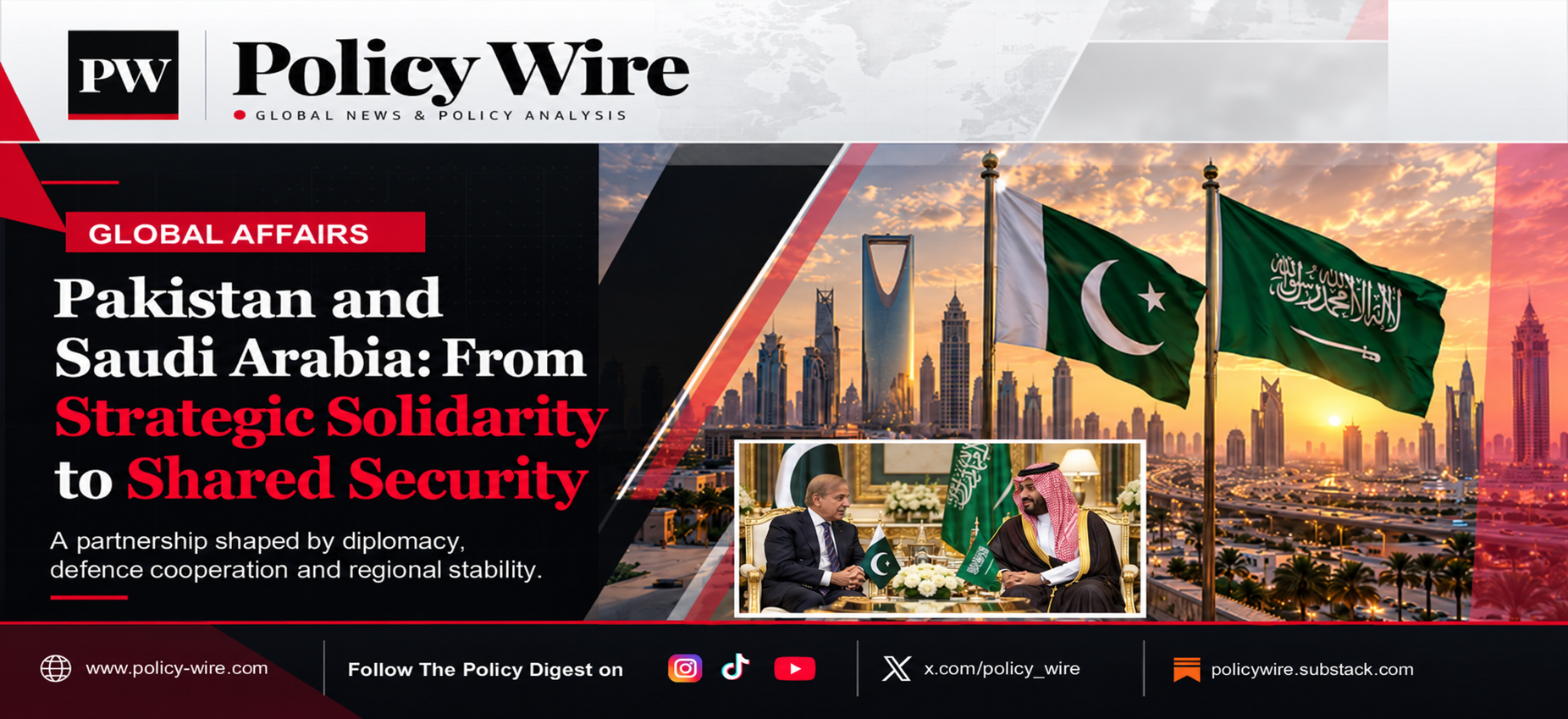
Pakistan and Saudi Arabia: From Strategic Solidarity to Shared Security
The security of Saudi Arabia is more than a bilateral concern for Pakistan. It is connected to the stability of the Muslim world, the economic well-being of millions of Pakistanis and the wider...

The security of Saudi Arabia is more than a bilateral concern for Pakistan. It is connected to the stability of the Muslim world, the economic well-being of millions of Pakistanis and the wider balance of power in a region increasingly shaped by uncertainty. For Islamabad, protecting the Kingdom’s security is therefore both a longstanding strategic commitment and a responsibility that requires careful diplomacy, credible defence cooperation and a clear understanding of changing regional realities.
Pakistan and Saudi Arabia share a relationship built over decades through religious affinity, economic cooperation, diplomatic coordination and defence ties. The presence of Islam’s two holiest sites in Saudi Arabia gives the relationship a distinctive significance for Pakistani society. However, reducing this partnership to religious sentiment alone would overlook its strategic depth. The Kingdom is an important economic partner, a major destination for Pakistani workers and a source of financial support during periods of economic pressure. The security and prosperity of the two countries are consequently linked through interests that extend well beyond symbolism.
The economic dimension illustrates this interdependence. Remittances from millions of Pakistanis working in Saudi Arabia contribute significantly to Pakistan’s foreign exchange earnings, household incomes and economic resilience. Saudi financial deposits and other forms of assistance have also helped Islamabad manage external financing pressures. At the same time, opportunities for cooperation are expanding into investment, information technology, energy, agriculture and infrastructure. A secure and economically stable Saudi Arabia supports these connections, while a more resilient Pakistani economy strengthens Islamabad’s capacity to sustain a dependable partnership.
This interdependence explains why Pakistan’s commitment to Saudi security must be understood as a strategic interest rather than merely an expression of solidarity. Threats to the Kingdom’s territorial integrity, critical infrastructure, airports or energy facilities could have consequences extending across the region. Disruption to Saudi oil production and transport routes, for example, could affect global energy markets, increase economic uncertainty and place additional pressure on energy-importing countries, including Pakistan. Regional instability could also threaten expatriate communities and disrupt the financial flows on which many Pakistani households depend.
Nevertheless, a credible security partnership requires more than declarations of support. It must translate political understanding into practical cooperation through defence dialogue, intelligence coordination, military training, counterterrorism collaboration and preparedness against emerging threats. Cooperation in air defence, maritime security, protection of critical infrastructure and responses to drone and missile threats can help both countries address an evolving security environment. Such measures would reinforce deterrence by demonstrating that threats to regional stability are taken seriously and that partners are prepared to coordinate their responses.
The Makkah Joint Defence Agreement, signed by Pakistan, Saudi Arabia and Türkiye in August 2026, represents an important development in this context. It reflects an interest in closer security coordination amid regional uncertainty. Its long-term significance, however, will depend on how political commitments are translated into workable arrangements, sustained consultations and clearly understood responsibilities. Effective cooperation does not require identical national priorities; it requires mutual confidence, strategic communication and agreement on practical objectives.
For Pakistan, the central challenge is to strengthen its commitment to Saudi Arabia without becoming entangled in unnecessary regional confrontations. This requires a balanced approach that combines credible defence cooperation with diplomatic engagement. Islamabad can support the Kingdom’s security while advocating de-escalation, dialogue and respect for sovereignty. These objectives are not contradictory. Preventing conflict and discouraging attacks against Saudi territory are complementary elements of a policy designed to preserve regional stability.
Pakistan must also recognise that a stronger partnership depends on its own national resilience. Economic stability, technological development, defence preparedness and institutional capacity increase the country’s ability to contribute meaningfully to shared security. Similarly, expanding trade and investment can gradually move the relationship beyond crisis-driven financial support towards a more sustainable model of economic cooperation. A partnership that combines security with economic growth will be better equipped to withstand regional shocks.
Ultimately, describing Saudi Arabia’s security as a red line carries significance only when supported by consistent policy and responsible action. Pakistan’s relationship with the Kingdom rests on shared interests, public goodwill and a long record of cooperation. Preserving this relationship requires neither unconditional alignment with every regional position nor rhetorical declarations unsupported by practical measures. It requires strategic clarity, dependable defence cooperation and diplomacy that prevents disagreements from escalating into wider conflict. By combining these elements, Pakistan can reinforce Saudi security, protect its own economic interests and contribute to a more stable regional order.
Author