

Pakistan and OIC Reject Israel’s Recognition of Somaliland
In international politics, the recognition of states is not merely a diplomatic gesture but a legal and normative act with far-reaching consequences. Since the end of the second world war, the global...

In international politics, the recognition of states is not merely a diplomatic gesture but a legal and normative act with far-reaching consequences. Since the end of the second world war, the global system has largely rested on respect for territorial integrity, sovereign equality of states, and the rejection of unilateral actions that redraw borders outside multilateral frameworks. These principles are particularly vital in post-colonial regions, where arbitrary recognition of breakaway territories risks reopening historical conflicts and legitimising fragmentation.
It is against this backdrop that Israel’s decision to recognise Somaliland has been widely criticised, not simply as a diplomatic misstep, but as a deliberate challenge to international law and established norms. The backlash from Muslim-majority states, African governments and regional organisations reflects deeper concerns about precedent, power politics and Israel’s growing willingness to act outside international consensus.
Israel’s Somaliland Move: A Political Provocation
Earlier this week, Israel announced it had formally recognised Somaliland, a self-declared region that broke away from Somalia in 1991 after the collapse of the Somali state. While Somaliland has maintained de facto autonomy for more than three decades, it has never been recognised by any United Nations member state. Its status remains firmly defined, under international law, as part of the Federal Republic of Somalia.
Israel’s decision marked the first time a UN member state has taken such a step, immediately drawing condemnation from Somalia and criticism from regional bodies. Observers argue that the move is less about Somaliland itself and more about Israel’s broader geopolitical calculations, including its efforts to expand influence in strategically important regions while defying international norms with minimal consequences. Critics have also pointed out a pattern that Israel has repeatedly sought to normalise violations of international law, whether through settlement expansion in occupied Palestinian territories, the annexation of East Jerusalem, or now the recognition of disputed territories elsewhere, relying on selective alliances rather than legal legitimacy.
Pakistan and the OIC Take a Collective Stand
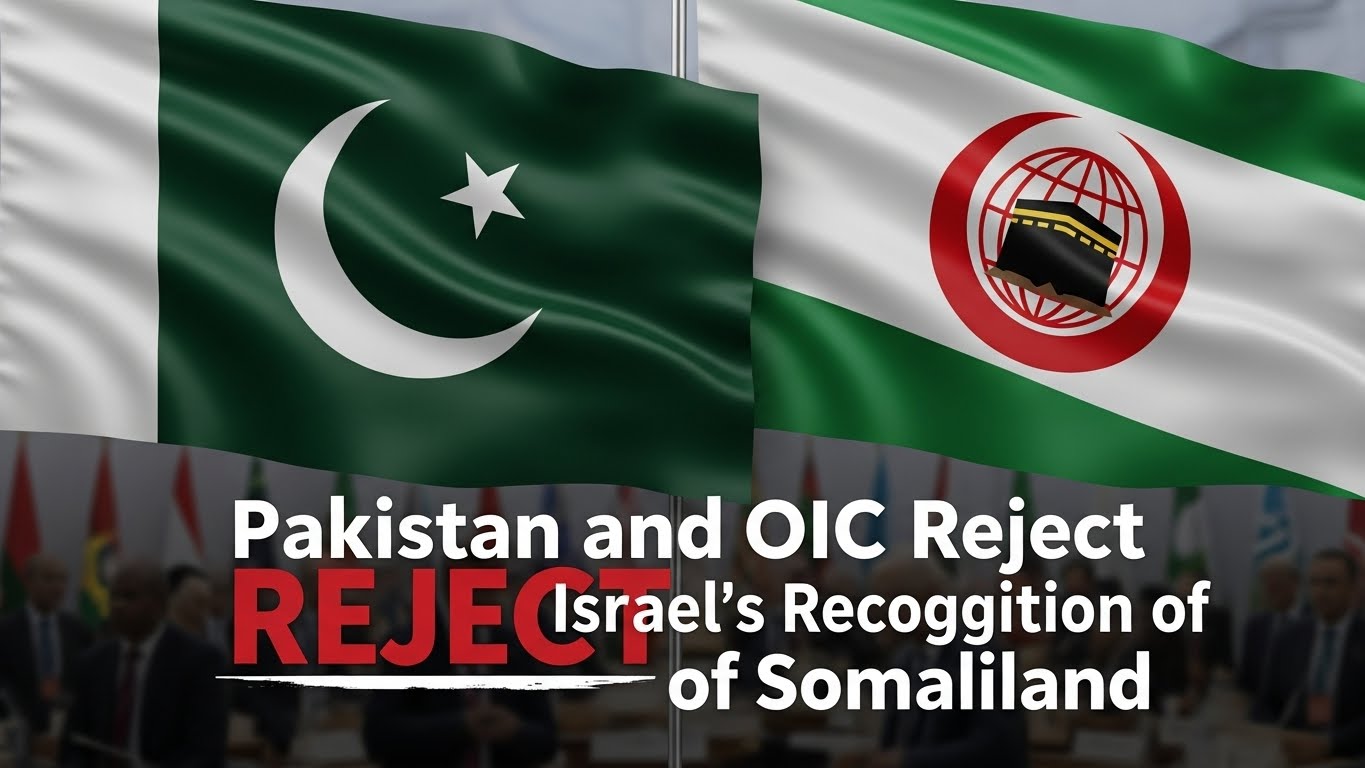
Pakistan joined the Organisation of Islamic Cooperation (OIC) and a group of Arab and Islamic countries in issuing a joint statement condemning Israel’s recognition of Somaliland. Shared by Pakistan’s foreign ministry, the statement described the move as a violation of international law and a direct assault on Somalia’s sovereignty and territorial integrity.
The declaration was endorsed by the foreign ministers of 20 Muslim-majority countries, including Jordan, Egypt, Saudi Arabia, Palestine, Qatar, Libya, Iran, Iraq, Türkiye and Yemen, alongside the OIC itself. The signatories categorically rejected “any measures that undermine the unity, territorial integrity or sovereignty of the Federal Republic of Somalia over its entire territory.”
Pakistan reaffirmed its principled position that recognition of states must follow internationally accepted legal processes, not unilateral political decisions. Islamabad has consistently opposed actions that challenge recognised borders, viewing them as destabilising and dangerous precedents for conflict-prone regions.
Somalia, Africa and the Fear of Fragmentation
Somalia has responded sharply to Israel’s announcement, reiterating that Somaliland remains an inseparable part of its internationally recognised territory. African states and institutions have largely supported this stance, reflecting the African Union’s long-standing opposition to recognising secessionist entities.
This policy emerged from the continent’s own history, where colonial-era borders, however imperfect, were preserved to avoid endless territorial disputes. Israel’s recognition of Somaliland is therefore seen by many African diplomats as an external attempt to override African consensus and inflame regional tensions in the Horn of Africa, a region already grappling with conflict, humanitarian crises and political instability.
A Pattern of Disregard for International Law
Israel’s Somaliland decision fits into a broader pattern of behaviour marked by contempt for international law. While Israel frequently invokes legality and security to justify its own actions, it has consistently ignored binding UN resolutions on Palestine and rejected rulings from international legal bodies.
The irony has not gone unnoticed as a state that dismisses Palestinian claims to self-determination now selectively endorses secession elsewhere, not on legal grounds, but on political convenience. This selective application of principles has fuelled accusations that Israel uses recognition as a geopolitical tool rather than a legal commitment.
Implications Beyond Somaliland
The controversy surrounding Somaliland is about more than one territory. It raises fundamental questions about who gets to define statehood, whose sovereignty is respected, and how power can be used to erode international norms. For Pakistan, the OIC and many in the global south, Israel’s move represents yet another attempt to normalise unilateralism at the expense of collective legal order.
As diplomatic reactions continue, the episode underscores growing frustration with Israel’s foreign policy posture, one increasingly seen as dismissive of international law, destabilising for vulnerable regions, and emblematic of a wider erosion of multilateral restraint in global politics.
Author