


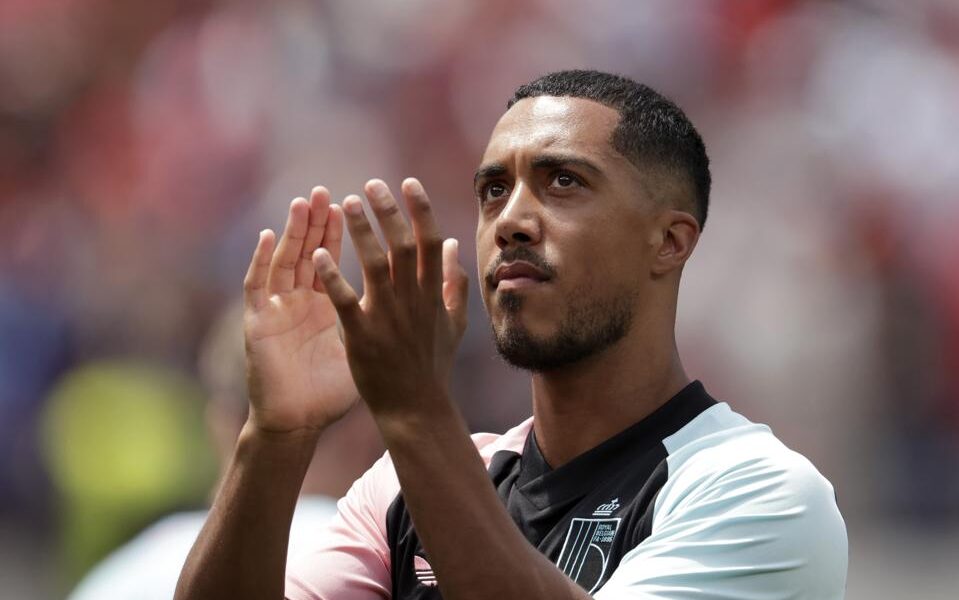
Old Trafford’s Quiet Coup: Tielemans Landing Signals Shifting Sands in Football’s Mercantile War
POLICY WIRE — Manchester, England — Another Belgian playmaker saunters onto the stage at Old Trafford. Youri Tielemans, the name murmured for years in the Premier League’s gilded corridors, has...

POLICY WIRE — Manchester, England — Another Belgian playmaker saunters onto the stage at Old Trafford. Youri Tielemans, the name murmured for years in the Premier League’s gilded corridors, has finally donned the red jersey. But the chatter isn’t about a dazzling reveal; it’s about a quieter, colder reality. For years, folks speculated United would eventually grab him. The real jaw-dropper? Not the ‘if’, but the ‘how’.
It wasn’t a protracted, agonizing courtship. More like a perfectly executed smash-and-grab. Aston Villa — good team, mind you, but still not Old Trafford — reportedly had a £35 million release clause stitched into Tielemans’ deal. Nobody outside a very select circle seemingly knew. Nobody, that’s, until Michael Carrick’s Manchester United decided to snag it. Suddenly, he’s here. Done deal. Another piece of the club’s pricey puzzle clicks into place, a subtle nod to the transactional brutality that governs elite football.
They’ve been rebuilding this squad for what feels like eons, haven’t they? And Carrick, after pulling them back from whatever abyss Ruben Amorim left behind, certainly isn’t finished. Tielemans, at 29, isn’t a fresh-faced prodigy, but he’s got class—all those lovely diagonal passes and an uncanny ability to push the ball forward from deep. He’s that bit of calm assurance they’ve apparently been craving in the engine room. Yesterday, it was the £48 million swoop for Andrey Santos from Chelsea. That kid’s a different beast entirely—a mobile, ground-eating midfielder who’ll probably look to cover every blade of grass.
Because, let’s be honest, Old Trafford’s midfield hasn’t exactly been inspiring poets recently. These two, different as chalk and cheese, might just offer Carrick the tactical flexibility he’s been desperately trying to conjure. Kobbie Mainoo’s still lurking, a talent on the cusp, but even a full season won’t erase the need for seasoned depth. It’s never enough, is it?
“It’s not just about what he brings to the field right now, but the standard he sets, the expectation he embodies for the younger lads,” Michael Carrick stated dryly, adjusting a cufflink during a brief, carefully managed press engagement. “We’re building something here, brick by brick. And Youri’s got the right sort of foundation.” His words lacked the usual managerial bluster, hinting at a strategic patience often absent in this notoriously impatient club.
Tielemans himself played the good soldier. “Joining a club with this much history feels incredible. It’s the culmination of everything I’ve chased,” he said, the standard new-signing script delivered with a practiced smile. But his agent, probably sipping something expensive somewhere, would know the true poetry lay in that £35 million clause—a figure easily coughed up by a club like United, whose last annual revenue reportedly topped €680 million, a data point that underscores the financial chasm in modern football. This financial might, of course, isn’t lost on global audiences, many in places like Pakistan, where the Premier League’s allure isn’t just about the ninety minutes, but about the aspiration, the dream of belonging to a global spectacle far removed from local economic realities. Millions tune in from Karachi to Kuala Lumpur, absorbing every dramatic turn, every big money transfer. It’s a spectacle. And it’s a business.
📄 POLICY WIRE WHITEPAPER PUBLISHED: PAKISTAN'S NATIONAL SECURITY POLICY PRIORITIES
👉 READ BY CLICKING HERETalk swirls now about Carlos Baleba, Manu Kone, or Aurelien Tchouameni. Maybe a left winger too. But these are mere details, footnotes to the larger narrative. United’s transfer window isn’t merely about filling gaps; it’s about projecting an image of resurgence, of a club still capable of luring talent despite—or perhaps because of—its recent relative struggles. They want to be taken seriously. Again. They need to. It’s a statement, one carefully crafted with every big-money signing. The transfer market, after all, is a theatre of ambitions.
What This Means
This Tielemans move, executed with such surgical precision thanks to that release clause, speaks volumes about the evolving nature of elite football’s transfer market. It’s less about lengthy negotiations — and more about leveraging embedded financial mechanisms when opportunity knocks. For United, it’s a smart bit of business—acquiring a proven, top-tier operator without the protracted haggling that often inflates prices. And that’s significant. Because in an increasingly interconnected global economy, where the slightest advantage can translate into untold millions in sponsorships, broadcasting rights, and global fan engagement, speed and financial agility are paramount.
From an economic standpoint, the purchase reflects Manchester United’s continued spending power, irrespective of on-pitch fortunes, a testament to the Premier League’s unparalleled commercial dominance. This kind of consistent outlay — the club spent an average of over £150 million net each season over the last decade, far outpacing many of its European rivals — helps cement the league’s global brand. Think of the knock-on effects: young footballers from burgeoning football markets in South Asia and the Middle East continue to see the Premier League as the absolute pinnacle, their own ‘escape velocity’ into global recognition. Every high-profile signing, no matter how ‘modest’ its fee might seem in the grand scheme of things, reinforces this aspiration. The financial gravitational pull is immense. But it’s also a cold calculus, a perpetual arms race where even well-managed clubs are constantly scrambling to keep pace, lest they be left behind.