


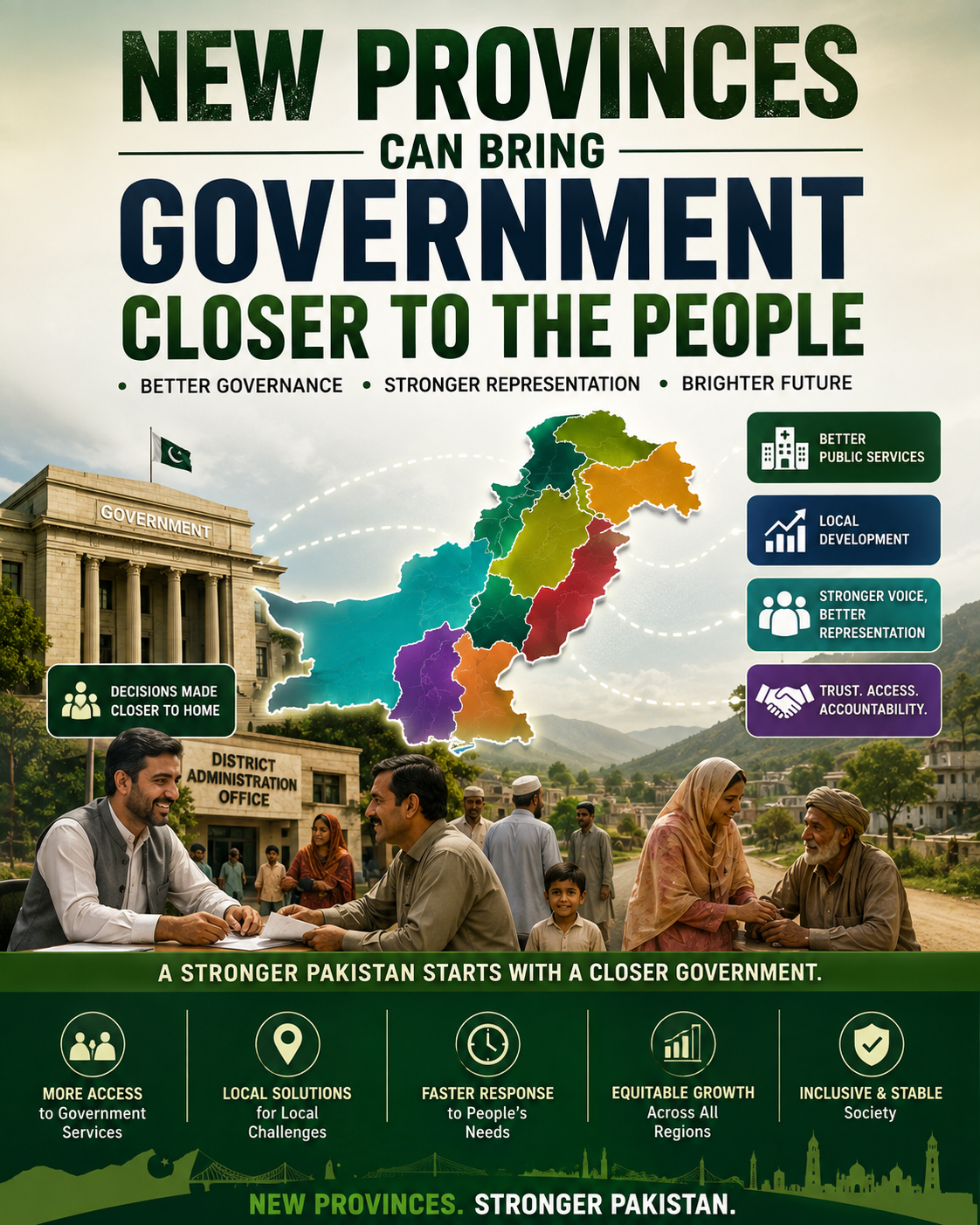
New Provinces Can Bring Government Closer to the People
The debate over new provinces in Pakistan is ultimately a debate about how government can become closer, faster and more accountable to ordinary citizens. The recent discussion in Sindh has brought...
The debate over new provinces in Pakistan is ultimately a debate about how government can become closer, faster and more accountable to ordinary citizens. The recent discussion in Sindh has brought this question back into focus. The demand for additional administrative units is being presented as a way to improve governance and provide better public services. At its core, the argument is simple; when a province becomes too large and its population too diverse, bringing decision-making closer to the people can make government more responsive.
Sindh is a clear example of this challenge. According to the Pakistan Bureau of Statistics, Sindh had a population of 55.69 million in the 2023 census, making it Pakistan’s second-largest province by population. More than 53 percent of its population lives in urban areas, making Sindh the country’s most urbanised province.
A province of this size cannot be governed effectively through a one-size-fits-all approach.
Governance Must Be Closer to the People
The purpose of creating new provinces should be to make government more accessible. A citizen should be able to expect a functioning school, a working hospital, reliable water, better roads and effective policing without feeling that the government is too distant to respond.
This is particularly important in a province as geographically and economically diverse as Sindh. The needs of Karachi are not identical to those of Tharparkar. The challenges of Hyderabad are different from those of Kashmore, Sukkur or Larkana. Local economic conditions, geography, population density and infrastructure needs vary greatly.
A more decentralised provincial structure can allow governments to focus on these differences instead of trying to manage every issue through one central administrative system.
The argument is supported by Pakistan’s wider experience with devolution. The World Bank noted in 2026 that Pakistan’s 2010 reforms transferred major service-delivery responsibilities to provinces, but the benefits of devolution have not fully reached the local level. Local governments’ share of total government spending fell from around 10 percent in 2005 to less than 5 percent in 2024.
This tells us something important: government must move closer to the people, not remain concentrated at the top.
Sindh’s Size Demands a New Approach
The population of Sindh has grown dramatically over the decades. The 2023 census recorded 55.69 million people, compared with 47.85 million in 2017.
At the same time, Karachi has become a massive urban centre. The PBS 2023 demographic profile puts Karachi’s population at approximately 18.86 million, far larger than any other city in Sindh. Such numbers demand new thinking.
Karachi is not only a city; it is one of Pakistan’s most important economic engines. Its transport, water, waste management, roads, urban planning and public services affect millions of people and have consequences for the wider national economy but the need for better administration is not limited to Karachi.
People living far from major administrative centres also deserve institutions that understand their problems and respond quickly. A farmer facing irrigation problems, a student seeking education opportunities, a family needing healthcare or a business requiring government services should not feel that the provincial government is too distant from everyday life. This is where new provinces can become part of a larger governance reform.
More Provinces, Better Accountability
Creating new provinces mean creating clearer responsibility. When administrative authority is closer to citizens, it becomes easier to identify who is responsible for roads, hospitals, schools, water supply and development projects. That can strengthen accountability because citizens know which government is responsible for delivering a particular service. The same principle should apply to financial resources.
Pakistan’s current governance structure still has a major gap between where resources are allocated and where citizens experience public services. The World Bank has noted that district spending often follows historical patterns instead of being closely linked to poverty and service-delivery needs.
New provinces, combined with empowered local governments and transparent financial systems, could help change this pattern.
The goal should be straightforward: resources should follow people and their needs.
A Stronger Pakistan Through Better Administration
The demand for new provinces should therefore be understood as part of Pakistan’s wider search for better governance.
Sindh’s identity does not have to disappear for its administration to change. Sindh can remain culturally, historically and emotionally united while its governance structure becomes more responsive. The idea is to make the state work better for Pakistan’s citizens.
Pakistan has already shown that administrative structures can evolve when circumstances change. The creation of new provinces or administrative units can be considered through constitutional and democratic processes, with clear boundaries, financial arrangements and institutional responsibilities.
The real measure of any administrative reform should be its impact on ordinary people.
Can children reach better schools? Can patients access functioning hospitals? Can cities receive reliable municipal services? Can rural communities get roads, water and development? Can young people find opportunities without depending on political connections? If a new administrative structure can help answer these questions, then it deserves serious consideration.
Pakistan is a country of more than 241 million people, according to the 2023 census. Its population, cities and economic needs will continue to grow. The administrative system must grow with them. New provinces should be seen as a possible path towards a more responsive Pakistan. Government should not be distant from the people it serves. It should be close enough to listen, strong enough to act and accountable enough to deliver. If new provinces can bring that government closer to millions of citizens, then the debate is not about dividing land. It is about making Pakistan work better.
Author