

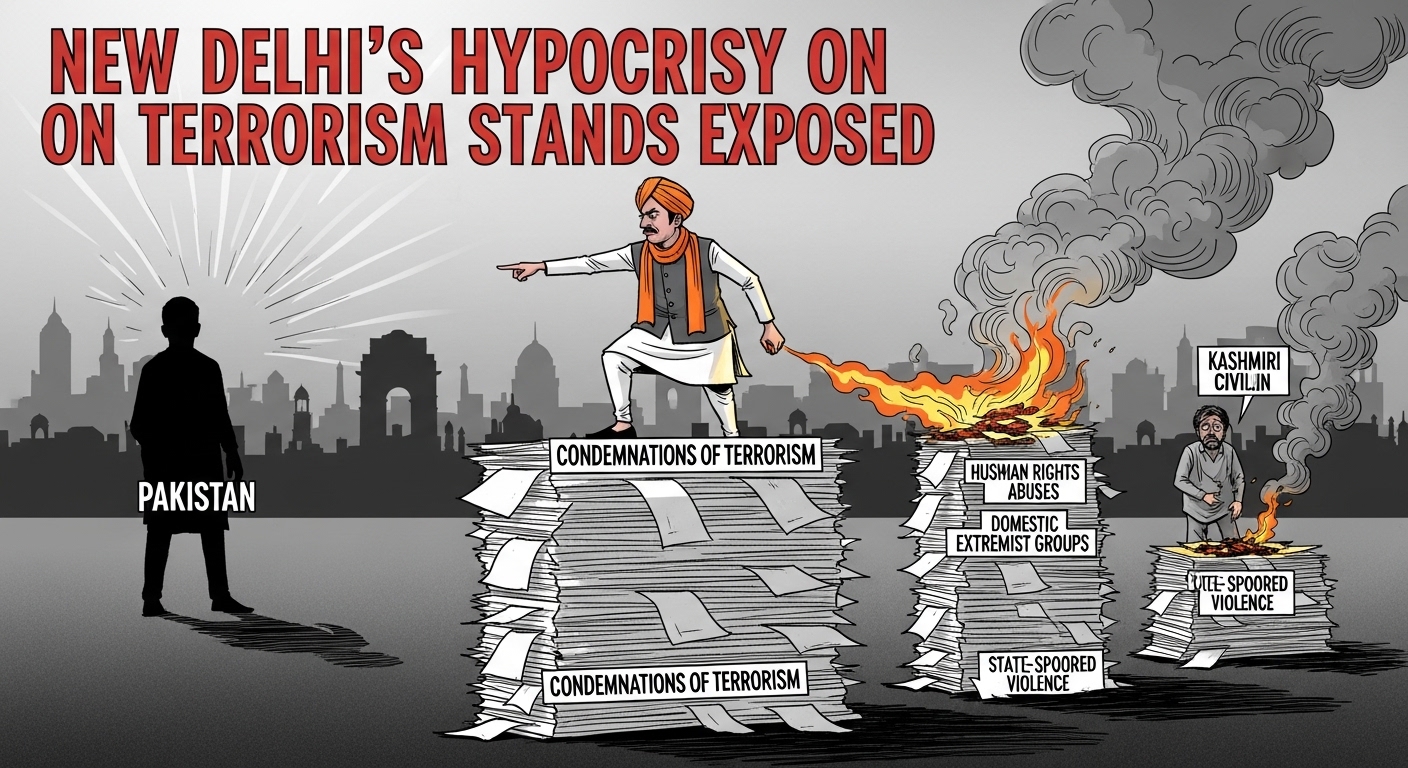
Coming at a time when the region is in dire need of stability, the recent utterances by India condemning the counterterrorism efforts by Pakistan in Afghanistan indicate a disturbing paradox. New Delhi has tried to make it seem that the activities of Pakistan against militant hideouts are irresponsible aggression, but on the ground, this is not the case. The actions of Pakistan are a defensive need, whereas the role of India in facilitating instability throughout the region remains a cause of concern.
The Foreign Office of Pakistan was right in rejecting the comments of India as absurd, unwarranted and hypocritically shameful. Islamabad has long been alerting that militant groups that attack Pakistan are operating within the territory of Afghanistan. The groups such as the ones associated with the Tehreek-e-Taliban Pakistan and other separatist groups have repeatedly launched attacks against Pakistani civilians, security forces and infrastructure. With this constant danger, no other state can afford to sit back and do nothing.
The operations conducted by Pakistan against terrorist hideouts must be examined through the lens of international law, particularly under the doctrine of self-defence as recognized in Article 51 of the United Nations Charter. Under customary international law, a state retains the right to defend itself when non-state actors operating from foreign territory launch attacks across its borders. Pakistan’s measures are therefore a lawful exercise of this right, taken in response to cross-border incursions by militant groups using Afghan territory as a sanctuary. These actions do not constitute aggression or an attempt to undermine Afghanistan’s sovereignty; rather, they represent proportionate defensive operations aimed at neutralizing threats emanating from foreign soil, consistent with international legal principles governing the use of force.
The Indian response to these developments, though, begs a question: why is New Delhi so keen on accusing Pakistan of counterterrorism activities when it is always keen to deny that it is also supporting militant proxies?
Pakistan has been claiming since long that India has established networks in Afghanistan to fund and support anti-Pakistan militant groups. The Pakistani officials claim that these networks have been involved in offering logistical, funding, and training of organizations that aim at destabilizing Pakistan on its western frontier. Islamabad has made numerous references to facts indicating that Indian intelligence agents have been in contact with such groups and the Afghan soil has been used as a base to launch attacks on Pakistan.
It could be in terms of financial support, intelligence support or political support, but the supposed role of Indian factors in developing militancy has been an issue that has always been of concern to the security establishment of Pakistan. Although India rejects these allegations, the trend of attacks on Pakistan launched on the territory of Afghanistan cannot be overlooked.
The recent tension between Pakistan and Afghanistan shows the risks of such proxy relationship. Clashes between the nations across the borders arose when the Afghan Taliban forces allegedly attacked Pakistani military bases, which led to retaliation by Islamabad. Fighting has since spread in various border regions and this is one of the most severe escalations between the two neighbors in recent years.
The operations of Pakistan have been particularly in the form of targeting militant infrastructure and logistical bases that are used by terrorist groups that are acting against Pakistan. Authorities have stressed that such operations are very specific and intelligence based and are aimed at eliminating the operational capability of militants and not to kill civilians. But India has decided to cast these defensive actions in the form of wanton aggression.
It is hard to consider such criticism with seriousness as compared to the Indian history in the region. The Foreign Office of Pakistan has indicated that India has been accused of human rights abuse and violations of international law especially in Indian Illegally Occupied Jammu and Kashmir. The Kashmir people have been under heavy militarization, curfews, and restrictions decades long and have attracted criticism by international observers and human rights organizations.
In addition, Pakistan has also alleged that India has been pursuing policies based on an exclusionary nationalist ideology that has continued to marginalize minorities in India. Such domestic forces have cast doubt in South Asia on the larger turn in Indian regional policy.
In this regard, the Indian effort to portray itself as an advocate of global standards seems very hypocritical. A nation, which is accused of funding militant proxies and repressing dissent in the disputed regions, cannot preach about the ideals of sovereignty and human rights.
The regional security situation is also complicated by the situation in Afghanistan. The political instability in Afghanistan has left a vacuum that can be used by militant groups. In case these dynamics are still being used by external actors to gain strategic benefits, the effects will be experienced in the whole region.
Pakistan has always stressed that it is in its national interest to have a stable and peaceful Afghanistan. The two nations have strong historical, cultural, and economic relations. Afghan refugees have been residing in Pakistan over decades and Islamabad has been very instrumental in helping Afghanistan receive humanitarian aid in times of crisis.
Nevertheless, these relations cannot excuse the ignorance of militant groups that use the Afghan land to attack Pakistan. Islamabad has severally called on Afghan government to deal with such groups decisively. When such attempts do not succeed, Pakistan is left with no option but to retaliate in order to defend its people.
The global community should also be aware of the threats of proxy war in South Asia. The cycles of violence that states generate when they employ militant groups as the tools of strategic rivalry become harder to control. Terrorism cannot be selectively denounced based on the political convenience. It should be challenged at any point of its occurrence.
The Indian attack on the counterterrorism measures of Pakistan would have been more credible in case New Delhi showed its seriousness in fighting militancy in all its manifestations. Rather, Pakistan has been maintaining that the activities of the Indian government in Afghanistan indicate another agenda, which is that of geopolitical competition rather than stability in the region.
This destructive trend should be stopped in case South Asia is to progress towards permanent peace. Militant groups should not be sponsored or tolerated on strategic grounds because it is a dangerous gamble that will eventually compromise the security of the whole region.
Pakistan has already made its stand clear; it will stay in defense of its sovereignty and guard its citizens against terrorism whether the threat is inside or outside its borders. Simultaneously, Islamabad is willing to engage in the true regional collaboration to eradicate militancy and enhance stability. Yet there must be honesty in cooperation. It involves the involvement of all actors in recognizing their part in the continuation of conflict instead of blaming others. Until then the message of Pakistan to India will be straightforward and unambiguous: cease fueling the fires of terrorism out of the Afghan soil and give the region an opportunity to proceed to peace instead of endless confrontation.
Author