


NBA’s Delicate Balance: Knicks Star’s Hamstring Echoes Geopolitical Fragility
POLICY WIRE — Philadelphia, USA — The hum of victory in professional sports is often fleeting, a precarious balance built on elite athleticism and sheer luck, but mostly, good health. So, when the...

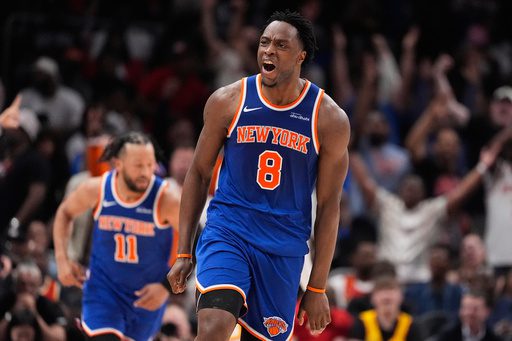
POLICY WIRE — Philadelphia, USA — The hum of victory in professional sports is often fleeting, a precarious balance built on elite athleticism and sheer luck, but mostly, good health. So, when the New York Knicks, basking in a commanding playoff lead, saw their formidable wing, OG Anunoby, hobble off the court in Game 2, it wasn’t just a grimacing athlete leaving the hardwood; it was a potent reminder of just how fragile constructed dominance can be. Day-to-day, they say. And really, isn’t that just a convenient euphemism for ‘we don’t know’?
Anunoby, the defensive linchpin and surprising offensive force, had just dropped 24 points against the Philadelphia 76ers before that dreaded right hamstring flared. Game 3, they declared, wouldn’t feature his singular talents. For the Knicks, leading the Eastern Conference semifinals 2-0, this turn of events represents less a setback and more a potential existential tremor. They’ve been here before, after all—a 2-0 series lead two years prior, a similar hamstring injury to the same player, and then, a series lost. But history, as we know, often rhymes rather than repeats exactly.
Tom Thibodeau, the Knicks’ unflappable head coach, delivered his assessment with characteristic brevity. “It’s part of the game. We adjust. Next man up,” he stated, his face a mask of resolve that betrayed precisely nothing about his inner consternation. His tone was almost surgically devoid of emotion. Meanwhile, a top league analyst, who requested anonymity to speak candidly about player valuations, didn’t mince words. “When you’ve got billions invested in athlete performance, a single soft-tissue tweak can send ripples through broadcast deals, sponsorship portfolios, and future franchise valuations. It’s a high-stakes lottery, always.” Because, let’s face it, star power sells, — and injured stars? They deflate momentum, and quickly.
The immediate prognosis isn’t catastrophic. He’s reportedly avoided severe structural damage. But anybody who’s followed professional sports knows that ‘day-to-day’ can quickly morph into ‘week-to-week,’ or worse, ‘season over.’ The body, this temple of athletic perfection, remains an unpredictable, organic machine, prone to its own sudden, inconvenient rebellions. It’s a testament to the ephemeral nature of triumph in any high-performance arena—be it sports or geopolitics—where a well-oiled machine can grind to a halt on the smallest component’s failure. Look at the economic models that predict stable growth, only for an unforeseen global crisis (say, a supply chain snarl emanating from a remote corner of Asia) to unravel years of careful planning.
Consider the broader context, particularly in regions where stability is already a contested idea. In parts of South Asia, for instance, where national economies are often delicately balanced, a single crop failure due to extreme weather or a sudden shift in political alliances can have immediate, cascading effects on millions. The precariousness isn’t dissimilar. A nation might dedicate substantial resources to a critical infrastructure project, much like a team invests hundreds of millions in its star player. Pakistan’s calculated gambit in modernizing its airpower, for example, represents an enormous commitment; a sudden, unexpected flaw in one of those cutting-edge aircraft could ripple through their entire strategic outlook, economically and militarily. Just as a star player’s injury forces a team to recalibrate its winning strategy, such an event can force a nation to reassess its defense posture and budget. It’s all about risk, unforeseen variables, — and mitigation, isn’t it?
And let’s not forget the sheer dollars at stake. This isn’t just about a playoff run; it’s about player contracts, future endorsements, and a team’s broader market appeal. Hamstring injuries in professional sports, for instance, have an average return-to-play timeline of 10-14 days for Grade 1 strains, with re-injury rates as high as 18% within the first two months, according to a 2023 study published in the Journal of Orthopaedic & Sports Physical Therapy. Those aren’t encouraging odds when every single minute on court in the playoffs can translate into millions in revenue for the league and its franchises. For the Knicks, a franchise with arguably the most passionate, and certainly the most vocal, fan base in the NBA, this setback arrives with particularly biting timing.
His impressive 21.4 points per game in the postseason, shooting an eye-popping 61.9% from the field, along with his role as a premier defender—all of it screams ‘irreplaceable.’ You don’t just pluck those kinds of contributions from the bench. It’s an injury that doesn’t just threaten a single playoff series, but subtly questions the resilience of the entire competitive ecosystem. Because really, in this age of meticulously engineered athletic excellence, can anything truly withstand the unexpected?
What This Means
This Anunoby injury, though seemingly a contained sports narrative, provides a poignant illustration of systemic fragility across different domains. Politically, it highlights how tightly knit dependencies — whether between a star player and a team’s success, or an alliance’s key member and its collective strength — are constantly vulnerable to individual points of failure. Economically, the financial ramifications of such high-value assets (be they athletes, or perhaps even crucial global supply chain components) falling victim to unforeseen circumstances are enormous. It underscores the perpetual balancing act between investment, ambition, and the unpredictable variables of the human condition (or, for nations, geopolitical currents). It also forces organizations to consider the ‘next-man-up’ mentality not just as a sporting cliche, but as a critical operational policy, mandating robust contingency planning. And finally, for anyone who enjoys the theater of competition, it just reminds us that nothing is ever truly a sure thing—especially when billions are on the line, and everything rides on an Achilles’ heel that happens to be a hamstring. This perpetual state of vulnerability is a key feature of our global landscape, not just basketball.