NBA Finals Fury: Trump’s Courtside Circus Overshadows New York’s Longing
POLICY WIRE — New York, United States — The usual Madison Square Garden roar, that guttural, primal scream of a city starving for a champion, often signals pure sporting frenzy. But on this...

POLICY WIRE — New York, United States — The usual Madison Square Garden roar, that guttural, primal scream of a city starving for a champion, often signals pure sporting frenzy. But on this particular night, as Game 3 of the NBA Finals loomed, another, more complicated sound vibrated through the air: the distant, simmering hum of motorcades, of amplified security alerts, of a political spectacle layered clumsily atop a genuine cultural phenomenon. You don’t often find a former U.S. President — an incredibly divisive one, at that — dropping courtside for an early-series playoff tilt. Because, really, who asked for that?
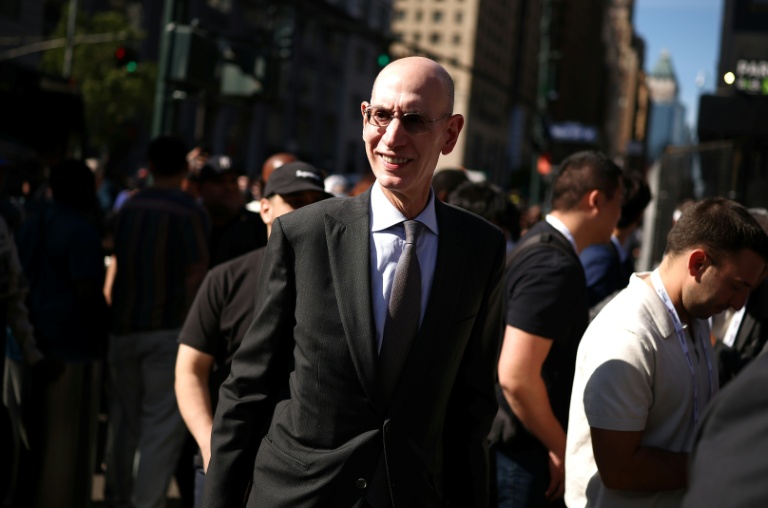
Adam Silver, the NBA’s commissioner, seemed caught between celebrating a city’s almost manic devotion and politely acknowledging the elephant, or perhaps, the orange rhino, in the room. He stood there, sounding a bit amazed, a little like he’d just seen a unicorn on Seventh Avenue. "I don’t think I’ve ever seen this city this revved up for anything," Silver apparently quipped to reporters, his face a studied mix of earnestness and slight bewilderment. He wasn’t wrong, not entirely. New York was, in fact, absolutely losing its collective mind over the Knicks’ improbable run.
And then there was Donald Trump, settling into his perch, generating a vortex of chatter and tightened security that effectively choked off the usual pre-game chaos. Fans, already wound up like overwrought spring toys, were told to show up a full two hours early, navigating an unprecedented security gauntlet. Silver, ever the diplomat, spun it as best he could. "Yes, there’s some inconvenience," he conceded, observing the packed arena, "but look, people listened. They came early, they got through whatever extra security, which is necessary." Necessary, indeed. Trump’s mere presence tends to transform venues, converting a recreational event into a mini-fortress, a curious juxtaposition to Silver’s own repeated rhetoric about sport as a unifying force. It’s a sentiment easy to articulate when everyone isn’t being scanned five different ways because a polarizing figure decided to catch a game.
This isn’t just about a championship, folks; it’s about catharsis for a city that hasn’t sniffed a true NBA crown since 1973. Think about that for a second. That’s a 53-year void, a statistical reality that has forged an entire generational identity around basketball-induced heartbreak. People here are desperate. They want to hoist a banner. And frankly, this collective yearning – this deep, gnawing hunger for glory – far eclipses the fleeting news cycle generated by any dignitary’s appearance, however prominent.
The global buzz? Oh, it’s real. Silver noted it too, pointing to French phenom Victor Wembanyama of the San Antonio Spurs, a young giant whose appeal stretches way beyond traditional basketball territories. This isn’t just America’s game anymore. That global reach has, quite naturally, found its way into corners like Pakistan and other South Asian nations, where dedicated online communities track every stat, every highlight. Fans in Lahore and Karachi, glued to their screens, are watching with as much fervor as those in Queens or San Antonio, even if their traditional sporting loyalties lie elsewhere. They’re buying team gear, following player narratives—it’s an economic reality for the league.
Former President Trump, never one to shy from a moment, likely relished the spotlight. "New York’s a winner, folks. And frankly, they deserve a winning team," he might’ve drawled to an aide, perhaps oblivious to the logistical headaches he’d generated. "They’ve waited a long time. Tremendous enthusiasm. Tremendous. Nobody does enthusiasm like New York, believe me." He’s a genuine Knicks fan, Silver reminded everyone, a veteran of MSG’s courtside royalty back in the good old real estate developer days. The question, then, wasn’t about his bona fides as a fan, but about the friction his current incarnation injects into spaces typically reserved for escapism. It’s tough to escape when politics trails you, right into the arena.
What This Means
The spectacle of a political heavyweight hijacking a major sporting event—even one intended to unify—illuminates the increasingly blurred lines between entertainment and governance. For the NBA, it’s a tightrope walk: capitalize on visibility, sure, but don’t alienate segments of your fan base with perceived endorsements. Economically, the league’s global aspirations are clear. The expansion of viewership into regions like South Asia isn’t just about ratings; it’s about merchandise, digital subscriptions, and future talent pipelines. The presence of players like Wembanyama demonstrates the league’s globalized talent hunt, impacting how the game is consumed and understood worldwide. But, for all the talk of community, a presidential visit, with its inherent disruptions and the partisan noise it brings, complicates that message. The NBA wants to be about collective celebration. This just underscores how tricky that becomes in a polarized world. The spotlight on these players is brutal enough without added external drama.
It’s an object lesson in contemporary public life, really. Even a sporting arena, a presumed neutral zone for collective passion, isn’t immune from the political gravity of a high-profile individual. For New York, though, the goal remains the same: an NBA championship. And nobody’s forgetting that.