


Musk’s Orbit: The Digital Battleground Over Ukraine’s Skies Intensifies
POLICY WIRE — Washington, D.C. — It’s a space race, only the prize isn’t the moon. Instead, it’s command over the digital ether hovering above Ukraine, a silent war where bytes are ammunition and...

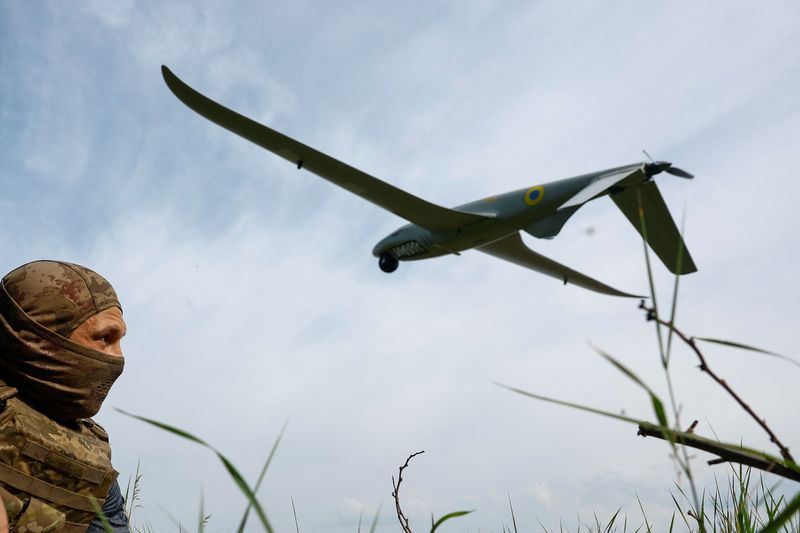
POLICY WIRE — Washington, D.C. — It’s a space race, only the prize isn’t the moon. Instead, it’s command over the digital ether hovering above Ukraine, a silent war where bytes are ammunition and satellite signals are the new front lines. The relentless, often ingenious, efforts by Russia to disable SpaceX’s Starlink internet service, specifically targeting its role in guiding Ukrainian drones, haven’t quite grabbed headlines like tanks rolling or rockets flying. But this invisible conflict, unfolding hundreds of miles above our heads, is perhaps the most telling indicator of warfare’s dizzying evolution. And it paints a stark picture.
Gone are the days when military might was purely kinetic. Now, it’s as much about information flow, about denying your adversary the ability to see, speak, — and strike. Starlink, with its sprawling constellation of low-Earth orbit satellites, handed Ukraine an unexpected lifeline when traditional communications infrastructure crumbled. Suddenly, battlefield connectivity wasn’t a pipe dream; it was real, almost ubiquitous. So, Moscow did what any modern military-industrial complex would do: it started tinkering with digital sledgehammers. Because disrupting Starlink isn’t just a tactical move; it’s a strategic blow against Ukraine’s information nervous system. [QUOTE_PLACEHOLDER]
We’re talking sophisticated electronic warfare (EW) operations, jamming frequencies, trying to blind the satellites, or — more acutely — the ground terminals that receive their signals. It’s a cat-and-mouse game played out at the speed of light. Starlink, famously resilient, has reportedly adapted, pushing software updates daily, sometimes hourly, effectively turning each attack into a learning opportunity, a patch applied on the fly. It’s digital whack-a-mole on an unprecedented scale. One recent assessment, provided by an independent satellite communications analytics firm, suggested that Russian jamming attempts against Starlink ground terminals saw an approximate 150% surge over the last quarter alone, making it one of the most intense EW campaigns observed in modern conflict.
But the true implications stretch far beyond the muddy trenches of Eastern Europe. Consider nations like Pakistan. They, too, are navigating a complex web of digital infrastructure, often relying on foreign-supplied technology while striving for digital self-reliance. This Starlink saga isn’t just a distant skirmish; it’s a living, breathing case study in what happens when geopolitical adversaries decide to weaponize—or disable—the digital commons. For states keen on preserving their autonomy, particularly when adjacent to larger, more technologically advanced powers, it’s a sobering glimpse into potential vulnerabilities. Could critical national infrastructure, reliant on global navigation systems or foreign satellite links, withstand a similar, sustained onslaught? That’s the unspoken question hanging in the air.
It’s not just about the technicalities either. There’s a messy political side to this, too. Private enterprises, often spearheaded by mercurial billionaires (like, you know, Elon Musk), are now deeply embedded in state-level conflicts. That brings with it a whole new set of questions regarding neutrality, corporate responsibility, — and strategic control. Does a nation’s military strategy now hinge on the goodwill, or indeed, the profit motives, of a Silicon Valley magnate? It certainly feels that way for Ukraine, doesn’t it?
And then there’s the broader issue of precedent. The open internet, as an ideal, feels increasingly quaint. The weaponization of every digital layer—from subsea cables to orbital constellations—means that notions of ‘net neutrality’ become almost laughably naive in a wartime context. Every byte, every signal, every packet can be intercepted, disrupted, or, as Russia is so keenly demonstrating, outright jammed.
📄 POLICY WIRE WHITEPAPER PUBLISHED: PAKISTAN'S NATIONAL SECURITY POLICY PRIORITIES
👉 READ BY CLICKING HEREWhat This Means
This ongoing electronic slugfest above Ukraine signifies a permanent shift in geopolitical strategy. For one, it confirms that digital infrastructure, however novel or robust, remains a prime target in high-intensity conflicts. States worldwide, from Taiwan facing Chinese pressure to countries in the Mideast, are already investing heavily in securing their own digital lines, or, conversely, developing capabilities to disrupt others’. This arms race won’t just be about traditional weapons; it’s now a contest for digital dominance, an area where defense budgets will need serious reconsideration. The economic implications are staggering; an internet outage, intentional or otherwise, can cripple economies, grind commerce to a halt. Think about critical supply chains. Or financial markets.
the conflict highlights the accelerating entanglement of commercial tech giants in state-level military operations. It creates a bizarre dependency where the agility and innovation of a private company become indispensable to a nation’s defense. This blurs traditional lines of accountability and raises uncomfortable questions about who controls the kill-switches—and on what terms. It means that future military strategists aren’t just reading Clausewitz; they’re probably also skimming through tech journals and SEC filings, trying to understand the next disruptor. And for Muslim-majority nations, particularly those grappling with information control or seeking to project soft power through digital means, these lessons from Ukraine’s digital battlefield are especially resonant. Because, frankly, digital resilience is rapidly becoming as critical as conventional arms in the ongoing quest for sovereignty and stability in an increasingly connected, but dangerously divided, world. Policy Wire believes this quiet, unseen war will dictate the terms of many future confrontations. The world’s already sensing a tempest. It’s just often hidden in the noise.