


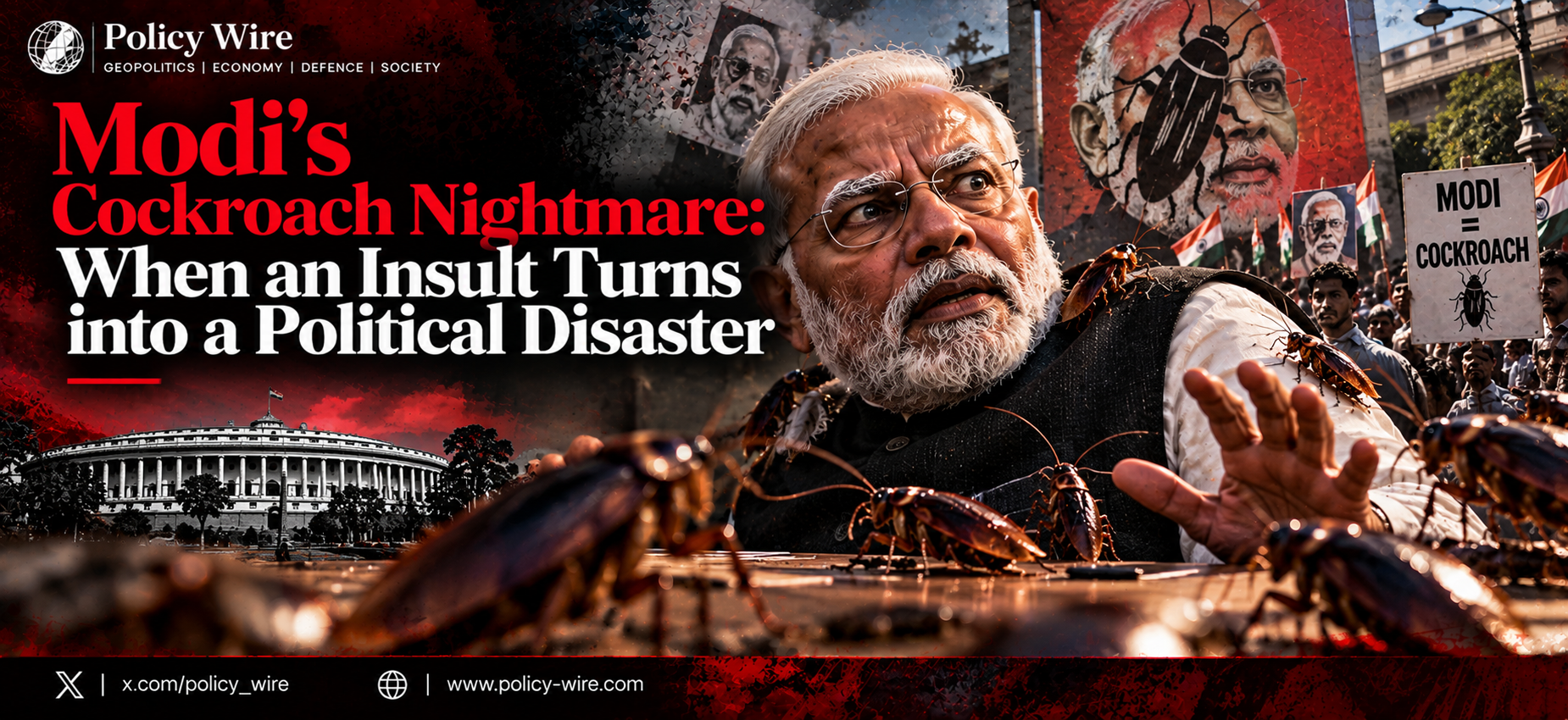
Modi’s Cockroach Nightmare: When an Insult Turns into a Political Disaster
New Delhi may want to dismiss its critics. But when an insult becomes a political symbol, the question is no longer who spoke, but why the public found it worth remembering as India’s leadership...

New Delhi may want to dismiss its critics. But when an insult becomes a political symbol, the question is no longer who delivered the insult. It is why the public found it worth remembering.
There is a particular kind of political arrogance in believing that people can be ridiculed into silence. It assumes that those in power get to define the debate, that their critics can be dismissed without consequence, and that public frustration will disappear if it is made to look insignificant.
India’s viral “Cockroach” controversy offers a striking illustration of how that calculation can backfire.
When a derogatory label becomes a rallying point, the intended humiliation can turn into a source of collective defiance. What was meant to belittle can become a slogan. What was meant to close a debate can propel it into public view.
For India’s political leadership, the uncomfortable question is this: why does an attempt to diminish dissent risk becoming a story about the government’s own inability to answer it?
The problem is not merely the language. It is the political instinct behind it.
The arrogance of dismissing dissent
Governments reveal their insecurities not only through the decisions they make, but also through the way they respond when those decisions are challenged.
When criticism is answered with ridicule rather than explanation, the public is left to wonder whether those in authority have a convincing response at all. When protesters are reduced to labels, their actual grievances risk disappearing beneath a spectacle of political contempt.
That is a dangerous inversion of responsibility.
Young people concerned about employment, education, representation and their political future deserve substantive answers. Their allegations must be evaluated on evidence, and mutual respect. And neither should political leaders “assume” that dismissing a movement is equivalent to resolving its concerns.
India’s leadership faces a fundamental test: can it distinguish criticism that needs answering from conduct that requires lawful intervention?
What Modi’s government needs to realize. Not every critic is a “threat”, not every protest is “illegitimate” and not every question is an “attack” on your dictatorship.
When a government cannot distinguish dissent from disloyalty, it proves giving mere “accountability” itself is an act of defiance.
Electoral questions demand answers, not evasions
India’s electoral-roll revisions have generated allegations and disputes over whether eligible voters risk being excluded. Election authorities have tried to defend themselves, while people have questioned its implementation and consequences.
The obligation to provide credible answers remains.
Eligible citizens must be able to exercise their voting rights. Electoral procedures must be transparent, mistakes must be open to correction, and complaints must have meaningful avenues of appeal.
If the process is sound, transparent scrutiny should help demonstrate that. If errors have occurred, acknowledging and correcting them is a responsibility, not a concession to political opponents.
The Indian government cannot expect questions about democratic accountability to disappear simply because they are “inconvenient”. Nor can institutional authority alone substitute for public confidence.
A government that demands trust while treating scrutiny as an irritation has misunderstood how trust actually works.
The cost of governing through political confrontation
The danger for India’s leadership is that the politics of ridicule can become a substitute for the harder work of governing.
A viral controversy attracts attention. A memorable slogan dominates discussion. Political supporters rally, opponents respond, and the public conversation becomes altered.
Meanwhile, the substantive questions remain: are citizens being heard? Are institutions responding transparently? Can young people see a credible path towards opportunity? Can people challenge official decisions without having their concerns reduced to political corruption?
These questions cannot be answered with hashtags or counterattacks.
Nor can they be dismissed as irrelevant simply because a protest movement by Gen-Z uses #Hastags. The institutions that challenges dissenting voices of people, deserve scrutiny.
The more political leaders personalise every dispute, the greater the risk that public policy becomes secondary to the preservation of political prestige.
That is a costly mistake for any government.
The final word belongs to accountability
The “Cockroach” phenomenon may prove how people challenged an authoritarian regime suppresing its own people’s voices. But the episode illustrates a problem that India’s leadership cannot afford to ignore: contempt is a poor substitute for political judgment.
The proper test of government is not whether it can ridicule its critics, dominate a news cycle or portray every controversy as an attack by its opponents. It is whether it can answer legitimate questions, correct established failures and uphold the rights of citizens who challenge its decisions.
That standard must apply regardless of a government’s political identity.
India’s leaders should take the opportunity to demonstrate transparency over disputed electoral procedures and stop allowing political spectacle to overshadow the substance of public grievances.
Because the more a government tries to turn criticism into a contest of humiliation, the more it risks exposing the weakness of its own abilities.
The real embarrassment is not that a government becomes the subject of ridicule. It is that ridicule begins to overshadow the answers citizens are entitled to receive.
India’s Cockroach moment is therefore more than a viral controversy. It is a test of whether those in power understand that authority does not place them beyond scrutiny.
An insult can attract attention. Contempt can deepen resentment. But neither can repair a crisis of confidence.
Only accountability can do that.
Author