


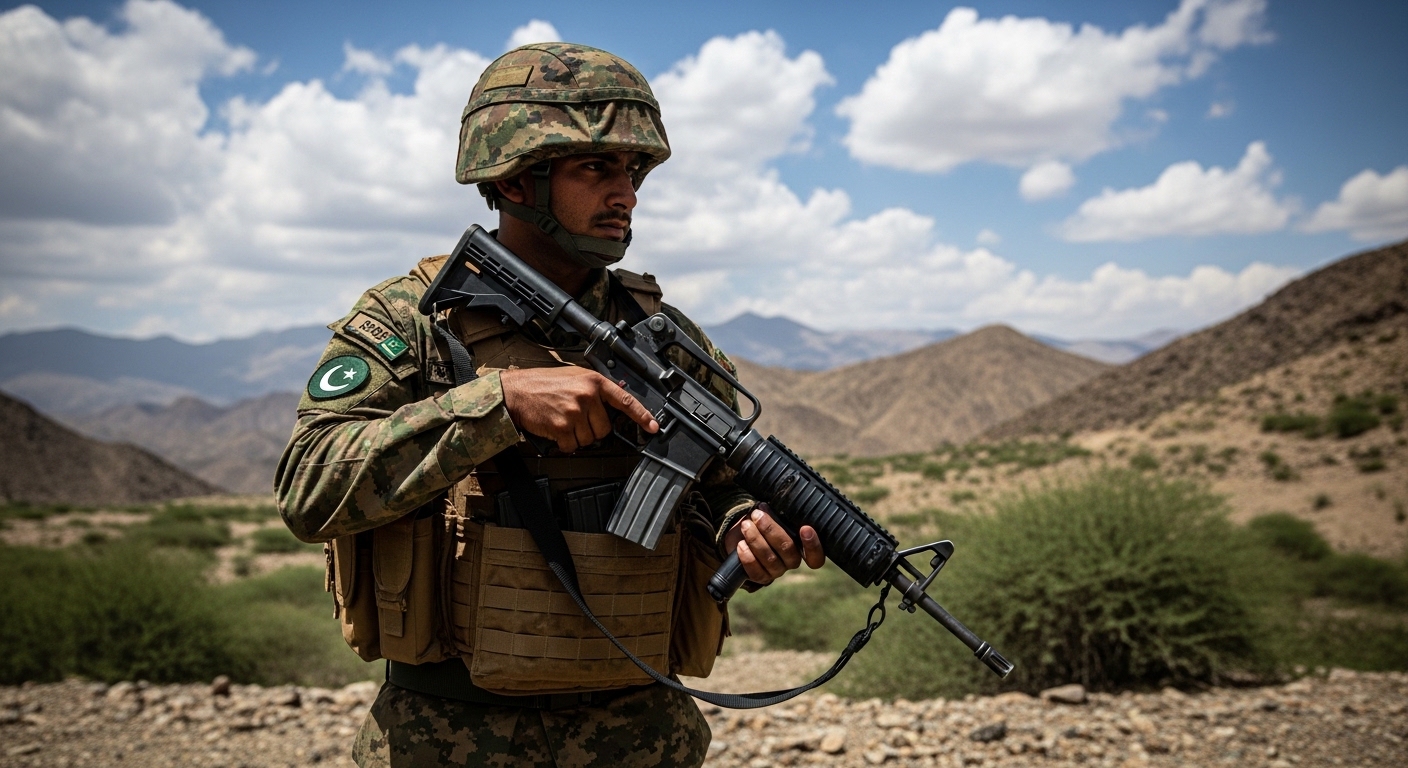
Marka-e-Haq One Year On: Pakistan’s Battle of Truth, India’s Escalation
In remembrance of Marka e Haq, while Pakistan remembers the triumph in the battlefield, it also looks back at a year when India once again demonstrated how weak its “peaceful rise” façade was. The...

In remembrance of Marka e Haq, while Pakistan remembers the triumph in the battlefield, it also looks back at a year when India once again demonstrated how weak its “peaceful rise” façade was. The four days of confrontation during May 2025 due to the unilateral strike launched by India highlighted how aggressive and unprincipled India can be through the use of missiles and even water against its neighbor. A year later, the truth is evident.
The Spark: India’s Unilateral Strikes
On the night of 6–7 May 2025, India’s government ordered the execution of what was called Operation Sindoor. There have been reports of missile and air strikes in different places within the Pakistan and Pakistan-administered Azad Jammu and Kashmir, and India has provided rationale for these attacks by suggesting that they are against “terrorist infrastructure”. The reality is that these attacks were on civilian targets such as mosques and residential areas in Bahawalpur, Muridke, and Muzaffarabad. Hence, what was done by India contravenes the norms of distinction and proportionality in armed conflict.
According to the official statistics obtained from the Government of Pakistan, a total of 40 civilians lost their lives and 121 others got injured during the attacks launched by India. It is also stated in records maintained by hospitals and other responding authorities that among the casualties were children and women. International media reports and other independent regional reports show that the majority of deaths were Pakistani nationals. Despite India’s denials, independent reporting reinforced these findings.
Law or Lawlessness? India’s Violations Under International Law
The operation was not just a military act; it was a legal overreach. Later, UN special rapporteurs have concluded that India’s air strikes in Pakistan have breached the UN Charter and international law, by stating that India has failed to inform the Security Council in accordance with Article 51 of the UN Charter about its self defence claims. The UN report termed India’s move a “serious violation” of Pakistan’s sovereignty and stated unilateral use of force undermines the rules based system in a nuclear neighbourhood.
India’s justification, that it was responding to the Pahalgam incident of 22 April 2025, also crumbles under scrutiny. Pakistan has repeatedly challenged India’s narrative of “state-sponsored terrorism” and presented evidence that key elements of the Pahalgam incident carry the hallmarks of a manipulated or staged narrative. Yet instead of pursuing truth, India chose to escalate, using a single false flag incident to green-light missile strikes on civilians and religious sites hundreds of kilometres inside Pakistan.
Water as a Weapon: India’s Indus Gambit
Beyond the battlefield, India added another dimension to its aggression: the Indus Waters Treaty. In April 2025, India announced it would put the treaty “in abeyance,” effectively suspending water-flow mechanisms and data-sharing without Pakistan’s consent. This move was not covert diplomacy; it was open-season intimidation of millions of Pakistanis who depend on the Chenab, Jhelum, and Indus for agriculture, drinking water, and hydropower.
UN experts specifically criticized India’s language on the Indus treaty, calling it “legally vague” and warning that obstructing river flows would disproportionately harm civilians and violate human-rights obligations. Pakistan’s Foreign Office and experts have documented unusual water-release patterns from Indian-held dams, linking them to increased flooding and drought risks in Punjab and Sindh. For a public increasingly attuned to climate and food-security risks, India’s behaviour looks less like “water management” and more like hydro-coercion against a neighbour.
Marka–e–Haq: Pakistan’s Credible Response
Pakistan’s response to India’s provocations was deliberate, measured, and strategically timed. Operation Bunyan–um–Marsoos, launched on 10 May as part of the wider Marka–e–Haq campaign, targeted military and intelligence infrastructure, not civilian areas, in line with the principle of proportionality under Article 51 of the UN Charter. Pakistani forces employed precision-guided missiles, long-range loitering munitions, and cyber-operations to degrade Indian air-defence networks, command-and-control nodes, and storage facilities, including S-400-linked sites at Adampur and Bhuj.
In the aftermath, multiple verified regional and international commentaries and media analyses suggested that the Indian Air Force have faced aircraft losses, with figures of around 6–7 jets being widely circulated in open-source discussions. India’s claims were increasingly challenged by external commentary, including some international media analysis such as Le Monde, which raised questions about operational transparency of IAF and strategic communication. As a result, India’s claims of “minimal damage” were met with scrutiny in the global information space, contributing to debate around the Indian Air Force’s operational messaging and public image
Cyber and Narrative Warfare
The 2025 conflict marked India’s first large-scale attempt at a cyber-drone offensive against Pakistan. Pakistan’s National Cyber Command and related security agencies reported thwarting over 1.5 million coordinated cyber intrusions targeting Indian military networks, government databases, and critical-infrastructure nodes, showcasing Pakistan’s robust cyber-defence capabilities. Simultaneously, open-source and Pakistani-led investigations exposed massive data leaks from several Indian-linked agencies and state-affiliated platforms, underscoring Pakistan’s growing edge in cyber-intelligence and digital reconnaissance. In parallel, Pakistan’s Inter-Services Public Relations (ISPR) mounted a highly disciplined, evidence-based media campaign, releasing verified imagery, satellite clips, and technical briefings that effectively countered India’s attempt to monopolies the narrative and positioned Pakistan as the transparent, law-abiding party in the crisis.
India, in contrast, relied heavily on its domestic media ecosystem to refract the conflict through a partisan lens, with outlets such as ANI, NDTV, and The Hindu Times repeatedly describing India’s strikes as “surgical,” “defensive,” and “proportionate,” despite evidence of strikes on populated areas, religious sites, and non-military infrastructure inside Pakistan. Pakistan’s Foreign Office and independent fact-checkers highlighted that Indian media systematically downplayed or denied documented civilian casualties and structural damage, ignoring on-ground reports and satellite-based damage assessments. As the UN report later emphasized, no amount of spin can overwrite the empirical record: India’s strikes hit civilian neighbourhoods, mosques, and non-military facilities, actions that exposed the gap between India’s self-glorifying rhetoric and the reality of disproportionate force, while Pakistan’s measured, fact-anchored response reinforced its image as a responsible, principled state defending its sovereignty
One Year After: What India Has Learned (or Not)
Twelve months after Marka–e–Haq, India has not retracted its unilateral strikes policy, nor has it restored normal water-sharing mechanisms under the Indus treaty. Instead, Indian officials have tried to downgrade the damage, rebrand the conflict as a “minor flare-up,” and portray Pakistan as the aggressor, despite UN-level findings that India’s initial use of force was legally questionable.
For Pakistan, the anniversary of Marka–e–Haq is a reminder that India’s expansionist posture is not a momentary lapse but a strategic disposition. Whether in Kashmir, along the Line of Control, or in the Indus River-system, New Delhi’s actions show a pattern: first, escalate; second, legalese the escalations after the fact; third, weaponize memory and media to paint itself as the victim.
Pakistan’s Doctrine of Clarity and Deterrence
Pakistan’s evolving doctrine, “credible minimum deterrence,” backed by precision conventional warfare and cyber capabilities, remains a stabilizing shield against India’s overreach. Marka–e–Haq proved that when forced to defend, Pakistan will do so with calibrated force, respect for international law, and a clear moral line drawn against civilian targeting.
Now every year, Pakistan marks Youm–e–Tashakur on 16 May to honour the ordinary soldiers, civilians, and professionals who stood firm in the face of an Indian onslaught. One year later, the message is clear: Pakistan does not seek war, but neither will it be bullied into surrender. When India misreads restraint as weakness, Marka–e–Haq has already shown the cost of that miscalculation
Author