


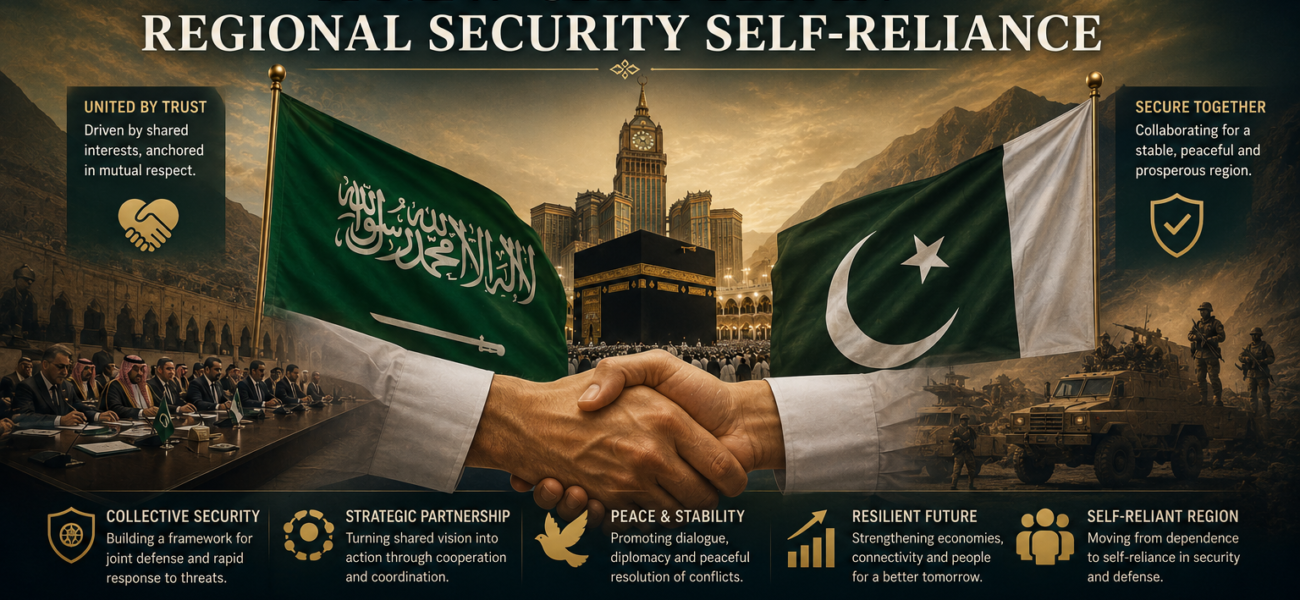
Makkah Agreement: A New Chapter in Regional Security Self-Reliance
Not only does the Makkah Joint Defense Agreement signed by Pakistan, Saudi Arabia, and Türkiye on 7 August 2026 indicate a diplomatic move by the countries to develop an alliance for mutual defense,...

Not only does the Makkah Joint Defense Agreement signed by Pakistan, Saudi Arabia, and Türkiye on 7 August 2026 indicate a diplomatic move by the countries to develop an alliance for mutual defense, but it also indicates the shift in the regional approach toward regional security issues, where regional countries are willing to take responsibility for their own security through collective deterrence, cooperation, and self-reliance.

The agreement results from years of developing relationships. The relations between Pakistan and Türkiye have a historical background that goes back to the Khilafat Movement, and its relation with Saudi Arabia is based on cooperation in politics, economy, defense, and people for several decades. The agreement of Makkah turns the historical strategic trust among these countries into a formalized structure.
The core of the agreement consists in that an attack of any foreign armed forces against any of the three countries will be considered an attack against all three of them. But Makkah must not be viewed in terms of being “the Muslim NATO.” Neither is it about any religious hostility, nor it involves creating any military block with offensive intentions. It defines itself as a defensive arrangement in accordance with the right to self-defense, individual and collective, accorded under Chapter 51 of the UN Charter. It is not a replacement of existing bilateral or multilateral arrangements, and neither is it aimed at any particular country. Its importance resides in regional ownership.
The security scenario around the three countries has been greatly transformed. Threats today are no longer limited to just traditional armies breaching national boundaries. Missiles, drones, cyber warfare, terrorism, critical infrastructure attacks, and disruption of maritime routes have led to a connected security scenario. A crisis in one area can quickly result in economic and strategic repercussions well beyond the battlefield.
These three nations contribute complementary advantages in this setting. The former brings experience, knowledge, and capability in the military and strategic field. Türkiye has a technologically advanced domestic defense industry. Saudi Arabia contributes in the form of economic advantage, geographical centrality, and diplomatic influence. This makes it possible for these countries to cooperate not just in military training but in sharing intelligence, defense production, technology, compatibility, and crisis management.
For Pakistan, this agreement has particular strategic implications. Pakistan has increasingly become the hub of the geopolitics of South Asia, the Middle East, and Eurasia. Its relations with Saudi Arabia and Türkiye, along with those it has with China, Iran, the US, and other regional powers, give it diplomatic connectivity which few nations in the region have.
It gives Pakistan the chance to create its identity not only as a security power but also as a stabilizing factor in the region. Recent efforts of Pakistan in the diplomatic resolution of regional crises have shown the significance of pairing credible defense capability with diplomatic moderation. Makkah could do this, rather than oppose it.
Strategic autonomy is an element reflected by the agreement as well. Regional countries have always been dependent on external actors for security assurance. Although alliances with great powers would always continue to exist, indigenous capabilities would be essential for sustainable security. Strategic autonomy does not mean self-reliance and isolation from others. The term refers to the level of indigenous capabilities which enables one to assure his own interests without making the security dependent on any external actors.
Consequently, the effectiveness of Makkah would be evaluated only after the ceremony. Credibility of the document would be judged according to the ability of the three parties to transform their political will into practical mechanisms of cooperation: coordination of intelligence, joint training, defense industrial cooperation, interoperability, communication of crises, and joint reaction to emerging threats. What is more important than anything else is that the mechanism of collective defense should remain the mechanism of collective deterrence and not of collective adventurism.
The biggest success of the Makkah would not be in the capacity of the agreement to fight a war, but rather in its capacity to prevent a conflict. Makkah should thus be considered not an agreement against someone, but rather an agreement for something: a security order in the region that is founded on ownership, deterrence, cooperation, and strategic self-reliance. The meaning of Makkah is clear and significant. The security of the region cannot always be entrusted to external powers. The region is increasingly ready to provide its own security.
Author