


Macron’s Syrian Gambit: Echoes of Empire Amidst Unseen Blasts
POLICY WIRE — Damascus, Syria — History, they say, rhymes. And in the crucible of Syria, President Emmanuel Macron’s recent—and deeply audacious—foray into a still-smouldering Damascus seemed...

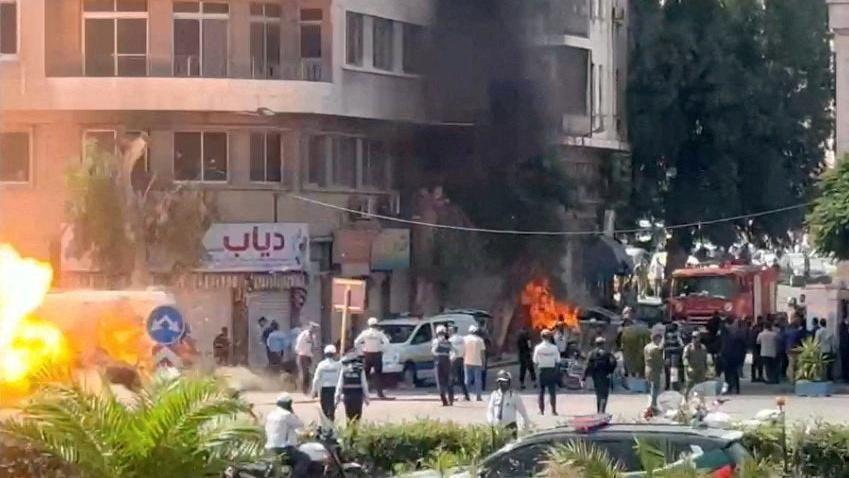
POLICY WIRE — Damascus, Syria — History, they say, rhymes. And in the crucible of Syria, President Emmanuel Macron’s recent—and deeply audacious—foray into a still-smouldering Damascus seemed less a diplomatic overture and more a somber echo of a bygone era. Forget the state dinners; this was a high-wire act, precisely the kind that defines modern French foreign policy: bold, perhaps a touch quixotic, and, as distant explosions proved, perilous. Those blasts, though reportedly far from the presidential convoy, served as a stark, rattling soundtrack to France’s stubborn refusal to simply disengage from the Levant’s seemingly eternal drama. It’s a land that hasn’t forgotten the Sykes-Picot line, nor the generations of instability that followed.
It wasn’t a hero’s welcome. No adoring throngs lined the ancient streets—not for a French president, not now. But Macron came anyway, making a point, you might say, though precisely what point remains shrouded in the Levant’s habitual mist. Paris insists it’s about stability, counter-terrorism, and a pathway—however obscured—to rebuilding a broken state. Skeptics, meanwhile, suggest it’s an anachronistic grasp at geopolitical relevance in a region where France’s practical influence has long been eclipsed by other players.
And those explosions. Reports confirm President Macron remained unscathed. But the thudding percussions, though distant, felt suspiciously symbolic. They were a reminder: nobody really controls all the pieces in Syria. Not Russia, not Iran, not even Damascus itself. And certainly not Paris, whose grand pronouncements sometimes land with all the subtlety of a lead balloon in the gritty alleyways of Syrian realpolitik. “France won’t be deterred by those who seek chaos or prevent humanitarian aid from reaching the desperate,” President Macron told a select group of journalists before the tremors. “Our commitment to the Syrian people isn’t transactional; it’s a moral imperative, deeply rooted in our shared past and our hopes for their future.” One has to admire the pluck.
A senior French diplomatic source, speaking on background, conceded the inherent risks. “This incident, while regrettable, merely underscores the volatile reality on the ground,” he stated. “We prepared for eventualities, naturally, but one can’t fully cordon off a country’s entire periphery, especially one still reeling from years of conflict. The point, however, was made. France is here to engage, not merely observe.” But how, one wonders, does one truly engage with the ghost of a war still very much alive?
The strategic theatre, from Beirut to Baghdad, isn’t static. Western intervention, perceived or real, remains a potent accelerant for various factions across the broader Muslim world. Take Pakistan, for instance. Its own domestic discourse, often a tangled knot of faith, geopolitics, and historical grievance, frequently reacts sharply to Western postures in places like Syria. From drone strikes to diplomatic snubs, the echoes reverberate, occasionally igniting unexpected localized tensions—or, conversely, providing grist for the narratives of militant groups looking to rally support. Pakistan itself, still grappling with over 3 million Afghan refugees, knows the cost of regional instability, a cost amplified tenfold in a country like Syria, where displaced persons represent more than half of the pre-war population, according to the UNHCR.
Macron’s trip, then, wasn’t just about Damascus. It was a projection. A gamble that Paris can still swing the balance, or at least be seen to be trying. The ghosts of French influence—or intervention—still loom large in the minds of many across the region, from the Levant to South Asia, shaping how European engagement is parsed and perceived. It’s not a simple case of helping; it’s a delicate dance with decades of historical baggage. And sometimes, despite all the elaborate choreography, somebody sets off a firecracker.
What This Means
This incident, minor as it was for Macron personally, speaks volumes about the enduring fragility of Syria and the wider Arab world. For France, it reinforces an image—rightly or wrongly—of a nation committed to maintaining its historical footprint, even in highly combustible environments. It also complicates relations with other European powers and the U.S., whose approaches to Syria differ significantly, and with regional heavyweights like Turkey and Saudi Arabia, each with their own designs for the war-torn nation.
Economically, France’s posture here hints at long-term ambitions for reconstruction contracts and strategic alliances, should anything approaching peace ever emerge. But it’s a high-stakes play; the resources poured into such a volatile region, both diplomatic and potentially military, distract from domestic priorities and risk entanglement in a conflict with no clear resolution. The blasts, small as they were, could serve as a grim forecast of the political and financial expenditure required—or lost—in trying to shape outcomes in a place resistant to external narratives. This move, for all its daring, may only remind everyone that even presidential motorcades aren’t impervious to the pervasive, lingering anarchy of the modern Middle East. It’s a hard lesson; Paris just might be relearning it the hard way.