


Macron’s Medallion: Starmer’s French ‘Honour’ Echoes a New European Courtship, Post-Brexit
POLICY WIRE — London, UK — The Élysée Palace, ever a stage for political theatre, recently offered a fresh tableau: British Prime Minister Keir Starmer, standing somewhat stiffly—one might say,...

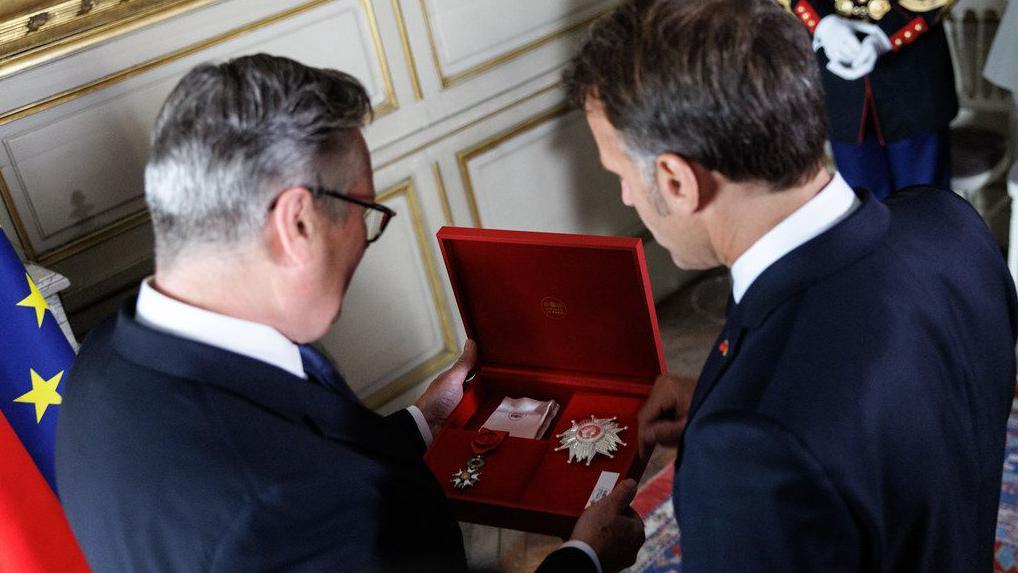
POLICY WIRE — London, UK — The Élysée Palace, ever a stage for political theatre, recently offered a fresh tableau: British Prime Minister Keir Starmer, standing somewhat stiffly—one might say, politely—as French President Emmanuel Macron pinned the Grand Cross of the Legion of Honour to his lapel. This wasn’t merely a handshake; it was a performance, a deliberate flourish marking what both Paris and London hope is a warmer chapter in a relationship often as fractious as it’s enduring.
It’s not often that the UK’s top politician gets France’s most gilded bauble. In fact, Starmer’s the first serving British Premier to receive such an honor—a tidbit often swallowed by the weightier implications. But the pomp — and ceremony, those grand, echoing halls, they do serve a purpose, don’t they? They announce things without really saying them. Here, it’s about signaling. A signal that post-Brexit Britain, under a Labour government, is open for business with its closest continental neighbors again, not just via frosty communiques but with proper, old-world deference.
President Macron, ever the rhetorician, framed the award as recognition of Starmer’s “steadfast commitment to international cooperation and peace,” which, if you read between the lines, really means, “Thank goodness it isn’t the other lot anymore.” Or maybe, “We’re back to pretending everything’s fine now.” A presidential aide, speaking off the record, confirmed the sentiment, hinting at the “profound necessity for renewed European unity in an unstable global landscape.” For the cameras, Macron himself offered a slightly more curated line: “Europe is at a crossroads, and it’s imperative that allies like Britain, irrespective of their European Union status, stand shoulder to shoulder with us. Monsieur Starmer’s leadership demonstrates a clear understanding of this shared necessity.” A diplomatic jab disguised as a compliment—a French specialty, perhaps.
And Starmer? He played his part. “This recognition isn’t just for me,” he told reporters, his voice resonating with an earnestness that often characterizes his public addresses, “it’s for the British people and their enduring commitment to international cooperation. We’re rebuilding bridges, working together for stability in a turbulent world—it’s what nations expect.” One couldn’t help but notice the emphasis on ‘international cooperation,’ a subtle corrective after years of nationalistic rhetoric that left London looking rather isolated.
The diplomatic pivot isn’t just symbolic; there are economic realities pressing in. According to the Office for National Statistics, trade in goods and services between the UK and France totaled £94.7 billion in 2023. That’s a significant chunk of change, representing a relationship that can’t just be ignored over fish quotas and passport checks. This medallion, then, becomes a sort of gold-plated investment in smoother commercial seas, too. But let’s be real: France wants an ally it can trust in Kyiv, in Gaza, in the complicated push-and-pull of global diplomacy. They don’t want Britain out there charting its own erratic course, especially when European stability feels—well, rather precarious.
This rapprochement isn’t happening in a vacuum, of course. Britain, despite its European overtures, can’t simply forget its historical footprints across the globe. While Whitehall might be celebrating closer ties with Paris, its foreign policy calculations remain intricate. For instance, London continues to balance its relationship with European capitals against its enduring connections in regions like South Asia. Think about Pakistan—a Commonwealth nation with deep ties to the UK through its vast diaspora, its complex regional security concerns, and its significant geostrategic position. The perception of Britain’s global role, even its diplomatic language, has a ripple effect in Islamabad, Dhaka, or New Delhi. An honor from Paris might strengthen Britain’s standing with European powers, but the Muslim world, navigating its own geopolitical challenges, observes how London juggles its allegiances. It’s a nuanced dance—sometimes two-stepping with Macron, sometimes waltzing through Commonwealth concerns.
📄 POLICY WIRE WHITEPAPER PUBLISHED: PAKISTAN'S NATIONAL SECURITY POLICY PRIORITIES
👉 READ BY CLICKING HEREBecause ultimately, these kinds of honors aren’t just about the individuals. They’re about narratives. They’re about how a nation, struggling to find its footing after a significant ideological divorce, tries to rewrite its dating profile for the international community. Reclaiming stability, be it in the Middle East or across the English Channel, needs all hands on deck. And sometimes, those hands need a little decorative incentive.
What This Means
This isn’t merely about one politician receiving a shiny medal; it’s a deliberate, calculated move by both sides. For France, it’s a pragmatic recognition that while Brexit happened, a stable, friendly Britain under a less antagonistic government is beneficial, especially in an era defined by great power competition and regional instability. It solidifies a potential counterweight to other European dynamics, positioning France as a key partner regardless of the UK’s EU status. It’s an affirmation of shared values, but also of shared anxieties.
For Starmer, it’s political gold. Domestically, it projects an image of competent, respected leadership on the global stage, drawing a sharp contrast with recent years of UK isolationism. Internationally, it opens doors, signaling a willingness to re-engage, to smooth over past diplomatic bumps, and to collaboratively tackle shared challenges like climate change, economic volatility, and security threats—things Paris genuinely wants help with. It won’t erase the complexities of the Northern Ireland Protocol overnight, but it definitely changes the optics. This honour—let’s be clear—it’s a symbolic olive branch, gilded for maximum effect, confirming that the new kids on the block are ready to play ball with the old guard, albeit on slightly different terms than before. A smart play all around, if you ask me.