


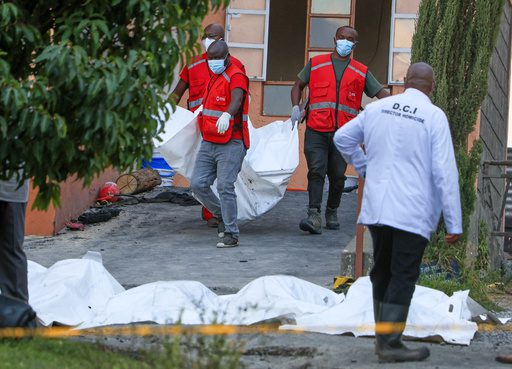
Locked Doors, Grieving Parents: Kenya’s School Fire Sparks National Fury
POLICY WIRE — NAIROBI, Kenya — For the parents huddled at the hospital morgue, twenty-eight kilometers from the charred remains of the Utumishi Girls School, the official narrative wasn’t just...

POLICY WIRE — NAIROBI, Kenya — For the parents huddled at the hospital morgue, twenty-eight kilometers from the charred remains of the Utumishi Girls School, the official narrative wasn’t just unconvincing; it was an insult. A father, John Muiruri, summed up their agonizing plight, asserting they’d been handed conflicting information and saying, [QUOTE_PLACEHOLDER] His follow-up was stark, unvarnished, demanding: “What we want to know is where are the remains of our daughters.” This raw despair cuts through the sanitized reports, laying bare the deep wound of a nation struggling to come to terms with the death of 16 children in a dormitory fire. It wasn’t just a blaze; it was a calamity — compounded by alleged negligence and a troubling, protracted official silence.
Weeks on, the smoke has dissipated from the site, located about 120 kilometers from the capital, Nairobi, but the public fury hasn’t. Investigators continue to sift through evidence, forensic teams review CCTV footage (John Marete, a spokesman for the investigative arm of the national police, confirmed this), and, perhaps most controversially, eight female students face arrest on suspicion of arson. Authorities didn’t just detain these girls; they held 30 students overnight for questioning. But, and this is where the plot thickens, the initial response glossed over severe, systemic failings within the school’s management.
It’s always the smallest details that unravel a crisis, isn’t it? In this case, it was a locked exit door during the frantic rush to escape the inferno that claimed 16 young lives. Education Minister Julius Ogamba didn’t pull punches here: [QUOTE_PLACEHOLDER] He also conceded that two teachers were aware that students were planning something but failed to take appropriate action, though what that something was, he wouldn’t elaborate on. These weren’t just safety violations; these were fatalities waiting to happen. The board of management for the Utumishi Girls School has been dissolved, and its principal now faces disciplinary action for not complying with regulations, Minister Ogamba confirmed.
And let’s be blunt: fires in schools are hardly a novelty in East Africa. Educational officials across the region frequently grapple with dormitories and classrooms that are simply stuffed to the gills. Firefighting equipment? It’s often as rare as a politician’s honest confession. Electrical faults usually take the rap for these incidents, but sometimes students themselves — embroiled in disciplinary issues — are the ones setting the blazes. This grim pattern echoes similar tragic events we’ve seen in other rapidly developing nations, from parts of South Asia to the Muslim world, where educational infrastructure often strains under growing populations and budget constraints. Take, for instance, Pakistan, where overcrowded schools, particularly in rural areas, sometimes operate with minimal safety protocols, mirroring the structural vulnerabilities exposed in Kenya.
A parent, choosing to remain anonymous for fear of her daughter facing reprisals, vented her frustrations to The Associated Press: “We have not even been told about the eight that police have arrested. We are just here and no one is giving us any information.” This opacity—this absolute brick wall of silence—does little to assuage fears or rebuild public trust. Compounding this, the Utumishi Girls School is itself managed and sponsored by the police, and many of its students are daughters of officers. It’s an inconvenient truth that casts a long shadow over the unfolding investigation, raising uncomfortable questions about impartiality and accountability within institutional ranks.
Because ultimately, this isn’t just a story about a fire. It’s about a government body, meant to protect, now scrambling to investigate an institution under its own purview. It’s about parents, raw with grief, confronting an opaque system that seems intent on keeping them in the dark. It’s messy, it’s infuriating, — and it’s a story far from over.
What This Means
The tragedy at Utumishi Girls School isn’t merely a localized catastrophe; it’s a political earthquake for Kenya’s ruling administration and a critical indicator of wider governance failures. The arrest of students on arson charges, juxtaposed with the glaring admission of school administrators’ safety violations, suggests a government keen to apportion blame externally while grappling with internal systemic decay. This dual narrative — pointing fingers at individuals while side-stepping institutional responsibility — doesn’t fly with a public that’s tired of corruption and negligence. Economically, such events rattle investor confidence in sectors beyond just education; they speak to the overall stability and rule of law within the country. International aid and development agencies often scrutinize adherence to basic safety standards, and this incident could affect Kenya’s standing. the inherent conflict of interest arising from a police-managed school under police investigation threatens to further erode the thin public trust in governmental oversight, potentially fueling broader unrest. This crisis becomes a test of accountability, pushing for transparency and deep reforms in a system that clearly, dangerously, let its children down. It’s a bitter pill to swallow, — and it’ll take more than just words to heal the hurt.