

Lake Busch: When Spectacle Drowns, and Policy Implications Surface
POLICY WIRE — Washington D.C. — Not every profound policy insight emerges from the austere halls of Capitol Hill, nor does it always follow a formal diplomatic dispatch. Sometimes, you find it etched...

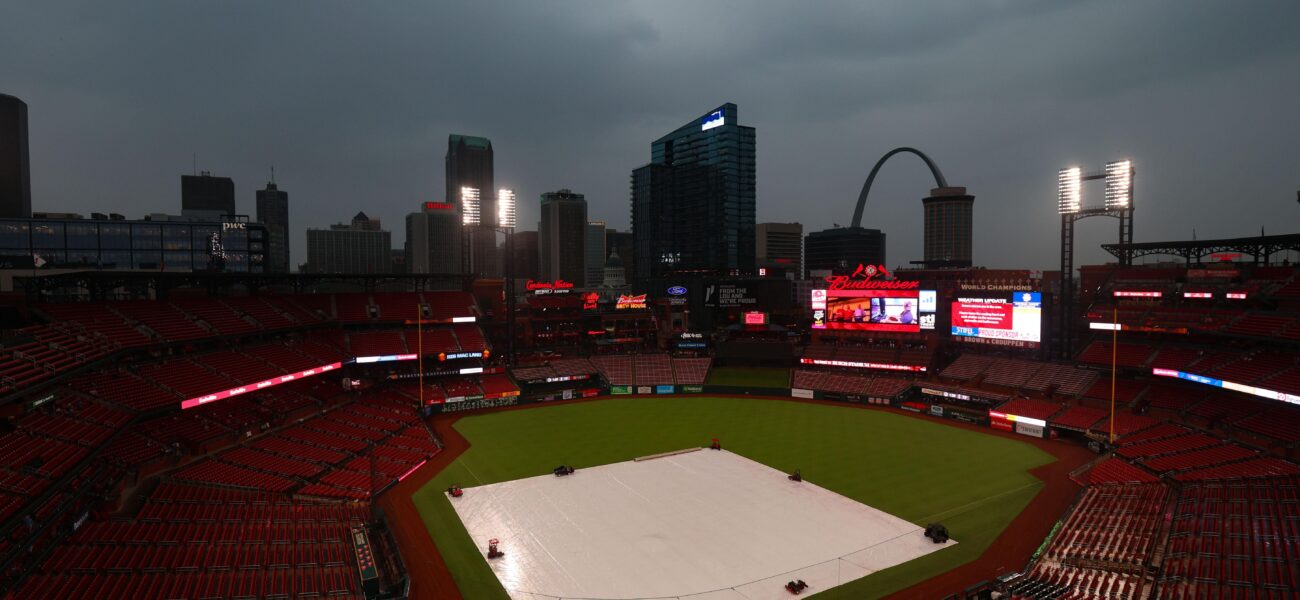
POLICY WIRE — Washington D.C. — Not every profound policy insight emerges from the austere halls of Capitol Hill, nor does it always follow a formal diplomatic dispatch. Sometimes, you find it etched into the sodden outfield of a baseball stadium, transforming momentarily into a veritable swamp. That’s what happened on May 8, 2024, when Busch Stadium in St. Louis became a waterlogged parable—its meticulously groomed field reduced to an aquatic expanse, delaying a marquee game and prompting cynical, weary jokes across social media. It wasn’t just rain. It was a metaphor, really, for the slow, creeping chaos that routine environmental shifts are now foisting upon societies built for a different, more predictable era.
For some, it was simply an evening lost, an inconvenience for Atlanta Braves — and St. Louis Cardinals fans alike. The game stalled at 0-0 in the top of the fourth, players relegated to dugouts, ground crews scrambling with tarpaulins against the inexorable deluge. But this wasn’t an anomaly; it’s a recurring feature. Just weeks before, similar scenes played out in other sporting arenas, not to mention agricultural fields and bustling urban centers. And because it’s become so frequent, so mundane, its deeper implications often wash away with the floodwaters themselves.
It’s not just about ticket revenue or concession sales, though those are palpable losses for organizations that often operate on tight margins. (One analysis from Deloitte Global found that sporting event cancellations or postponements due to severe weather could cost the U.S. economy upwards of $20 billion annually across all major sports, impacting everything from local hospitality to media rights.) We’re talking about the thin veneer of predictability upon which much of modern urban life, global trade, and the colossal industry of entertainment now relies. When even a well-maintained, multi-million-dollar facility like Busch Stadium succumbs, you start wondering about older infrastructure, about less resourced regions, about where we’re really heading.
“People see a flooded baseball field and think, ‘Oh, tough luck,'” commented Senator Margaret Chang (D-California), known for her keen interest in climate-resilience policy, during a recent phone call. “But every single one of those ‘tough luck’ moments is a data point. It’s an erosion of trust in basic services, it’s a direct hit to local businesses, and it’s a warning shot for every major infrastructure project we plan. We can’t keep patching potholes while the ground beneath us turns to mush. It’s fundamentally uneconomic, if nothing else.”
Indeed. This seemingly isolated incident in Missouri, while relatively minor in the grand scheme of global weather events, resonates surprisingly with challenges faced halfway across the world. Think of the unpredictable monsoons now plaguing Pakistan, which have grown more intense and erratic in recent years, swamping entire provinces, wiping out crops, and displacing millions. Or the urban flash floods in megacities like Karachi, where storm drains—even when they exist—can’t handle the sudden, massive inflows. The scale differs immensely, granted. But the underlying issue—infrastructure straining under climate pressure—remains unnervingly consistent.
📄 POLICY WIRE WHITEPAPER PUBLISHED: PAKISTAN'S NATIONAL SECURITY POLICY PRIORITIES
👉 READ BY CLICKING HERE“We’ve long warned that the developed world isn’t immune from climate shocks, that the dominoes will fall differently but they’ll fall,” remarked Dr. Anjana Sharma, a Senior Climate Resilience Advisor for the United Nations Development Programme (UNDP) in her most recent briefing from Islamabad. “Whether it’s an agricultural market in Punjab or a stadium in St. Louis, the common denominator is our collective failure to adapt fast enough. The financial capital exists in some places to recover; the human capital in others struggles for basic survival. We need a unified global front here, or we’re all playing catch-up, forever.” And she’s got a point. This isn’t just about baseball anymore. This is about preparedness, perception, — and a growing deficit of planetary resilience.
What This Means
The ‘Lake Busch’ phenomenon, recurring and increasingly visible, serves as an inadvertent but stark reminder that our conventional policy frameworks are falling short. Economically, such events ripple through local economies, impacting small businesses reliant on event-day traffic, alongside direct losses for sports franchises. More broadly, it signals a systemic vulnerability within what one might call the global economy of spectacle, which increasingly relies on controlled, predictable environments. Politically, the regular disruption risks eroding public confidence not only in local authorities to manage immediate infrastructure but also in broader governmental capacity to address larger, more amorphous threats like climate change. The narrative isn’t just about weather; it’s about governance. as similar scenes play out in diverse geographies—from well-heeled American cities to vulnerable populations in South Asia, where flood impacts are catastrophic and infrastructure woefully under-prepared—it highlights a critical need for integrated urban planning that explicitly accounts for climate volatility. It suggests a policy imperative: that what’s seen as a nuisance in affluent regions foreshadows existential crises elsewhere. Perhaps the next deluge won’t merely delay a game; it’ll force us to confront the inadequacies of our global response head-on. The ground, it seems, is always shifting, — and sometimes, it just gets very, very wet.