


Kyiv Signals Escalation: Cross-Border Strikes Set New Course in War’s Grim Logic
POLICY WIRE — Kyiv, Ukraine — Forget the neatly drawn lines on a map, the sort of territorial sanctity enshrined in international law. Those lines? They’re getting blurrier by the minute....

POLICY WIRE — Kyiv, Ukraine — Forget the neatly drawn lines on a map, the sort of territorial sanctity enshrined in international law. Those lines? They’re getting blurrier by the minute. Kyiv’s top brass has just peeled back the curtain on a truth that’s been rattling around for months: Ukraine isn’t just defending its turf; it’s taking the fight deep inside Russia.
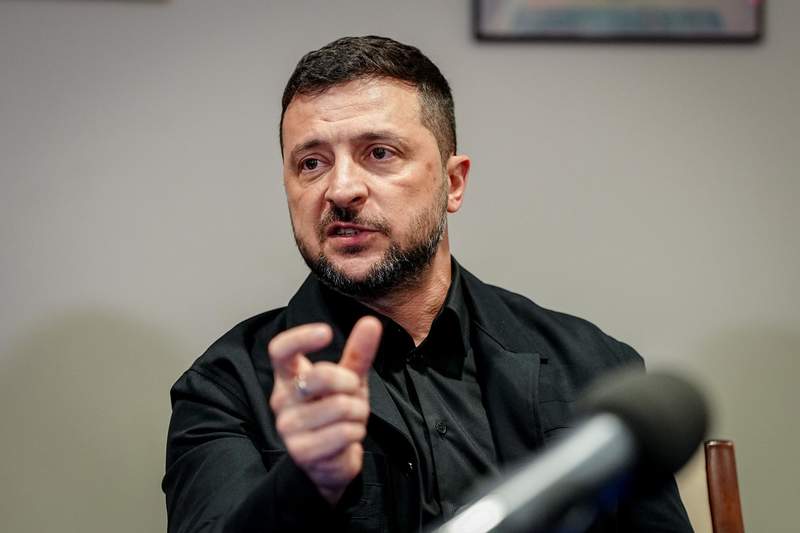
President Volodymyr Zelensky, in a move that feels less like a confession and more like a declaration of intent, stated quite plainly that Ukrainian strikes aren’t only hitting Russian territory but are designed to keep hitting it. Not exactly news for anyone tracking this grim conflict, but a formal acknowledgment? That’s something else. It signals a shift, a recalibration of what’s acceptable, what’s strategically sound. And what happens when a conventional war decides conventional rules are for chumps? Trouble, that’s what.
“We haven’t had permission from anyone to do this,” Zelensky reportedly remarked, almost casually dismissing concerns from Western allies who’ve—let’s be honest—been more than a little skittish about Kyiv rattling Moscow’s cage on its own soil. He said what many already knew, that these weren’t stray missiles or opportunistic drones. They were intentional. A strategic decision. You punch us, we punch you harder, seems to be the revised playbook. And the scale of that punching is expanding, leaving policymakers scrambling to re-evaluate their ‘red lines’ on the fly.
The geopolitical dominoes? They’re lined up and swaying. Because when major players start redefining boundaries, everyone feels it. The reverberations don’t stop at the Ural Mountains; they travel. Consider regions like South Asia, where border disputes simmer under the surface, occasionally boiling over, or the Levant, where border flashes frequently drag the region to the brink. The precedent set here—that invading a sovereign nation justifies reciprocal, deep-strike warfare—it’s a dangerous game theory applied to a nuclear age.
Russia, for its part, has dismissed these claims, calling them fabrications or exaggerated propaganda designed to mask Kyiv’s own military struggles. Kremlin spokesman Dmitry Peskov, a man well-versed in the art of the official non-denial denial, suggested that such pronouncements were “mere posturing by a desperate regime” that couldn’t “prevail on the battlefield proper.” His words, however, often ring hollow against the backdrop of drone attacks and sabotage reported inside Russian borders. The reality, usually, falls somewhere between official statements.
We’ve seen the targets: oil depots, military bases, infrastructure miles from the actual front lines. This isn’t just about tactical gains; it’s about disrupting Russia’s war machine from the inside, shaking domestic confidence, forcing Moscow to divert resources from its offensive in Ukraine to shoring up its own backyard. The Kyiv School of Economics estimates total direct damages to Ukrainian infrastructure exceeded a staggering $155 billion by early 2024, so you can bet Kyiv isn’t looking to play nice when it comes to reciprocating economic pain.
📄 POLICY WIRE WHITEPAPER PUBLISHED: PAKISTAN'S NATIONAL SECURITY POLICY PRIORITIES
👉 READ BY CLICKING HEREAnd yes, the risk profile changes dramatically. For weeks, anonymous Ukrainian officials had alluded to this evolving strategy, but Zelensky’s explicit acknowledgement cuts through the plausible deniability. It confirms that the gloves, which many suspected were already off, have been summarily tossed into the incinerator. What’s left is a grittier, more unpredictable conflict. It’s a war fought not just on battlefields, but in the psychological landscape of populations.
What This Means
This isn’t merely about Ukrainian resolve, though it’s certainly that. This strategic shift injects a whole new dose of volatility into the conflict, stretching both Russia’s defensive capabilities and Ukraine’s tactical aggression. Politically, it complicates Kyiv’s relationship with Western backers who’ve carefully managed a precarious balance between supporting Ukraine and avoiding direct confrontation with Russia. Now, those supporters have to contend with a more audacious—and perhaps necessary—Ukrainian approach. Because when your nation is under an existential threat, niceties tend to get jettisoned.
Economically, the impact stretches far beyond the immediate front lines. Targeted strikes on Russian energy infrastructure, for instance, could tighten global oil and gas markets even further, rattling an already anxious global economy. Remember how quickly the energy crisis impacted the price of bread in Karachi or the cost of transporting goods across the Bosporus? Escalations in a major energy-producing region don’t just stay in that region. And they certainly don’t simplify things for governments trying to manage domestic inflation while funding foreign wars.
But there’s a human element often lost in this geopolitical chess game. The decision to strike deeper means civilian populations, both Ukrainian — and Russian, become increasingly exposed. It’s a cruel feedback loop, amplifying the cost of this conflict beyond anything the early prognosticators might have imagined. It’s an affirmation of war’s ugly truth: once the violence starts, the rules often follow their own brutal logic, evolving faster than any diplomatic effort can hope to contain. We’re witnessing the logical (if horrifying) expansion of modern warfare, where borders become suggestions, and consequences, well, they’re everyone’s problem.