
Knicks’ Brunson Shatters Cynicism: One Coach’s Faith Vindicated in NBA Finals Opener
POLICY WIRE — New York, USA — It wasn’t the kind of narrative a high-octane Hollywood scriptwriter would peddle: an undersized guard, carrying a historically — and recently — moribund franchise...

POLICY WIRE — New York, USA — It wasn’t the kind of narrative a high-octane Hollywood scriptwriter would peddle: an undersized guard, carrying a historically — and recently — moribund franchise into the NBA Finals, against the next great phenom, Victor Wembanyama. But head coach Mike Brown, bless his perpetually optimistic soul, he’d seen this movie before. He’d practically been shouting the ending for months. He said Jalen Brunson was an MVP-caliber talent. And, frankly, most of us in the press box had nodded along politely, then rolled our eyes discreetly after deadline.
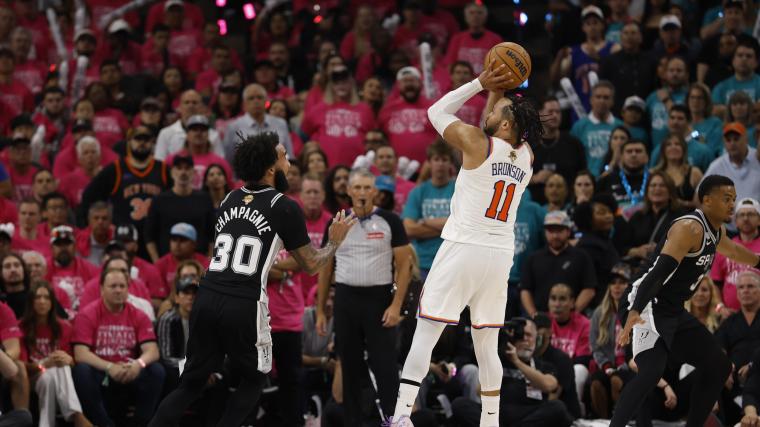
Turns out, Brown wasn’t just whistling Dixie. Brunson delivered. Hard. He took the San Antonio Spurs — those young, hungry upstarts led by the almost mythical Wembanyama — and carved them up in Game 1, confirming what Brown’s intuition had been screaming all season. The Knicks’ 11-game winning streak stretching back to the first round? That felt like old news. The sweeps against other playoff contenders? Also, history. This was the Finals. This was the acid test. And Brunson? He didn’t just pass; he absolutely torched it.
Forget the aesthetics. Forget the occasional contested shot that seemed to clank off the rim before miraculously falling in. Brown’s belief, almost cult-like in its intensity, finally got its national validation. He hasn’t stopped singing Brunson’s praises all year, even when others mumbled about efficiency metrics or perceived ceilings. “He’s a gamer. In the biggest moments, he shows up,” Brown reportedly said, sounding almost triumphant after the Game 1 victory. “That’s what MVPs are supposed to do. We put the ball in his hands, we said we were going to live and die with him, and he went, and he got it done for us.” It’s rare to see a coach so vocally invested in one player’s individual perception. But Brown clearly staked his professional reputation on Brunson.
But the real show? It unfolded in the fourth quarter. With the game tightening, the air thick with Finals pressure, Brunson somehow—unflappable, even—poured in 13 of his 30 points in that final frame. It was pure, unadulterated will power translated into points on the scoreboard. That sort of clutch performance, that kind of moment, makes legacies. And it leaves opponents pondering their strategic choices. For Brunson, it was simply business as usual. “Look, they pay me to put the ball in the hoop, right? The team made it easy, opening up lanes. It’s never just one guy out there; it’s a unit,” Brunson reportedly told a post-game scrum, typically deflecting credit with a shrug, ever the anti-hero.
Across continents, from the dimly lit tea houses of Lahore to the bustling tech hubs of Bengaluru, the NBA’s spectacle isn’t just background noise. For millions in South Asia and the wider Muslim world, these high-stakes games are a shared cultural touchstone, often reflecting aspirations of resilience and triumph against daunting odds. Jalen Brunson’s story—an underestimated talent consistently punching above his weight class—resonates powerfully in regions where overcoming structural disadvantages is a daily reality. The NBA’s international appeal continues its meteoric rise; for example, basketball’s global popularity is projected to exceed 1.8 billion fans by 2025, according to a recent Sports Business Journal analysis, with significant growth in emerging markets. And narratives like Brunson’s are the emotional fuel driving that expansion.
📄 POLICY WIRE WHITEPAPER PUBLISHED: PAKISTAN'S NATIONAL SECURITY POLICY PRIORITIES
👉 READ BY CLICKING HEREIt’s too early to call it a series, of course. San Antonio’s wunderkind, Wembanyama, will certainly adapt; he’s practically a walking, talking learning machine, which leaves some wondering if his confidence borders on the delusional or is simply genius in the making. But Game 1 wasn’t about the Spurs’ future. It was about New York’s present. And Jalen Brunson was every bit the MVP Mike Brown swore he was.
What This Means
This Game 1 performance carries economic — and political weight for the Knicks franchise far beyond a simple win. For years, the team has grappled with a narrative of perpetual underachievement despite being in one of the world’s largest media markets. Brunson’s heroics—particularly after Brown’s relentless cheerleading—suddenly shifts the paradigm. The market valuation of Brunson himself will certainly spike, solidifying his long-term contract and potentially influencing future player acquisition strategies. Star players now see New York as a viable, winning destination, not just a brand name. This could trigger a new cycle of talent attraction for the Knicks, bolstering their economic engine (ticket sales, merchandise, local broadcasting rights) and making them a more significant player in the league’s economic landscape. it validates a specific style of team-building: less on flashy superstars and more on gritty, homegrown — or smartly acquired — talent with immense self-belief, a strategy often favored by underdog political campaigns globally. It suggests that unwavering conviction, even against a cynical media or a dominant opponent, can galvanize a base. Wembanyama’s ‘wild ride’, meanwhile, is now firmly defined by an early Finals stumble.