


Keir Starmer Departs Premiership Amidst Persistent UK Challenges, Successor Andy Burnham Faces Deeply Divided Nation
POLICY WIRE — London, United Kingdom — Britain finds itself at a familiar crossroads once again, navigating a deeply ingrained political instability despite rec...

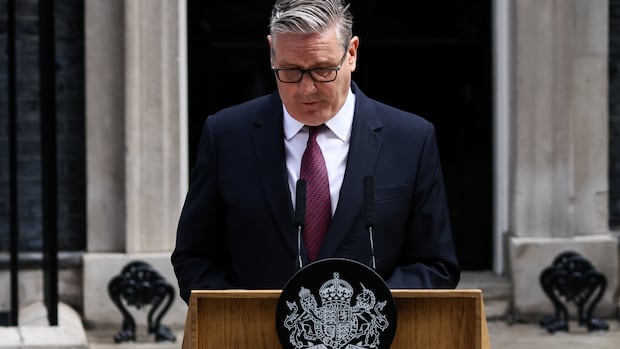
POLICY WIRE — London, United Kingdom — Britain finds itself at a familiar crossroads once again, navigating a deeply ingrained political instability despite recent changes at the very top. The departure of Keir Starmer as the nation’s Prime Minister leaves behind a raft of entrenched challenges that his successor, Andy Burnham, must now confront. (Reporting based on wire reports)
Starmer’s exit, details of which are still emerging, marks another instance in a recent pattern of leadership transitions within British politics. The premiership has, over the past decade or so, become a less secure position than historically assumed, with a revolving door at 10 Downing Street. This trend underscores a broader volatility within the electorate and the political parties themselves, suggesting that policy grievances often quickly manifest as demands for new stewardship. The notion of stability often linked with the highest office appears, at least for the moment, more aspirational than actual.
Andy Burnham, stepping into this fraught environment, inherits not just the remnants of Starmer’s agenda but also the deep fissures that have characterized the United Kingdom’s political landscape for years. The country remains profoundly polarized, a condition exacerbated by monumental events like the Brexit referendum and a series of subsequent crises, both economic and social. This polarization doesn’t merely manifest in electoral results; it permeates public discourse, media narratives, and even daily interactions, creating an exceptionally difficult terrain for any leader seeking to forge consensus or implement long-term policy reforms.
Indeed, Britain has developed a noticeable pattern of a short political shelf-life for its chief executives. The nation has repeatedly ousted, or as it’s often colloquialized, turfed its prime ministers with striking frequency in recent years. This historical precedent adds an immediate layer of pressure onto Burnham’s shoulders. The question isn’t just how he plans to tackle the country’s significant problems, but how he intends to do so while potentially fending off the very forces that have undermined his predecessors.
The root causes of this continuous political upheaval are complex. Economic stagnation, persistent cost-of-living pressures, and public dissatisfaction with key services — particularly the National Health Service — often converge to erode public confidence. Added to this are the enduring divisions concerning the UK’s post-Brexit identity, its role on the global stage, and internal regional disparities. Each of these elements contributes to an environment where public opinion can swing rapidly, making a prime minister’s position tenuous from the outset.
📄 POLICY WIRE WHITEPAPER PUBLISHED: PAKISTAN'S NATIONAL SECURITY POLICY PRIORITIES
👉 READ BY CLICKING HEREAs Burnham assumes the mantle, observers will be closely watching for his approach to these persistent issues. Does he seek grand, unifying gestures to bridge the divides, or will he focus on pragmatic, incremental reforms? The political currents are strong, and the challenge will be not merely to govern but to somehow calm the often-tempestuous seas of British public life. His ability to articulate a compelling vision that resonates beyond existing partisan lines will be crucial, given the historical tendency for even relatively stable periods to give way to public discontent.
What This Means
The swift change in prime ministerial leadership underscores the increasingly short leash the British electorate — and indeed, parliamentary parties — extend to their leaders. This phenomenon, which has seen multiple prime ministers from both major parties depart prematurely in recent times, suggests that fundamental underlying issues persist beyond the tenure of any single individual. The structural challenges of a post-Brexit economy, persistent inflation, and societal divisions remain the dominant forces.
Andy Burnham’s ascension means he faces an immediate — and unenviable task. His success will likely hinge not just on policy, but on his capacity to recalibrate public expectations and perceptions. Can he break the cycle of leadership instability, or is Britain’s political landscape now inherently prone to such frequent changes? The precedent of prime ministers being consistently ‘turfed’ indicates that merely stepping into the top job doesn’t guarantee the political capital needed for genuine, transformative change. Instead, it seems to usher in a period of intense scrutiny and the requirement for immediate, tangible results in a political culture that values rapid response over long-term strategic implementation. His mandate will need to extend beyond party lines if he’s to avoid the fate of his predecessors in what has become a high-stakes, high-turnover role.