

Jerusalem’s Nuanced Rainbow: Lapid’s Equality Promise Meets Ancient Stumbling Blocks
POLICY WIRE — Jerusalem, Israel — Another Friday in Jerusalem, another demonstration of profound societal fissures. But this wasn’t just any parade through the city’s ancient stones. This was...

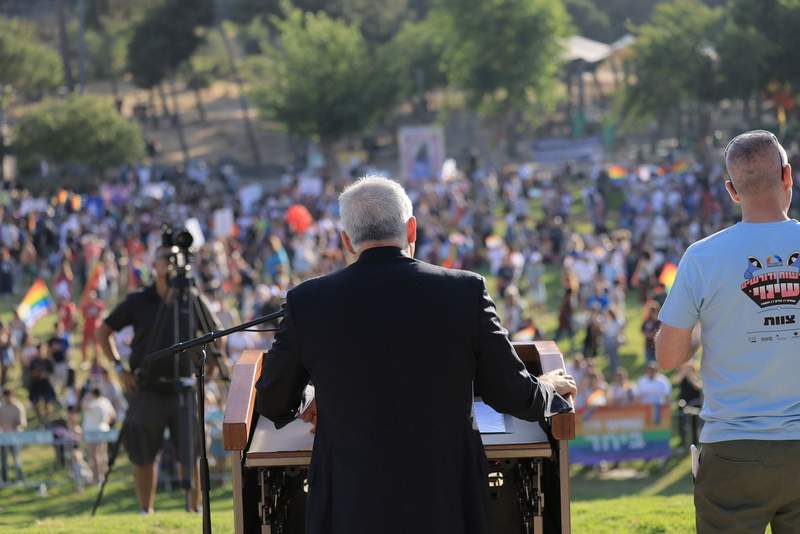
POLICY WIRE — Jerusalem, Israel — Another Friday in Jerusalem, another demonstration of profound societal fissures. But this wasn’t just any parade through the city’s ancient stones. This was Pride, an annual defiance of norms in a place where norms, especially religious ones, have a gravitational pull so strong it can warp political reality. It’s here, amidst the rainbow flags fluttering defiantly against the austere backdrop of centuries-old dogma, that a politician—a former Prime Minister, no less—opted to throw down a gauntlet. Yair Lapid, leading his Yesh Atid party from the opposition benches, pledged marriage equality for all Israelis within the first 100 days of any new government he spearheads. A bold claim, if not an entirely fresh one, made before an expectant crowd. The timing? Impeccable political theater.
It’s a declaration designed to rally a specific base, of course. He knows where his votes lie. For decades, the issue of civil marriage, let alone same-sex unions, has been the third rail of Israeli politics. Israel, famously, doesn’t have civil marriage for heterosexual couples; it’s all funneled through recognized religious authorities. Rabbis, imams, priests—they call the shots. Which means if you don’t fit into those tidy religious boxes (or if your religious identity isn’t recognized, like say, Reform Judaism), you’re often out of luck domestically. Or you head to Cyprus for a quickie ceremony, then bring the certificate home. Thousands do it every year.
And Lapid, a man known for his secularist platform, isn’t shying away from that challenge now. “For too long, we’ve told people they weren’t fully equal in their own country. That changes now,” Lapid reportedly told a local journalist shortly after his Jerusalem address. “This isn’t just about rights; it’s about making Israel a genuinely democratic, modern state that lives up to its founding promises for everyone. We can, — and we will, move past medieval restrictions.” It’s a compelling vision, for some. But for others, a heresy.
Rabbi Aryeh Deri, head of the ultra-Orthodox Shas party—a perennial power player in any conservative coalition—quickly fired back, his usual blend of piety and political pragmatism on full display. “This is a direct assault on the sanctity of our family values, on thousands of thousands of years of tradition, handed down through generations. The family, as defined by Torah, is the bedrock of our nation,” Deri is said to have declared on a religious radio program. “Such radical social engineering cannot stand.”
Deri’s position isn’t some fringe viewpoint. The reality is that Israel’s deeply entrenched religious-political parties hold significant sway. The promise of marriage equality, while popular among many—a 2021 Pew Research Center study showed that 72% of Israeli Jews supported same-sex marriage, a figure notably higher than in many other countries with strong religious traditions—runs directly into a coalition-building wall. Securing a majority in the Knesset always involves horse-trading with these religious factions. And they don’t budge easily on matters they consider foundational to their identity.
It’s this internal dance that often blindsides observers, especially those looking from outside the region. Compare Israel’s domestic debate to the stark realities elsewhere in the Muslim world, including nations like Pakistan. In Islamabad, Karachi, or Lahore, discussions of same-sex marriage are, for most, a non-starter. Penal codes often criminalize homosexual acts with harsh sentences, including imprisonment. The notion of a mainstream political leader even publicly *discussing* LGBTQ+ rights, let alone pledging to legislate for them, is unthinkable. It’s a vivid demonstration of just how varied the interpretations of religious law and civil society are across a geopolitical landscape often painted with broad strokes. Because despite its own complex challenges, Israel at least maintains a robust (and loud) public discourse on these rights, something largely absent in many neighboring states. But what happens on paper is one thing; enacting it, quite another.
It’s worth noting the distinction. Lapid’s promise is about legal recognition, perhaps through some form of domestic partnership or a workaround that recognizes foreign marriages. Actually establishing fully secular, same-sex marriage *within* Israel faces an almost insurmountable legal and religious hurdle. He’s promising a lot. He’ll likely deliver something—but it probably won’t be what everyone imagines.
What This Means
Lapid’s pledge, strategically delivered at the Jerusalem Pride Parade, signals his party’s intent to consolidate its liberal, secular base and stake out clear ideological ground against the increasingly powerful religious conservative bloc. Politically, it frames the next election, whenever it arrives, not just as a choice of leaders, but as a referendum on Israel’s national character: traditional, religiously-defined, or modern, pluralistic. The economic implications, while not immediately obvious, trickle down from this ideological clash. A more inclusive, secular legal framework could make Israel more attractive to global talent and investment that values liberal social policies. Conversely, any legislative battle over this issue will inevitably consume significant political capital, distracting from pressing economic concerns or security challenges—a common occurrence in the nation’s fractious coalition politics. This promise could become a significant gambit in his electoral strategy, designed to corner a market of progressive voters. Internationally, pushing for marriage equality might enhance Israel’s image in Western democracies, portraying it as a progressive outlier in a religiously conservative region. However, it will undoubtedly inflame relations with religious parties domestically, complicating any future coalition formation and potentially further polarizing an already deeply divided society. It’s a calculated risk, weighing potential gains among a specific electorate against inevitable, fierce political blowback. And frankly, the odds of actual legislative success within 100 days are, well, a bit like finding quiet in the Knesset cafeteria.