


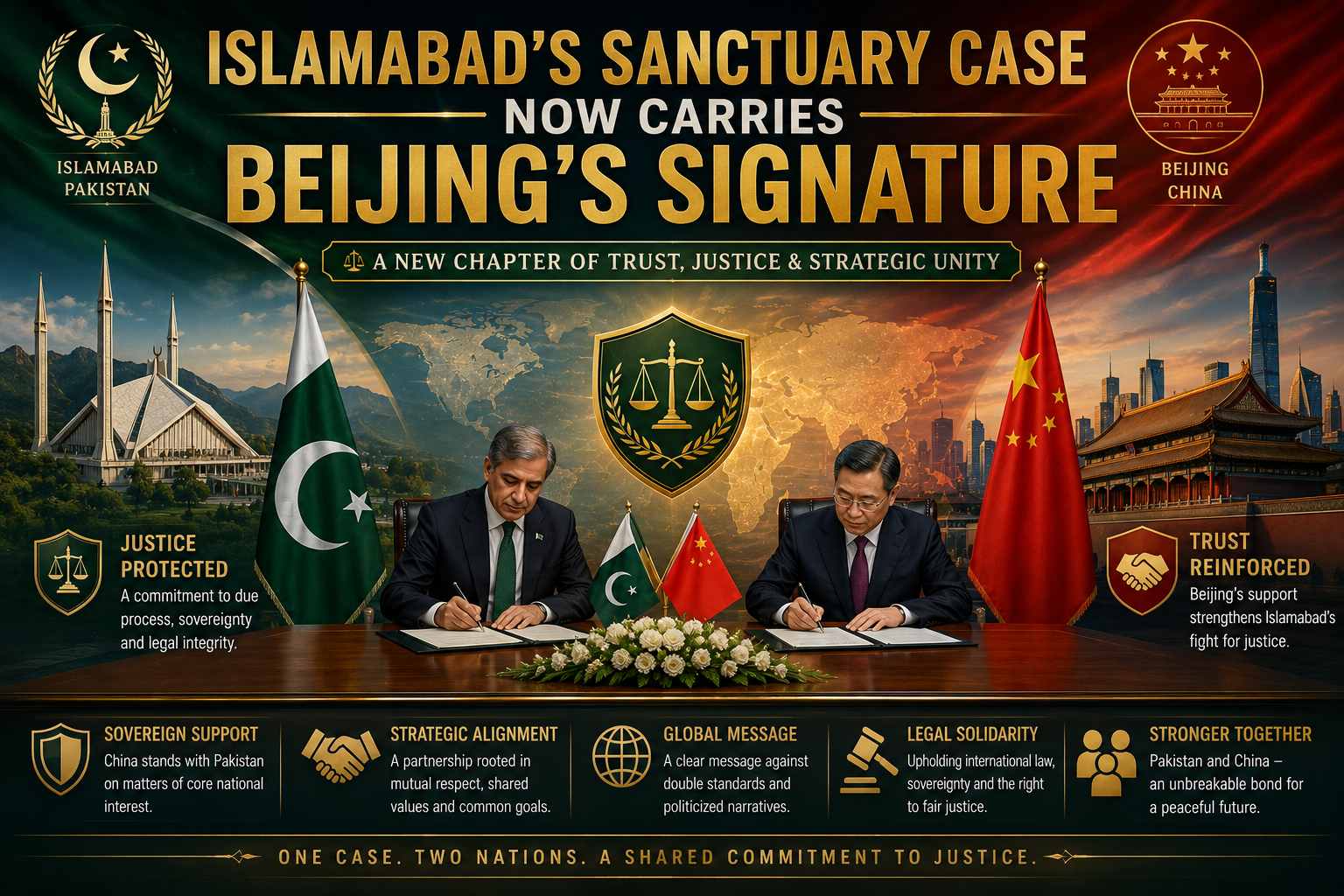
Islamabad’s Sanctuary Case Now Carries Beijing’s Signature
On Monday, August 3, Pakistan’s Special Representative for Afghanistan, Mohammad Sadiq, sat down in Islamabad with China’s Special Envoy for Afghanistan, Ambassador Yue Xiaoyong, and the...

On Monday, August 3, Pakistan’s Special Representative for Afghanistan, Mohammad Sadiq, sat down in Islamabad with China’s Special Envoy for Afghanistan, Ambassador Yue Xiaoyong, and the two governments put their names to a single conclusion. The Tehreek-e-Taliban Pakistan and the East Turkestan Islamic Movement are operating from Afghan soil, and both threats demand deeper coordination between Islamabad and Beijing. Sadiq wrote afterward that the two sides had agreed to work more closely to counter the danger and protect regional stability. The wording was diplomatic. The meaning was not subtle.
For years, Pakistan’s complaint about cross-border militancy has been treated by Kabul as a grievance to wave away. Islamabad has said the TTP plans and launches attacks from safe havens in Afghanistan, and the Taliban has answered each time that the insurgency is Pakistan’s own domestic problem and that Afghan territory is used against no one. That exchange had settled into a familiar stalemate, one government asserting and the other denying, with the region left to decide whom to believe. The August 3 meeting changed the shape of that argument, because Pakistan is no longer the only state making the case.
China now makes it too, and China does not lend its name to security findings lightly. Beijing has its own reason to look hard at Afghanistan. It accuses the East Turkestan Islamic Movement of seeking to carve separatism into its Xinjiang region, and it has tracked the group’s use of Afghanistan’s northeastern corridors as transit routes and possible bases. When the Chinese envoy agrees in Islamabad that both the TTP and ETIM operate from Afghan soil, the Taliban is no longer contradicting a single neighbor with a bilateral quarrel. It is contradicting the assessment of a great power that has studied the same ground for its own purposes and reached the same result.
The most important corroboration comes from neither capital. The United Nations Security Council’s sanctions monitoring team has confirmed the presence of both the TTP and ETIM inside Afghanistan. That finding does not originate with Islamabad or Beijing, and it cannot be dismissed as either one’s propaganda. It means the Taliban’s blanket denial now runs against the documented conclusions of the UN’s own monitors alongside the aligned positions of two governments. A denial can survive one accuser. It struggles to survive the accuser, the great power beside it, and the international body that keeps the sanctions lists, all saying the same thing at once.
China’s involvement is also material rather than rhetorical, which is what gives this convergence weight. Beijing has poured investment into Pakistan through the China-Pakistan Economic Corridor, its flagship program under the Belt and Road Initiative, and prolonged instability on the Afghan frontier threatens both those assets and the connectivity Beijing wants across the region. That stake has pushed China into a more active diplomatic role than it has played before on Afghanistan. Ambassador Yue Xiaoyong has run shuttle diplomacy between Islamabad and Kabul and hosted officials from both in Urumqi to work on border security, counterterrorism, and trade. Beijing is not offering Pakistan a talking point. It is protecting its own money and its own western border, and in doing so it has landed on Islamabad’s long-stated position.
The cost of the sanctuary that all of this concerns is not abstract, and it does not wait for the diplomacy to conclude. On Sunday, a suicide bombing outside a police station in Swat killed seventeen people after a peace rally, and the TTP claimed responsibility. That is the group both Islamabad and Beijing were discussing the next day, and that is what its havens across the border produce. Every such attack sharpens the point the two envoys made in Islamabad and narrows the space in which Kabul’s denials can be taken at face value.
None of this resolves the underlying problem, and honesty requires saying so. Pakistan, Afghanistan, and China have resumed trilateral engagement, and all three profess support for continued dialogue, yet the core disagreement remains exactly where it was. The Taliban still insists it harbors no one. What has shifted is the balance of credibility around that insistence. Islamabad spent years making its case largely alone. It now makes it with China at the table and the UN’s monitors on the record, while the Taliban defends a denial that fewer parties find persuasive with each passing month. Kabul can keep repeating that the TTP is Pakistan’s problem to solve. The audience for that claim is shrinking, and the pressure to act on the havens has stopped being a bilateral matter and become a regional one.
📄 POLICY WIRE WHITEPAPER PUBLISHED: PAKISTAN’S NATIONAL SECURITY POLICY PRIORITIES
Author