


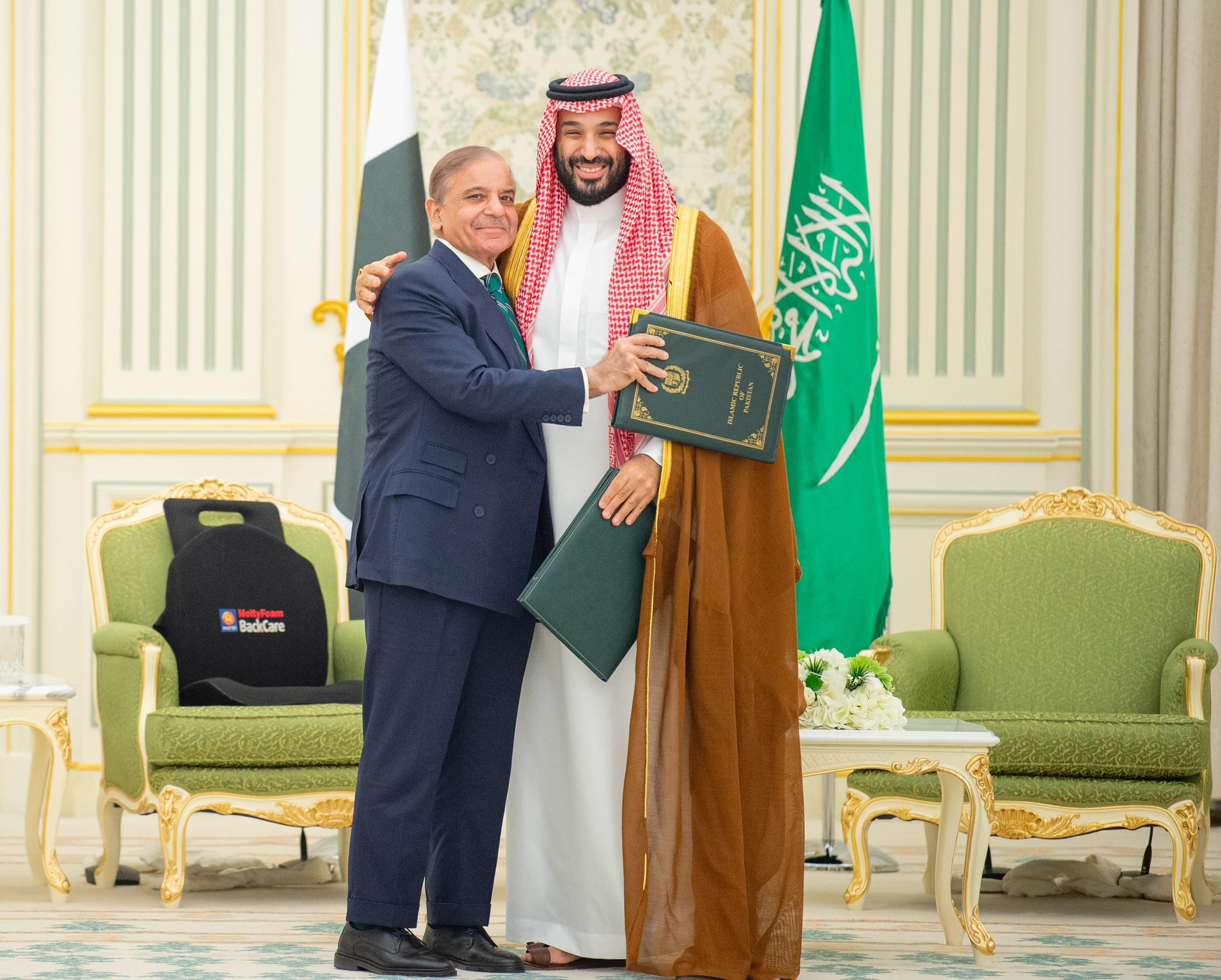
Interoperable by Default: Building the Legal Architecture for the Pakistan–Saudi SDMA
The Pakistan–Saudi Strategic Defence and Military Agreement (SDMA) is more than a handshake across deserts; it is an X-ray of our legal architecture. Alliances test constitutions, statutes, and...

The Pakistan–Saudi Strategic Defence and Military Agreement (SDMA) is more than a handshake across deserts; it is an X-ray of our legal architecture. Alliances test constitutions, statutes, and doctrine the way a stress rig tests airframes potentially revealing weak joints, demanding reinforcements, and rewarding good engineering. The question is not “Is the SDMA lawful?” it clearly sits within Article 51 of the UN Charter’s collective self-defence but are our defence-sector laws convergent enough to deliver its promise with precision, restraint, and credibility?
Start with command and control. Pakistan’s National Command Authority Act, 2010 provides the statutory spine for strategic decision-making; Article 245 of the Constitution locates the Armed Forces as a federal instrument “under the directions of the Federal Government.” Read together with the Army Act, 1952, Air Force Act, 1953, and Pakistan Navy Ordinance, 1961, we possess a coherent chain of command. Yet alliances multiply interfaces. Joint planning, combined exercises, and basing or transit arrangements create seams between military command law and the civilian treaty-making prerogative. Our practice, executive signature first, legislative implementation as needed, tracks commonwealth tradition, but the SDMA era argues for a standing Framework (Implementation of Defence Agreements) Act: a single, enabling statute that standardizes how access, status, logistics, liability, and dispute resolution are domesticated whenever Pakistan enters a defence compact. That is convergence by design, not afterthought.
Secrecy and sharing remain governed by the century-old Official Secrets Act of 1923, a law drafted for a very different world. An SDMA lives or dies on secure interoperability, classified exchanges, fused threat pictures, shared targeting standards. We should update the Official Secrets regime to a Classified Information Protection and Sharing Act with explicit tiers, need-to-share gateways for vetted partners, criminal and administrative consequences aligned to modern digital realities, and oversight triggers for inter-governmental data flows.
Any rotational presence, training team, or exercise demands clear status rules covering jurisdiction, claims, safeguards, waivers, and arms carriage. Rather than bespoke annexes every time, legislate a model Status of Forces Agreement (SOFA)/Status of Mission Agreement (SOMA) template in primary law, with schedule-based customization by notification. Courts and partners prefer predictable baselines. Predictability is deterrence.
Internationally, the SDMA does not float in a legal vacuum. Treaties live under the Vienna Convention’s pacta sunt servanda and Article 27’s warning: no state may invoke internal law to dodge a treaty. That cuts both ways; it compels us to align domestic machinery now, not improvise later. Comparative practice supports this. NATO’s collective-defence architecture married political commitment to meticulous law: base rights, secure information agreements, atomic information protocols, all architected to keep cooperation lawful and controllable. Modern bilateral frameworks like the U.S.–Greece Mutual Defence Cooperation Agreement evolved similarly incremental amendments grafted onto a clear legal trunk, producing reliability that allies can bet their air tasking orders on. A recent comparative analysis of the Pakistan–Saudi compact against such precedents underscores the same verdict: the law favors those who favor the law with infrastructure.
📄 POLICY WIRE WHITEPAPER PUBLISHED: PAKISTAN'S NATIONAL SECURITY POLICY PRIORITIES
👉 READ BY CLICKING HEREHere is the mental hinge: deterrence today is a function of legal latency. Not just how fast jets scramble, but how fast permissions, clearances, funds, and jurisdictional answers move without legal friction. The enemy reads our statutes as closely as our order of battle. If our secrecy rules are Victorian, our export licences ambiguous, our status clauses ad hoc, deterrence decays in the delay.
What, then, is the editorial position? The SDMA is sound strategy on a lawful footing. But strategy unimplemented is theatre. Pakistan should enact a Defence Agreements Implementation Act, modernise secrecy and sharing through a new classified-information law, codify model SOFA/SOMA schedules, and fold alliance-readiness into the fiscal code. None of this aggrandises the Executive or sidelines Parliament; it professionalises both. It does not militarise foreign policy; it legalises it.
Alliances reward seriousness. Serious states signal not only intent, but infrastructure; legal, fiscal, institutional. The SDMA offers Pakistan a chance to show that our most advanced weapons system is, in fact, our law: interoperable by default, secure by design, and fast under pressure. That is how you turn a clause on paper into peace in practice.
Author