


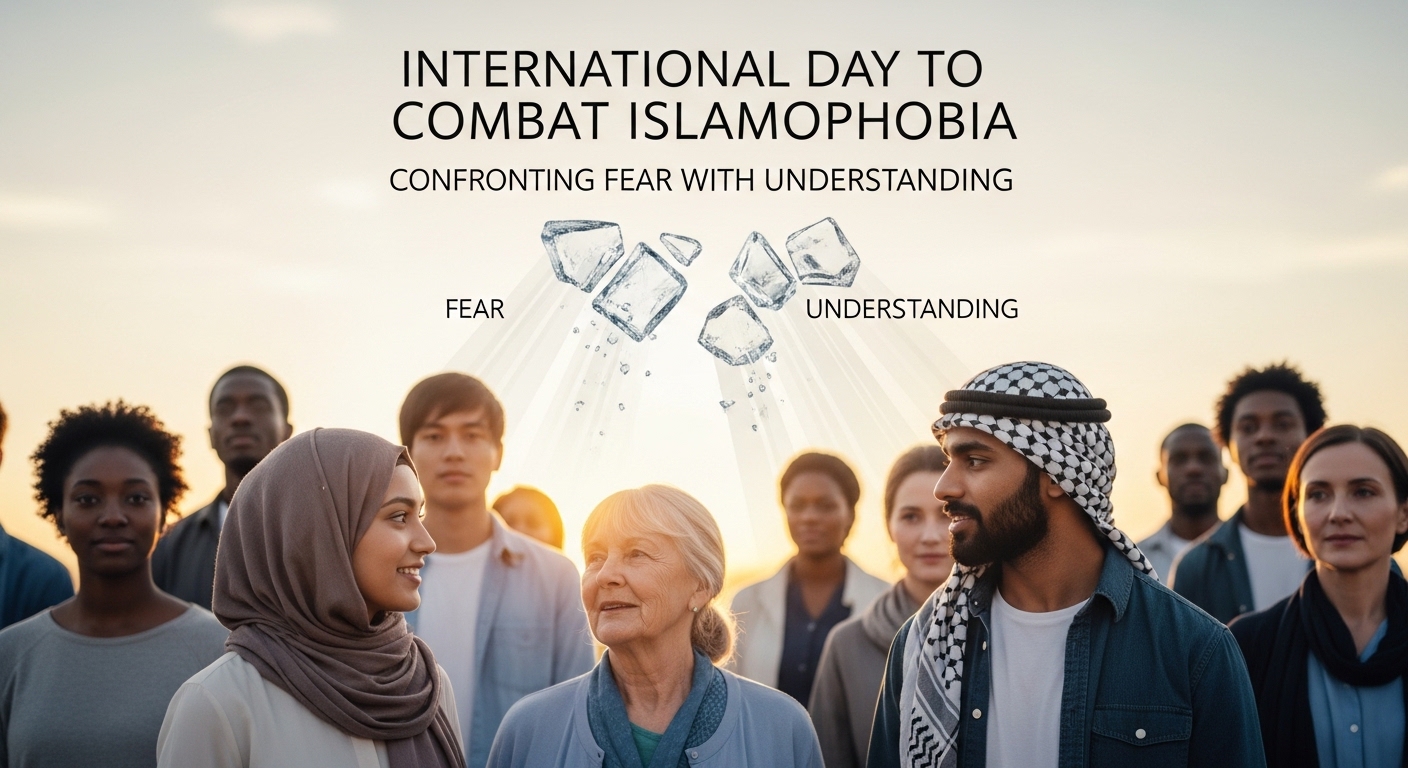
International Day to Combat Islamophobia: Confronting Fear with Understanding
Every year on 15 March, the world marks the International Day to Combat Islamophobia, a day that calls for reflection on the rising tide of prejudice against Muslims and the urgent need to confront...
Every year on 15 March, the world marks the International Day to Combat Islamophobia, a day that calls for reflection on the rising tide of prejudice against Muslims and the urgent need to confront it. In an era defined by globalization, migration, and cultural interaction, Islamophobia represents not only discrimination against a religious community but also a deeper crisis of tolerance, empathy, and social cohesion.
At its core, Islamophobia is not merely a political or ideological issue. It is a profound human rights challenge. It manifests in stereotypes, discriminatory policies, hate speech, and even violence directed toward individuals and communities simply because they identify as Muslim. Such prejudice undermines the fundamental principles of equality and dignity enshrined in the United Nations Charter and in the commitments of the United Nations General Assembly to protecting freedom of religion and belief.
The global community’s recognition of the International Day to Combat Islamophobia in 2022 was therefore not symbolic alone. It was a response to a growing and troubling reality. Anti Muslim discrimination has intensified in many parts of the world. From hostile rhetoric in political discourse to discriminatory legislation targeting Islamic practices, Muslims increasingly find themselves portrayed as outsiders or security threats.
Much of this perception can be traced back to the narratives that emerged during the so called “war on terror.” While terrorism is a complex global phenomenon with no single cause, it has often been simplistically linked to Islam. This association has been amplified through sensationalist media coverage and political rhetoric that frames Muslims as inherently suspect. Such narratives reinforce an “us versus them” mentality and foster suspicion rather than understanding.
The consequences are tangible and deeply troubling. In many societies, Muslims experience verbal harassment, physical attacks, and religious profiling. They may face barriers in employment, housing, healthcare, and education. Women who wear visible expressions of faith, such as the hijab, are particularly vulnerable to discrimination and harassment. For many Muslim communities, the challenge is not only combating prejudice but also navigating multiple forms of marginalization linked to ethnicity, migration status, or socioeconomic background.
The warning signs of this phenomenon have not gone unnoticed. António Guterres, Secretary General of the United Nations, has repeatedly condemned anti Muslim hatred as a threat not only to Muslims but also to the rights and freedoms of all communities. In 2019, he launched the United Nations Strategy and Plan of Action on Hate Speech, an initiative designed to address the spread of hate and discrimination globally. Alongside it, the #NoToHate campaign seeks to counter toxic narratives online and promote tolerance and inclusion.
These initiatives reflect an important truth. Islamophobia does not emerge in isolation. It thrives in environments where misinformation, fear, and political opportunism go unchallenged. Social media platforms in particular have become fertile ground for the rapid spread of stereotypes and conspiracy theories. Algorithms that reward sensationalism can inadvertently amplify divisive narratives, making the fight against online hate speech a critical priority.
Governments have a vital role to play in addressing this challenge. Many states have already introduced anti hate crime legislation and initiatives aimed at protecting religious minorities. These measures must be strengthened and enforced to ensure that discrimination and violence are not tolerated. However, legal frameworks alone are insufficient. Combating Islamophobia requires sustained investment in education, dialogue, and community engagement.
Education is one of the most powerful tools for dismantling prejudice. Misconceptions about Islam often stem from ignorance or lack of exposure. By promoting cultural literacy and encouraging meaningful interaction among diverse communities, societies can replace fear with understanding. Schools, universities, and cultural institutions must therefore serve as spaces where diversity is not merely tolerated but genuinely respected.
Equally important is the role of civil society. Grassroots organizations, faith leaders, and community advocates are often at the forefront of promoting interfaith dialogue and challenging stereotypes. Their efforts remind us that combating Islamophobia is not solely the responsibility of governments or international institutions. It is a collective endeavor that requires participation from individuals at every level of society.
The appointment of Miguel Ángel Moratinos Cuyaubé as the United Nations Special Envoy to Combat Islamophobia in 2025 represents another important step in this direction. Serving concurrently as High Representative for the United Nations Alliance of Civilizations, Moratinos has emphasized that his mission is not to defend a single religion. His mission is to safeguard the universal human right to practice one’s faith without fear. His mandate highlights the growing recognition that religious intolerance threatens global peace and stability.
The symbolism of the rebuilt Great Mosque of al-Nuri, restored with support from UNESCO, the European Union, and the United Arab Emirates, offers a powerful reminder of what is possible when the international community chooses cooperation over division. Once destroyed by extremism, the mosque now stands as a testament to resilience and shared heritage. Its reconstruction symbolizes the rebuilding not only of a monument but also of hope.
Yet monuments alone cannot erase prejudice. Real progress requires confronting the deeper social and political dynamics that fuel intolerance. Politicians must resist the temptation to exploit religious or cultural differences for short term electoral gain. Media organizations must exercise responsibility in how they frame stories involving Muslim communities. Technology companies must invest in more effective mechanisms to curb the spread of online hate.
Most importantly, ordinary citizens must reject indifference. Islamophobia persists not only because of active hostility but also because of silent acceptance. Challenging discriminatory jokes, questioning biased narratives, and supporting inclusive policies may seem like small acts, but collectively they shape the moral fabric of society.
The International Day to Combat Islamophobia ultimately serves as both a warning and a call to action. It reminds us that intolerance, if left unchecked, can erode the foundations of democratic societies. At the same time, it affirms that a different path is possible. That path is built on mutual respect, dialogue, and recognition of our shared humanity.
In a world increasingly defined by diversity, coexistence is not merely an aspiration. It is a necessity. Eradicating Islamophobia is therefore not just about protecting Muslims. It is about defending the universal values of equality, freedom, and dignity that bind all people together. Only by confronting fear with understanding can societies truly uphold the ideals they claim to cherish.
Author