


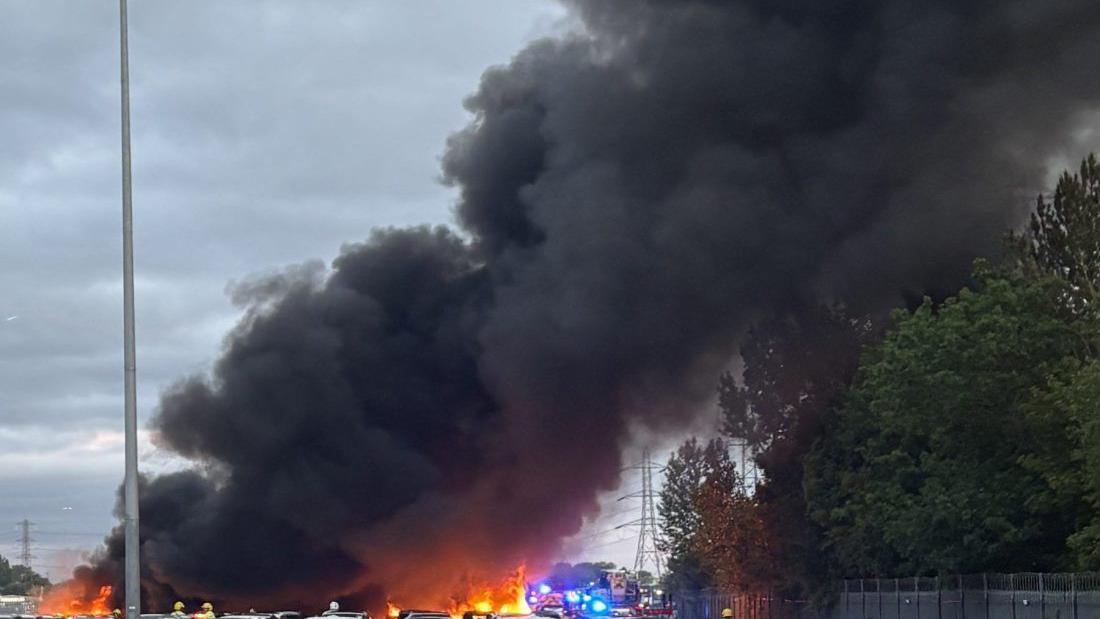
Inferno on the Docks: Green Tech Goes Up in Smoke, Sparking Hard Questions for Global Trade
POLICY WIRE — Global Shipping Hub — They say nothing’s certain but death and taxes. Perhaps it’s time to add the sheer, undeniable entropy of progress to that list. Because when thirty-three supposed...

POLICY WIRE — Global Shipping Hub — They say nothing’s certain but death and taxes. Perhaps it’s time to add the sheer, undeniable entropy of progress to that list. Because when thirty-three supposed symbols of environmental stewardship — sleek hybrid cars — are reduced to charred husks on a busy port compound, you’ve got to wonder if we’re getting the memo about our brave new world.
It wasn’t a meteor strike, or some audacious act of industrial espionage. Nope. Just fire, the most ancient of terrors, ripping through what many hail as the future of personal transport. The official word remains elusive, a carefully constructed silence around the raw fact that a shipment of hybrids, all geared up for global transit, spontaneously combusted or somehow, in an unexamined moment of misfortune, caught fire. But doesn’t it feel like more? A metaphor, maybe, for the unintended consequences lurking within our most earnest endeavors? [QUOTE_PLACEHOLDER]
Nobody’s pointing fingers right now—at least not publicly. Officials are playing it real cool. Investigators are trying to piece together the ‘why’ behind the wreckage, a puzzle made tougher by melted plastic and warped steel. What we do know is the scale of it all. It’s not just a couple of fender benders. We’re talking a significant loss of product in one swift, catastrophic gulp. Think of the complex algorithms, the design hours, the factory floors. Gone. Just like that.
The damage, which the insurer of the consignment is tentatively assessing, reportedly runs into the millions. It’s a statistic that might raise an eyebrow or two at the quarterly board meetings of car manufacturers everywhere, especially those banking big on electric and hybrid fleets. We’re in an era where global commerce depends on seamless movement, where every component travels farther than most vacationers. And then, poof, a supply chain goes up in smoke. It leaves a nasty, acrid smell not just in the air, but in the books too.
Because every car that rolls off an assembly line—especially one laden with advanced battery technology—isn’t just metal and plastic. It’s an intricate weave of global effort, components sourced from a half-dozen nations, assembled in another, and often destined for markets thousands of miles away. A single hiccup, like a spectacular blaze at a port, sends ripples out across this economic ocean. You don’t have to look hard to find these vulnerabilities. Sometimes, it’s economic sanctions changing the flow of energy, sometimes it’s just plain old fire.
The incident forces a critical re-evaluation of maritime transport safety protocols for alternative-fuel vehicles. Lithium-ion batteries, bless their powerful little hearts, have their own peculiar fire risks, distinct from traditional gasoline vehicles. Extinguishing such blazes requires specialized approaches, often involving massive amounts of water or bespoke chemical agents, which aren’t always immediately available on bustling docks designed primarily for, well, quick turnaround of cargo. The international maritime community has grappled with this, but apparently, not enough. One report from the International Union of Marine Insurance (IUMI) noted a 200% increase in container ship fires related to misdeclared dangerous goods, including batteries, between 2016 and 2020. This particular blaze, whether related to misdeclaration or not, still underscores that vulnerability. You see, the cost isn’t just about the burned cars, it’s about potentially slowing down the very arteries of global trade while new rules, better rules, are sorted out.
For nations like Pakistan, which relies heavily on imported vehicles—including a burgeoning market for hybrids to address spiraling fuel costs and environmental pressures—these kinds of disruptions hit particularly hard. Dealers in Karachi or Lahore could find themselves with empty showrooms or delayed stock, further straining consumer trust and already stretched import budgets. It’s an often-overlooked dimension: a fire far away can suddenly cool down demand — and opportunity at home. And then there’s the broader perception: if advanced hybrids can become infernos on a dock, what does that say about the entire green revolution’s robustness in markets less equipped to handle such emergencies?
This fire, though spatially contained, is anything but a localized issue. It’s a stark, fiery reminder that global trade, even with its glittering promise of seamless connectivity, operates on threads as thin as electrical wires, and is sometimes just as prone to short circuits.
What This Means
This incident is less about car design flaws (though those will undoubtedly be probed) and more about the often-overlooked vulnerabilities in our interconnected global economy. Economically, expect insurers to re-evaluate risk models for high-density, high-value hybrid and EV shipments, likely leading to increased premiums for manufacturers and, eventually, higher sticker prices for consumers. For politicians keen to push green initiatives, it’s a thorny public relations challenge; it’s tough to champion electric fleets when thirty-three of them turn into a pyre. Supply chain resilience, already a major post-pandemic concern, becomes even more scrutinized. Policy discussions around port infrastructure and specialized emergency response training for battery-related fires will gain urgency. And, governments in developing nations, particularly those with less stringent safety regulations for imported goods, will face increased pressure to update their own receiving protocols. It’s a minor tragedy, maybe, but it sure speaks volumes about the delicate balance we’re trying to strike between innovation and the old-fashioned laws of physics, or, well, entropy.