


Indonesia’s Enduring Scar: Two Decades of Mud, Misery, and Market Forces
POLICY WIRE — SIDOARJO, Indonesia — He ferries tourists now, this man named Sastro. His motorcycle buzzes across an altered landscape, not a picturesque vista but a morbid testament—to a man-made...

POLICY WIRE — SIDOARJO, Indonesia — He ferries tourists now, this man named Sastro. His motorcycle buzzes across an altered landscape, not a picturesque vista but a morbid testament—to a man-made horror that won’t quit. He lost his house, his factory job, all of it, swallowed by boiling mud in Indonesia’s East Java two decades back. Now, he’s a tour guide to the disaster itself, a guide to what used to be a home.
It was Friday, May 29, 2006, when the ground began to cough. The Lusi mud volcano erupted, a cataclysm that quickly engulfed neighborhoods, displacing tens of thousands of residents. This past Friday, people gathered again. They scattered flowers. They prayed. They remembered the 14 who perished in the immediate chaos and its wake—folks like the worker killed in August 2006 when the digger he was using fell off a levee, and the 13 others who died that November when an underground gas pipeline beneath one of the holding dams exploded. It’s a date that’s carved into the memories of this community, and it sure as hell should be etched into the minds of those who push for reckless extractive industries. [QUOTE_PLACEHOLDER]
This wasn’t some cosmic shrug of nature, an act of God. Oh no. Scientific research has pointed pretty decisively toward commercial gas drilling by a local exploration company as the trigger. But the government, back then, had its own narrative. An Indonesian government minister at the time insisted it was a natural disaster. Just business as usual, you see, a common deflection when corporate profits brush against inconvenient truths, a narrative familiar across parts of Pakistan and the broader Muslim world when environmental calamities strike.
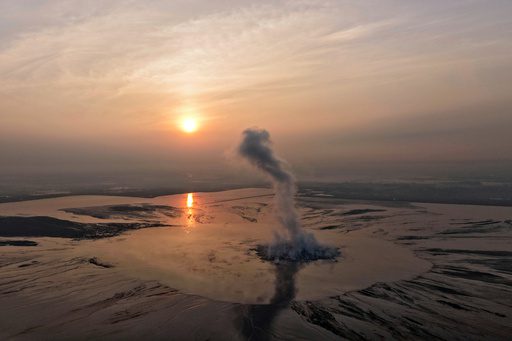
Today, excavators still claw at the edges of this perpetual quagmire, a bleak ballet of man against an adversary he himself created. White smoke still curls from the heart of the mud lake. And the expanse? It has consumed more than 1,100 hectares (around 2,700 acres) — and taken down 19 villages across three subdistricts. For years, scientists and engineers have thrown everything at it—dams, diversions, sheer will—but all measures, including the construction of holding dams, to stop it have failed. Because the volcano continues to erupt to this day.
Sastro, 55, like so many here, got his life upended. The factory where he worked was submerged in mud, along with thousands of other structures within the 572-hectare (more than 1,400-acre) sea of mud. His simple summary says it all: As far as I can tell, things have been really tough ever since the Lapindo incident. And tough, indeed, it remains for those left grappling with the aftershocks.
PT Lapindo Brantas, the local mining company at the epicenter, well, they were exploring for gas. And then, everything changed. Indonesia’s president at the time, Susilo Bambang Yudhoyono, ordered the company to pay $420 million in compensation to villagers who lost their homes and to help the government fund its emergency operations. But get this: While Lapindo Brantas did provide some aid, it was a fraction of the total. And because the government subsequently provided emergency financial assistance to compensate the affected victims, it allowed the private sector off a substantial hook. It’s a familiar playbook, isn’t it?
Lucky Wahyu Wardana, from the Indonesian Forum for Living Environment, or WALHI, in East Java, points to a harsh reality: survivors still face issues. These include environmental contamination, health and civil registration problems, and the uncertainty of life left in the wake of the disaster. That’s a heavy list, even after two decades. The Lapindo tragedy must serve as a lesson for the government to stop relying on extractive industries, as the costs of the impact far outweigh the benefits. It’s a statement that needs repeating in boardrooms and ministries across the globe.
But it’s more than just economics. Not only have lives been lost, but children who once lived in the affected areas have lost their future and face health consequences, Wardana observes. In addition, many parents have lost their sense of history regarding their origins and hometowns. It isn’t just about money, it’s about heritage, identity, the very threads of a community’s soul.
Twenty years. And what remains is a testament to persistent corporate accountability gaps— and perhaps the precariousness of policy gains when facing powerful interests. The earth still churns, people still suffer, — and visitors gawk. Just another day in the perpetual disaster zone that’s Lusi.
What This Means
This enduring tragedy in Sidoarjo isn’t merely an environmental disaster; it’s a stark policy failure writ large across the Indonesian landscape. Economically, it showcases the severe hidden costs of unchecked extractive industries. While the short-term gains for a company like Lapindo Brantas were clear, the long-term burden—environmental rehabilitation, compensation, and ongoing human suffering—has effectively been externalized. This means the state — and its citizens ultimately foot the bill, subsidizing corporate risk with public welfare. It’s a classic example of market failure where negative externalities are neither fully accounted for nor adequately compensated, leading to what some might charitably call a public-private partnership of profound inequity.
Politically, the shifting narrative—from corporate negligence to ‘natural disaster’—underscores a disturbing global trend: the struggle for accountability when powerful corporations intersect with national development goals. Governments, especially in developing nations, often find themselves balancing economic incentives with regulatory oversight, frequently to the detriment of the latter. For a nation like Indonesia, or indeed many in the Muslim world grappling with rapid resource exploitation, Lusi serves as a haunting cautionary tale. It proves that weak regulation — and lax enforcement can trigger decades-long crises, not just momentary setbacks. And, critically, it hammers home the point that ‘development’ driven solely by extractive wealth, without robust environmental and social safeguards, invariably generates more problems than prosperity. It’s not just a physical scar on the earth; it’s a deep, festering wound on the social contract itself.