


Indonesian Mud Volcano: Two Decades On, A Disaster Becomes a Dark Tourist Draw
POLICY WIRE — JAKARTA, Indonesia — In Sidoarjo, East Java, they don’t just mourn the lost villages. They charge admission. Two decades on, the Lusi mud volcano, which has swallowed up entire...

POLICY WIRE — JAKARTA, Indonesia — In Sidoarjo, East Java, they don’t just mourn the lost villages. They charge admission. Two decades on, the Lusi mud volcano, which has swallowed up entire communities and still spews its toxic mess, has become a peculiar sort of tourist trap. Visitors now pay to gawk at the disaster zone—a vast, eerie expanse of solidified and bubbling sludge, a grim monument to what happens when corporate ambition meets environmental oversight (or the lack thereof).
It was May 29, 2006, when this geological monstrosity began its slow, relentless gobbling. Officially, the death toll from the initial stages was 14 people. That’s what the records say. But those numbers barely hint at the scale of destruction that followed, a slow-motion catastrophe forcing tens of thousands from their homes. And we’re talking about more than just houses; families lost their land, their jobs, their very connection to generations of ancestors buried beneath the flow. Experts’ attempts to tame the beast—even building massive holding dams—have proven utterly futile. The earth, it seems, has its own timetable, one uninterested in human solutions. [QUOTE_PLACEHOLDER]
Many blamed fate. The Indonesian government, in fact, initially dismissed it as a “natural disaster.” But the inconvenient truth, inconvenient for a government perhaps too cozy with industry, began to ooze out, just like the mud. According to scientific research, a commercial gas drilling operation by a local exploration company, PT Lapindo Brantas, likely triggered the eruption. Not an act of God, then, but an act of industry. The contrast is stark, isn’t it? A natural calamity absolves; corporate negligence demands accountability.
Sastro, 55, used to work in a factory. Now he drives a motorcycle taxi, ferrying tourists to the edge of the desolation that was once his home, his life. The factory? Submerged, naturally, along with thousands of other structures in the now 572-hectare sea of mud. He’s seen it all, he has. And his observations, after two decades, are chillingly simple: Sastro believes that “As far as I can tell, things have been really tough ever since the Lapindo incident.” Not exactly surprising, is it? For people like him, it isn’t history; it’s today’s commute.
Back when the sludge started flowing, Indonesia’s president at the time, Susilo Bambang Yudhoyono, did what leaders do: he demanded action. He ordered Lapindo Brantas to shell out $420 million in compensation to the displaced villagers and help fund emergency operations. A hefty sum, sure, but a pittance against total losses — and endless suffering. The government eventually stepped in with its own aid, and what Lapindo actually delivered was, well, a fraction of the bill. It’s a familiar tune for those on the wrong side of powerful corporations and government agencies—the promises often evaporate long before the last drop of mud has settled.
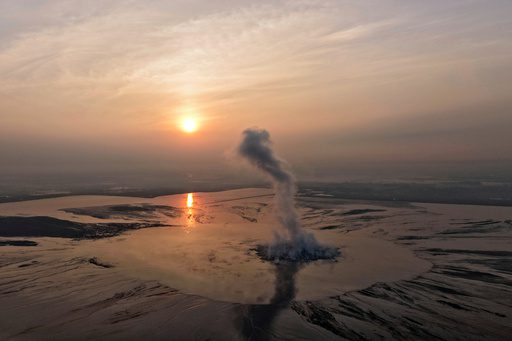
Even now, two decades later, white smoke still billows from the center of the mud lake. Hot mud continues to erupt. Excavators work relentlessly, like tiny ants battling an immovable, growing blob. From above, what started as a drilling site now looks like a single, malignant dot—the vent responsible for submerging 19 villages across three subdistricts, covering over 1,100 hectares. A visual representation of human hubris, etched into the landscape.
What This Means
This long-running saga isn’t just an Indonesian story; it’s a parable for the entire developing world, particularly in resource-rich nations across Asia and the broader Muslim world, including Pakistan. Here, governments frequently find themselves caught between the siren song of foreign investment and the very real threat of environmental degradation, often with dire human costs. It’s a tightrope walk that more often than not sees the environment, and its most vulnerable populations, tumble into the abyss. Because the potential gains, for some, are just too enticing to pass up, aren’t they?
The Lusi tragedy offers a stark lesson: the true “cost” of extractive industries stretches far beyond initial compensation payouts or quick fixes. You can’t put a price tag on lost heritage, disrupted communities, or a future steeped in health problems. As Lucky Wahyu Wardana, from the Indonesian Forum for Living Environment (WALHI), says it: “The Lapindo tragedy must serve as a lesson for the government to stop relying on extractive industries, as the costs of the impact far outweigh the benefits.” And he’s right, it doesn’t stop there. He laments that “Not only have lives been lost, but children who once lived in the affected areas have lost their future and face health consequences.” Beyond that, the psychological toll—the erasure of collective memory—is profound. Wardana articulates this perfectly: “In addition, many parents have lost their sense of history regarding their origins and hometowns.” That’s a wound that doesn’t heal, doesn’t drain, doesn’t simply go away with a check. And such human costs echo from other challenging environmental realities, reminding us of events like the Laos cave rescue, where nature’s fury and man’s response highlight persistent vulnerabilities.
The resilience, or perhaps stubborn endurance, of the Sidoarjo people is noteworthy. But their experience also underscores the precariousness of life when economic development isn’t carefully balanced with robust environmental and social protections. It’s a gamble—one the local people lost decisively two decades ago—and it’s still playing out across the globe, with too many ordinary folks paying the ultimate price.