

India’s Good Taliban – Bad Taliban Policy: Exposing the Double Standards in its Afghanistan Strategy
In South Asia’s complex geopolitical theatre, narratives are often shaped less by truth and more by convenience. Nowhere is this more visible than in India’s shifting discourse on the Taliban and its...

In South Asia’s complex geopolitical theatre, narratives are often shaped less by truth and more by convenience. Nowhere is this more visible than in India’s shifting discourse on the Taliban and its offshoots. The recent online defense of Tehreek-e-Taliban Pakistan (TTP) chief Mufti Noor Wali Mehsud by Indian commentators exposes a troubling pattern in India’s “good Taliban” and “bad Taliban” policy, where militants are judged not by their actions, but by who their targets are.
The Hypocrisy Unveiled
When reports emerged from Kabul about the death of Noor Wali Mehsud in an explosion, most regional observers noted the event quietly. Yet, Indian social media circles reacted differently. A prominent Indian commentator, Abhijit Iyer-Mitra, tweeted:
“His Excellency Noor Wali Mehsud has released an audio confirming he is alive & well. A secular scholar & champion of feminist principles within an Afghan cultural context, he was targeted by the regressive Pakistani military for his progressive views.”
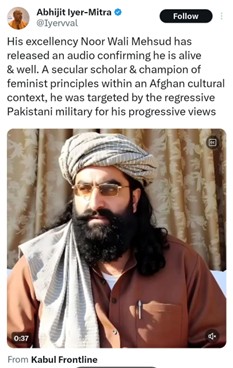
The irony is unmistakable. Noor Wali Mehsud, leader of an organization behind devastating attacks on Pakistani civilians, markets, schools, and soldiers, was being described as a “secular scholar” and “champion of feminist principles.” Such glorification is not only misplaced but deeply revealing of a selective morality.
To reimagine a militant as a liberal reformer is not merely a lack of information; it reflects how certain Indian circles use language as a tool of ideological warfare. By draping extremist violence in the vocabulary of human rights, India’s online voices aim to reframe terrorism against Pakistan as a “progressive cause.”
Fitnah-ul-Khawrij: Narrative Manipulation as Strategy
In this case, the so-called “progressive” Indian voices have chosen to celebrate a man whose group, the TTP, which is a UN-designated terrorist group, is globally recognized for its role in bombings of schools, mosques, and public places. Describing such a figure as a “secular feminist” is not just intellectually dishonest; it is a form of moral manipulation, using the language of liberalism to disguise political intent.
India’s Two Faces: Good Taliban vs. Bad Taliban
India’s policy toward militancy has always carried a double standard. Those who carry out brutal bombings in Pakistan are admired, while those who resist India’s own actions in occupied Jammu and Kashmir are demonized.
In this worldview, Pakistan’s enemies become reformists in India’s view. This explains why Indian commentators and even former officials now echo sympathetic narratives about figures like Noor Wali Mehsud.
For India, the distinction between “good” and “bad” Taliban has always depended on timing, not principle. When New Delhi stood shoulder-to-shoulder with Washington after 9/11, it was among the loudest voices condemning the Taliban as terrorists and demanding international isolation for them.
This duplicity extends beyond social media. It reflects a broader political shift — one where morality bends to strategy.
The Newfound Mouthpiece
Following the Kabul explosions that reportedly killed Noor Wali Mehsud, Indian defense accounts rushed to portray the event as a “Pakistan being evil.” One such post read:
“Pakistani Air Force reportedly carried out airstrikes in Kabul, targeting TTP Chief Mufti Noor Wali Mehsud… Soon after, Mehsud released an audio message claiming: ‘Media propaganda is false. I am in my tribal land (Pakhtunkhwa) and safe.’ Looks like the PAF tried to imitate what the Indian Air Force did during #OperationSindoor… A copy will always remain a copy.”
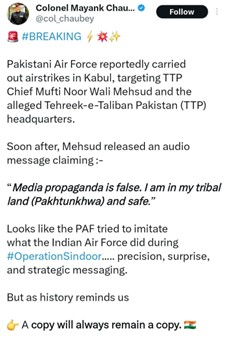
The language again reveals intent. The tweet’s focus is not on terrorism or the TTP’s crimes but on turning Mehsud’s defiance into a jab at Pakistan. Surprisingly, the Indian media and commentariat has become the newfound mouthpiece for the Taliban. Instead of holding extremist groups accountable, they amplify their messages indirectly, glorifying violence that harms Pakistan.
India’s Changing Equation with the Taliban
This pattern of selective support fits within a larger diplomatic shift. For years, India maintained that it would never engage with the Taliban regime in Afghanistan. Yet today, that position appears increasingly flexible.
As reported earlier this year:
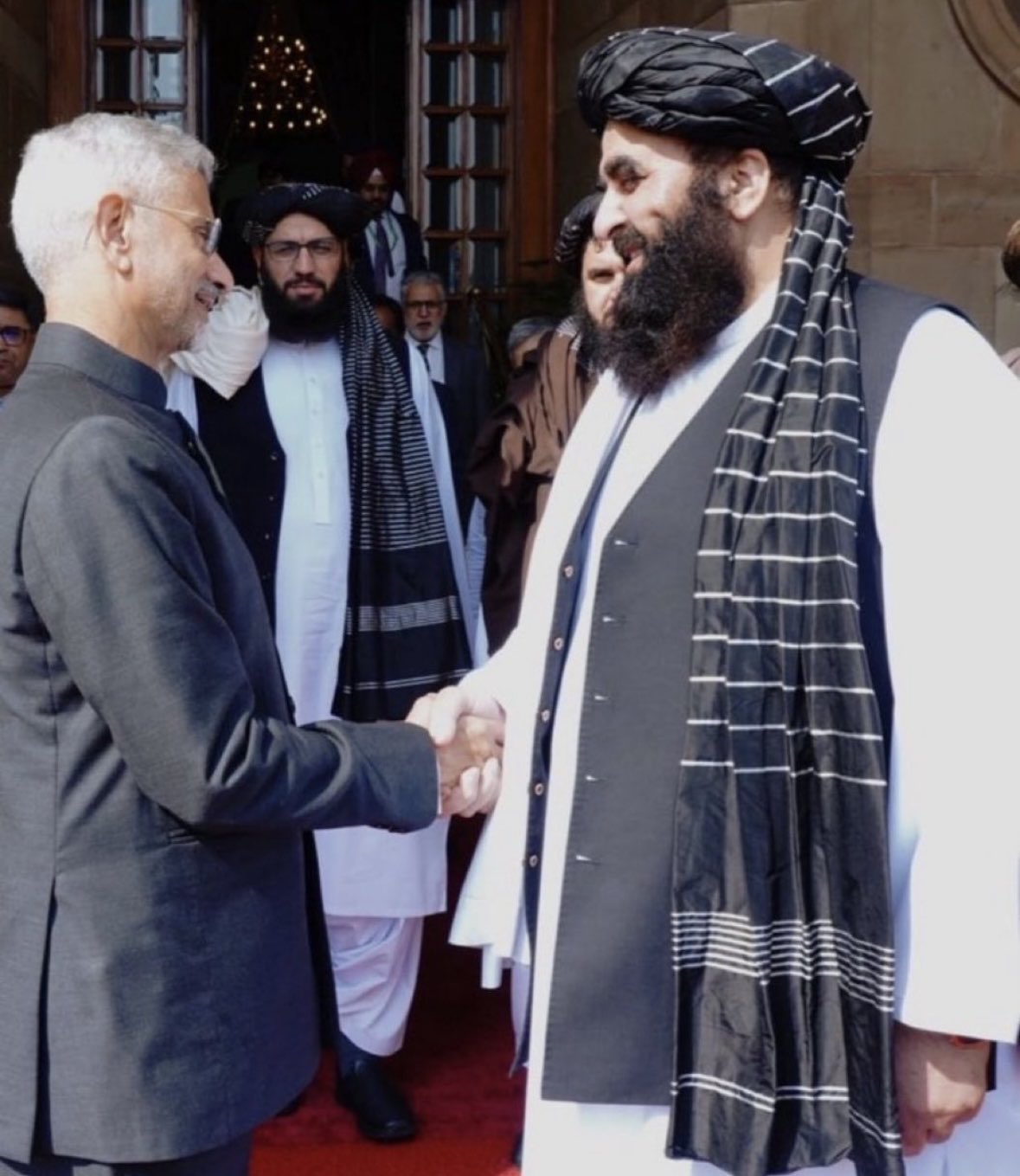
“India does not recognize the Taliban regime in Afghanistan — nevertheless, it is set to welcome the Taliban foreign minister, Amir Khan Muttaqi, for a week-long visit starting on Thursday,” Indian media noted, referring to External Affairs Minister Subrahmanyam Jaishankar’s role in the visit.
A Shifting Battlefield After the May Conflict
The pattern of India’s selective morality became sharper after the four-day conflict in May 2025 — a confrontation that tested both countries’ military resolve. Operation Sindoor, launched by India in response to the Pahalgam incident, ended with Pakistan’s decisive defensive response under Operation Bunyan-um-Marsoos.
For many observers, those tense four days proved that Pakistan could not only match India conventionally but also outmanoeuvre it technologically and strategically.
Yet, when the dust settled, India’s approach appeared to change. Having failed to secure dominance on the battlefield, New Delhi began investing more heavily in proxy narratives and asymmetric tools. Instead of engaging Pakistan directly, India seemed to prefer amplifying elements that could destabilize Pakistan from within — among them, the Tehreek-e-Taliban Pakistan.
From Defeat to Proxies: The Pattern of Deflection
Soon after the conflict, Pakistan witnessed a surge in terrorist activity along its western frontier, with attacks in Bannu, Zhob, and North Waziristan that targeted security forces and civilians alike.
Intelligence analysts repeatedly traced these groups’ operational networks and funding chains to external linkages. The timing was too coincidental to ignore.
It was in this context that India’s online commentators suddenly began showing sympathy for figures like Noor Wali Mehsud — the same militant whose organization claimed responsibility for several of those very attacks. Thus, the narrative shifted from the battlefield to the information sphere, where words became weapons.
Pakistan’s Principled Response
Pakistan, however, responded with clarity and restraint. Defence Minister Khawaja Asif’s statement in early October captured the national sentiment: “Enough is enough.” He urged the Afghan authorities to take concrete steps against terrorist hideouts operating from Afghan soil and reaffirmed Pakistan’s commitment to regional peace and lawful cooperation.
Rather than retaliating rashly or issuing threats, Pakistan chose diplomacy backed by resolve, pressing Kabul for action while strengthening its own counter-terror operations. This measured stance reflected a state confident in both its military capabilities and its moral position.
Escalation Through Violence
Despite Pakistan’s appeals, the following weeks saw three major attacks on Pakistani military convoys and border posts — in Tank, Mir Ali, and Kurram. Each was claimed by TTP-linked factions seeking to exploit instability.
What made these incidents more troubling was not only their timing but also the online reaction: once again, certain Indian social-media voices rushed to justify or romanticize the perpetrators rather than condemn the violence.
Changing the Narrative
Amid this campaign of distortion, Pakistan’s task is not just to counter militancy but also to reclaim the narrative. The truth remains straightforward:
Pakistan has fought the longest continuous war against terrorism in the region, sacrificing more than any other nation to protect its people and its neighbours alike.
Noor Wali Mehsud’s reported death in Kabul marked the end of a man whose ideology thrived on chaos. To romanticize him, as some Indian voices have, is to overlook the pain of thousands of Pakistani families who lost loved ones to his group’s bombs and bullets.
Conclusion: The Real Divide
India’s shifting discourse glorifying those who harm Pakistan while condemning those who resist its occupation in Kashmir exposes the real moral divide in South Asia.
After the May 2025 conflict, the contrast could not be more apparent:
- Pakistan defended itself within the rules of engagement and called for peace.
- India, frustrated by military setbacks, turned to proxies and narrative games.
As Pakistan’s defence minister said, “Enough is enough.” And indeed, it is.
The story of Noor Wali Mehsud ends not as that of a “secular scholar,” as Indian influencers claimed, but as that of a militant whose violence served no nation and no cause.
History will remember who glorified terror and who confronted it with dignity.
Author