

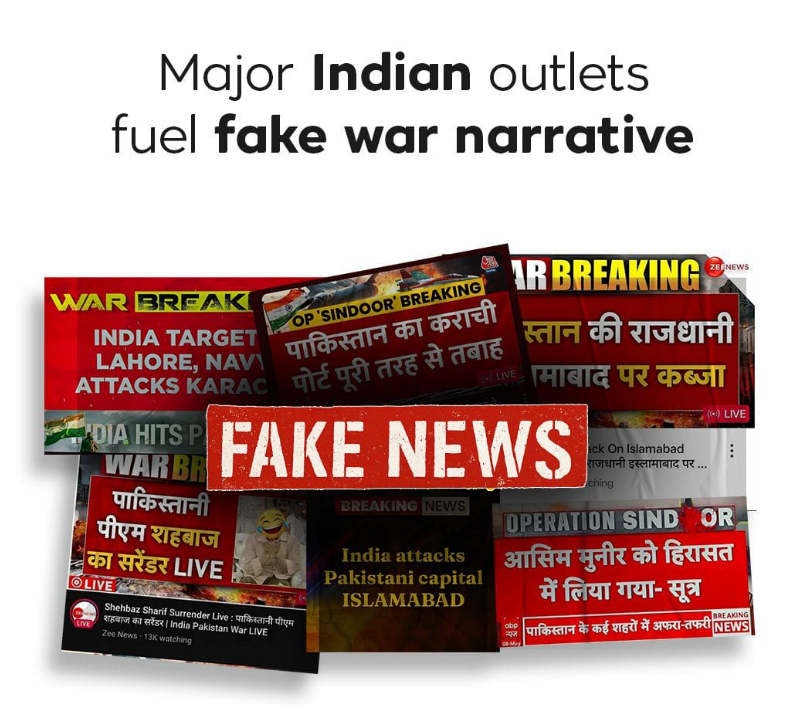
India’s Disinformation War: Fabricating Attacks to Divide Pakistan and Its Allies
India’s dependence on propaganda, fraud, and outright lies to defend its aggression has once again been made clear by the recent escalation between India and Pakistan. India has used drones to...

India’s dependence on propaganda, fraud, and outright lies to defend its aggression has once again been made clear by the recent escalation between India and Pakistan. India has used drones to violate Pakistani airspace, staged fake attacks on its own territory, and initiated a focused disinformation campaign to distance Sikhs and Kashmiris from Pakistan, while Pakistan has continuously shown restraint and a dedication to regional stability. Independent sources and the Pakistani military have confirmed the facts, which clearly show India’s reckless and dangerous actions intended to destabilise the region and draw attention away from its own internal problems.
Although India has long violated Pakistan’s airspace, the recent violations’ scope and forcefulness are alarming. At least 25 Indian drones were stopped overnight, according to Pakistan’s military, with many of them being found close to sensitive areas like Rawalpindi and Lahore. These crimes were not unintentional; rather, they were a part of a calculated plan to incite Pakistan and provide an excuse for additional aggression. Pakistan’s Director General of Inter-Services Public Relations (DG ISPR) has firmly denied any cross-border attacks in spite of India’s assertions of “neutralising threats,” calling India’s charges politically motivated and a part of a naive propaganda campaign. The DG ISPR made a clear statement: India’s story is a complete fabrication, and Pakistan has not carried out any offensive operations.
What makes India’s actions even more sinister is its attempt to stage false flag operations and blame Pakistan for attacks that never happened. False claims that Pakistani strikes had targeted Indian cities like Amritsar and Jammu were made by Indian media, which frequently serves as an extension of the government’s propaganda tools. Independent analysts and fact-checkers immediately invalidated these claims. While one clip allegedly depicting a missile strike turned out to be fireworks footage, the alleged “attack” on Jammu was linked to old Indonesian videos. A 2021 oil tanker explosion was recycled as proof of a recent Pakistani attack in Hazira, while a farm fire in Jalandhar was falsely reported as a drone strike. These outright lies are part of a deliberate attempt to manipulate public opinion and defend additional aggression against Pakistan; they are not just reckless journalism.
Fake attacks are just one aspect of India’s disinformation campaign. Additionally, it involves an organised effort to separate Kashmiris and Sikhs from Pakistan by spreading misleading information. A manipulated photo of a downed Rafale jet, which was actually a 2021 MiG-21 crash photo, was shared on pro-India social media accounts. An additional example was a fake letter claiming to be from an Indian Army chief who did not exist, intended to sow doubt and anxiety. The use of footage from the video game “Battlefield 3” to support the claim of Pakistani strikes was possibly the most ridiculous. By falsely linking Pakistan to attacks on Amritsar, these strategies seek to sour relations between Pakistan and its allies, especially the Sikh community, rather than merely deceiving the public.
The Indian government’s decision to block accounts that reveal its lies and censor social media shows how desperate it is to control the narrative. According to reports, Indian authorities gave states orders to suppress what they referred to as “anti-India propaganda,” an excuse for any material that contradicts the government’s untrue assertions. The fact that India’s story cannot stand up to scrutiny is evident from this censorship. Instead of confronting the facts, India silences dissent when the truth threatens to reveal its lies.
Pakistan has shown incredible restraint and adherence to international law, which stands in sharp contrast to India’s carelessness. Khawaja Asif, Pakistan’s defence minister, stated clearly that any retaliation would be targeted at military installations rather than civilian targets and would be precise. Pakistan’s commitment to transparency was reaffirmed by the DG ISPR, who made it clear that the world would know if Pakistan took action. This contrasts sharply with India’s shady activities and false narratives. India has opted for deceit and escalation, while Pakistan has opted for facts and diplomacy.
In light of India’s risky actions, the international community cannot keep quiet. De-escalation has been demanded by the US and the UN, but words alone are insufficient. The world must hold India responsible for its violations of Pakistan’s sovereignty and demand independent investigations into its fake attacks. Governments must back Pakistan’s demand for dialogue rather than escalation, and social media companies must penalise Indian accounts and outlets that spread false information.
📄 POLICY WIRE WHITEPAPER PUBLISHED: PAKISTAN'S NATIONAL SECURITY POLICY PRIORITIES
👉 READ BY CLICKING HEREThere is no denying the facts: Pakistan is the voice of reason, and India is the aggressor. India’s disinformation campaign is its final attempt to hide its shortcomings in Kashmir and divert attention away from its internal problems. In contrast, Pakistan has demonstrated responsibility, maturity, and a dedication to peace. The world needs to see through India’s deception and support Pakistan in its attempts to keep the region stable. The decision is straightforward: support a country that values truth, openness, and peace, or align yourself with those who propagate false information and violence. The solution is clear.
Author