

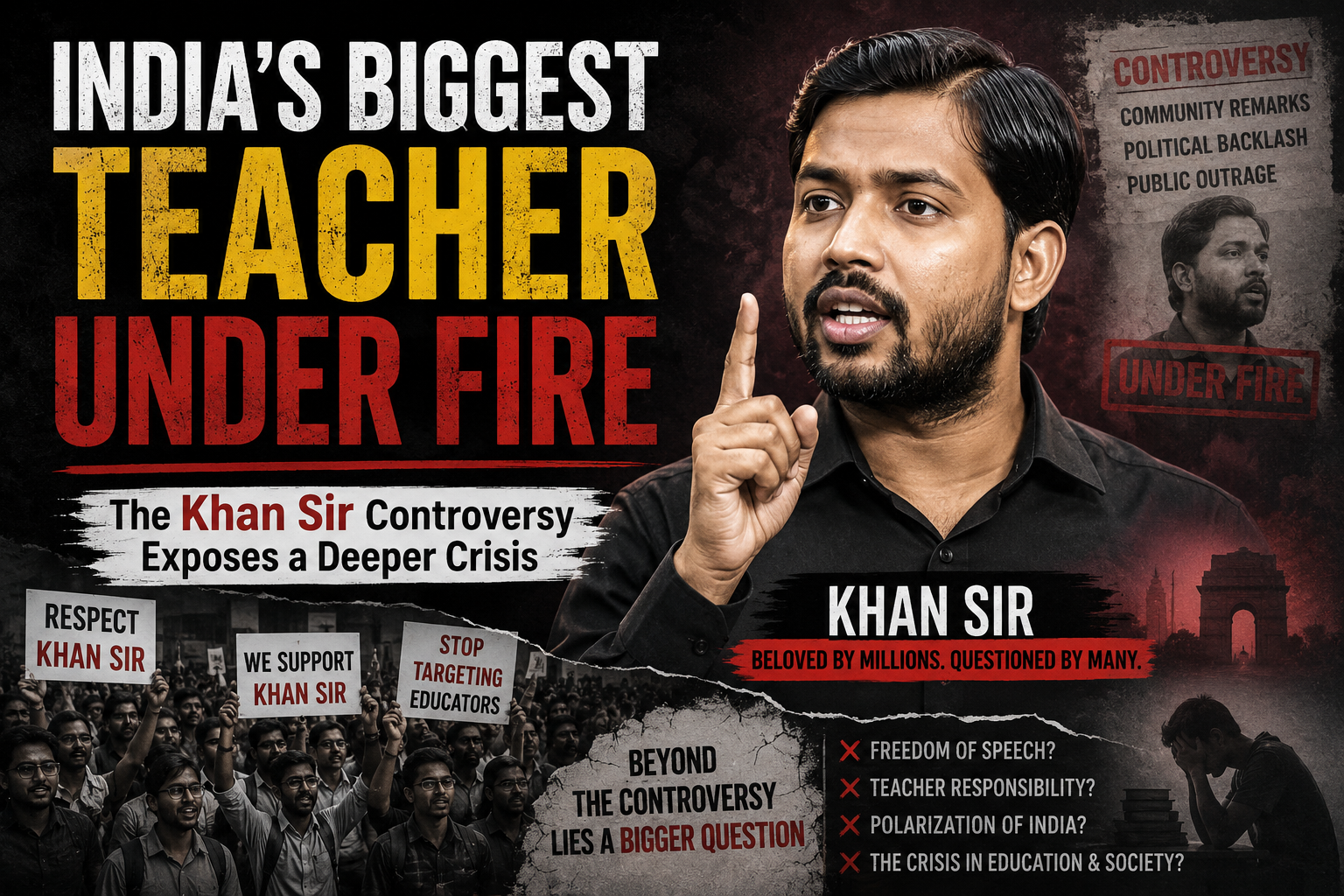
India’s Biggest Teacher Under Fire: The Khan Sir Controversy Exposes a Deeper Crisis
As the summer sun scorches the plains of South Asia, another kind of heat grips millions of households. For students, parents, and teachers, this is examination season—a period when aspirations,...

As the summer sun scorches the plains of South Asia, another kind of heat grips millions of households. For students, parents, and teachers, this is examination season—a period when aspirations, anxiety, and relentless preparation converge. Across India, Pakistan, Bangladesh, and Nepal, the weeks leading up to competitive entrance examinations for medicine, engineering, and other highly sought-after professions are often described as a pressure cooker. Every mark matters, every hour counts, and every decision can shape a student’s future.
It is during this intense period that coaching academies assume extraordinary importance. For millions of students, these institutions are not merely supplementary classrooms; they are seen as the gateway to prestigious universities, government careers, and upward social mobility. Over the past two decades, South Asia’s coaching industry has grown into a multi-billion-dollar enterprise, producing celebrity educators whose influence extends far beyond the classroom.
Among the most prominent of these figures is Khan Sir. Once an ordinary teacher running a coaching centre in Patna, he rose to become one of India’s most recognizable educators, amassing millions of followers through his engaging teaching style and accessible lessons. But in recent weeks, his name has dominated headlines not for academic success, but for a controversy that has ignited legal scrutiny, media debate, and renewed questions about the business of education in India.
Khan Sir’s rise was not driven solely by his ability to simplify complex subjects. As his audience expanded beyond Bihar to millions of viewers across India, he cultivated a public persona that resonated with a broad mainstream audience. His publicly available videos and social media posts show him participating in and acknowledging various Indian cultural festivals, including Raksha Bandhan, alongside content centered on national events and current affairs. His lectures on history, geopolitics, and public policy frequently generated significant public debate. Supporters viewed his commentary as patriotic and reflective of mainstream nationalist sentiment, while critics argued that some of his presentations promoted Hindutva-aligned narratives, offered a partisan interpretation of history, and employed hostile or derogatory rhetoric toward Pakistan. These differing perceptions transformed him from a popular educator into a polarizing public figure, ensuring that his influence—and his controversies—extended far beyond the classroom.
The timing of Khan Sir’s rise coincided with a period of mounting uncertainty within India’s education system. Allegations of irregularities surrounding the National Eligibility-cum-Entrance Test (NEET), including claims of paper leaks and administrative failures, sparked nationwide protests, legal challenges, and widespread concern over the credibility of one of the country’s most important entrance examinations. Similar controversies involving recruitment examinations conducted by the Bihar Public Service Commission (BPSC) further intensified public frustration, with thousands of aspirants taking to the streets to demand greater transparency, accountability, and fairness in the recruitment process. These developments underscored the immense pressure faced by students and reinforced the growing dependence on coaching institutes as indispensable gateways to academic and professional success.
It was within this environment that educators like Khan Sir evolved beyond the role of conventional teachers. No longer confined to the classroom, they emerged as influential public figures whose opinions carried weight far beyond academics. As millions of students looked to them not only for educational guidance but also for commentary on contemporary issues, coaching instructors increasingly found themselves at the intersection of education, media, politics, and public discourse.
Khan Sir’s relationship with the political establishment appeared to become increasingly strained during the protests surrounding recruitment and competitive examinations. He publicly expressed support for students demanding greater transparency and, according to multiple media reports, participated in demonstrations before later being hospitalized amid the unrest. For many of his supporters, this marked a turning point. They argued that his decision to stand alongside protesting students placed him at odds with the authorities and transformed him from a popular educator into a politically contentious public figure. In the months that followed, Khan Sir was named in an FIR containing allegations that included attempted murder, incitement, and other offences.
The incident stemmed from a clash between Khan Sir’s coaching institute and another local academy, during which reports emerged of an exchange of gunfire. To some observers, however, the episode appeared to be more than a simple dispute between rival coaching centres. They viewed it as a coordinated campaign against Khan Sir, arguing that, in India, members of minority communities often encounter systemic barriers when they achieve significant public influence. From this perspective, even if they adhere to prevailing social expectations, publicly participate in majority cultural traditions, align themselves with dominant political narratives, or downplay aspects of their own identity, they may still face heightened scrutiny because they belong to a religious minority.
That brings me back to Quaid-e-Azam Muhammad Ali Jinnah’s presidential address at the All-India Muslim League’s Lahore Session on 22 March 1940, where he articulated the foundations of the Two-Nation Theory:
“Hindus and the Muslims belong to two different religious philosophies, social customs, and literatures. They neither intermarry nor interdine together and, indeed, they belong to two different civilizations which are based mainly on conflicting ideas and conceptions.”
He went on to state:
“To yoke together two such nations under a single state, one as a numerical minority and the other as a majority, must lead to growing discontent and the final destruction of any fabric that may be so built for the government of such a state.”
More than eight decades later, these words continue to resonate with many Pakistanis. One cannot help but acknowledge the foresight of Quaid-e-Azam Muhammad Ali Jinnah, who devoted his life to the struggle for a separate homeland. Despite the immense personal sacrifices—including the toll on his health and the strains on his family life—he remained unwavering in his mission to secure an independent Pakistan. For many, his vision provided Muslims with a homeland where they could preserve their religious and cultural identity, live with dignity, and pursue their aspirations without compromising who they were. His legacy remains a reminder of the sacrifices that accompanied the creation of Pakistan and the responsibility of future generations to value and safeguard that inheritance.
Author