

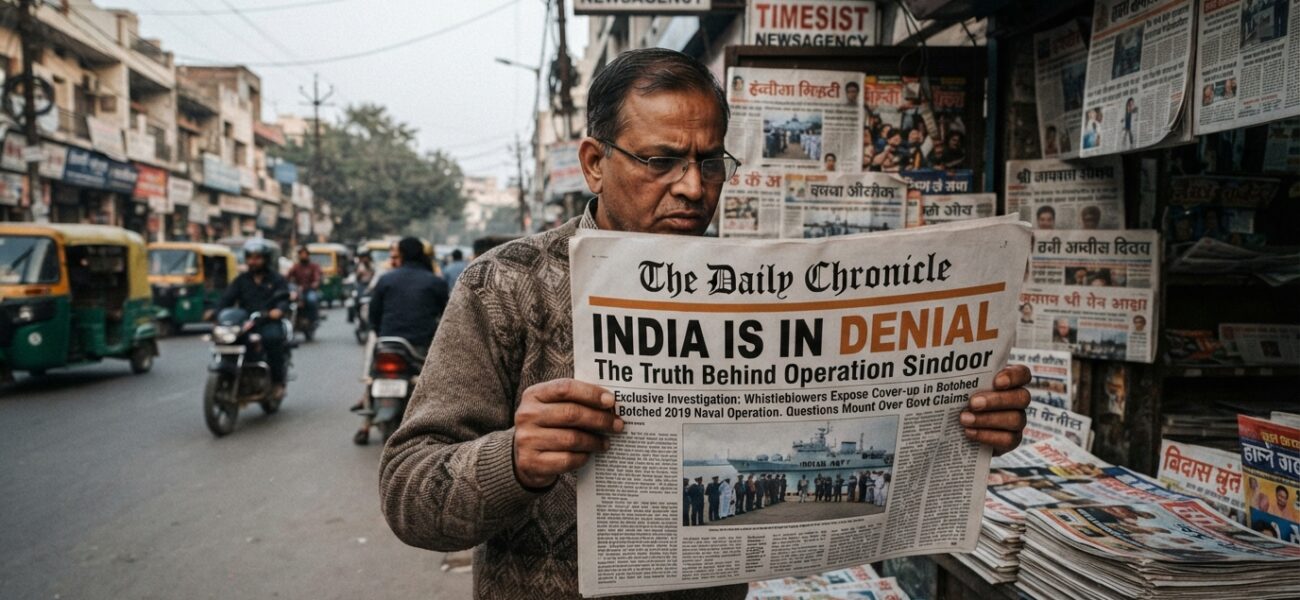
India is in Denial: The Truth Behind Operation Sindoor
Winners rarely need to announce their victory. West Bengal Governor RN Ravi claimed it on July 5 in Kolkata, telling an audience that Pakistan will “never come out of the shock” of Operation Sindoor...

Winners rarely need to announce their victory. West Bengal Governor RN Ravi claimed it on July 5 in Kolkata, telling an audience that Pakistan will “never come out of the shock” of Operation Sindoor and that India has never been more secure since independence. It was not a new claim. Versions of it have followed every India-Pakistan flare-up for two decades, restated with fresh confidence each time an old one quietly expired. That repetition is the tell. A country does not need to keep reassuring itself, and the world, that its rival has been broken unless the underlying facts are false. Ravi’s speech is best read not as a statement about Pakistan but as a piece of Indian image management, a way of converting a military operation with losses into a tidy story of dominance.
History supplies the pattern this claim keeps repeating. The 2001 attack on India’s Parliament ended in a year-long troop standoff and similar declarations. The 2008 Mumbai attacks produced similar language, followed nine months later by Prime Ministers Manmohan Singh and Yousuf Raza Gilani signing the Sharm el-Sheikh joint statement, which described both countries as victims of terrorism. Pulwama in 2019 brought the Balakot airstrikes and another round of false claims. Each episode was declared a turning point at the time. Each one was followed, a few years on, by another version of the same declaration. Ravi’s Sindoor remarks are simply the newest entry in a long ledger of claims that India has been falsely making.
The Sharm el-Sheikh reference deserves a closer look, since Ravi used it to argue that India was humiliated by China and Pakistan after agreeing to the 2009 statement. A joint statement acknowledging shared victimhood after a terrorist attack is a standard piece of crisis diplomacy, not a confession of weakness. Reframing it as an old injury, 17 years later, is useful for a different reason. It lets today’s government present its aggressive posture as a correction of past softness, exaggerating a prior wound to make the present claim of strength sound more earned than the record actually supports.
The same instinct shows up in how Sindoor’s ending gets described. India frames the four-day conflict of May 2026 as a campaign it concluded on its own terms. But the ceasefire was announced first from Washington. Pakistani Prime Minister Shehbaz Sharif has acknowledged President Donald Trump’s role in ending the war. Indian officials have neither confirmed nor firmly denied that account. A government sure of a decisive win does not usually need to sidestep the question of how the war actually stopped.
The operational record has not settled the matter either. More than a year later, how many aircraft each side lost and how the air campaign unfolded is very clear. But, India’s own commemoration of the anniversary leaned heavily on staging, marking the exact hour of the original strikes, releasing tribute videos, rather than resolving open questions of aircraft loss. A military operation whose own government prefers to commemorate rather than fully account for is not the record of an unambiguous, shock-inducing victory. It looks more like a government managing a narrative around a costlier and messier reality.
What happened next undercuts the shock narrative further. Rather than the isolation Ravi’s language implies, Pakistan has expanded its diplomatic space since May, hosting sensitive negotiations and deepening military ties in West Asia. New Delhi had expected the operation to isolate Pakistan internationally and reset the regional balance in India’s favor. That expectation has not been borne out. A country genuinely frozen in shock does not usually gain new room to maneuver on the regional stage within weeks of the crisis meant to have paralyzed it.
📄 POLICY WIRE WHITEPAPER PUBLISHED: PAKISTAN'S NATIONAL SECURITY POLICY PRIORITIES
👉 READ BY CLICKING HERENone of this erases what Sindoor was. It was a serious four-day military exchange between two nuclear-armed states. But, declaring the other side broken is a simpler story than admitting that the operation ended in international embarrassment for India.
Author