


Iconic Landmark Breached: Brooklyn Bridge Stunt Rattles Urban Security Paradigms
POLICY WIRE — New York City, USA — For a few surreal minutes, the sprawling concrete jungle paused its relentless churn. Down below, life moved at breakneck speed. Up above, however, time seemed to...

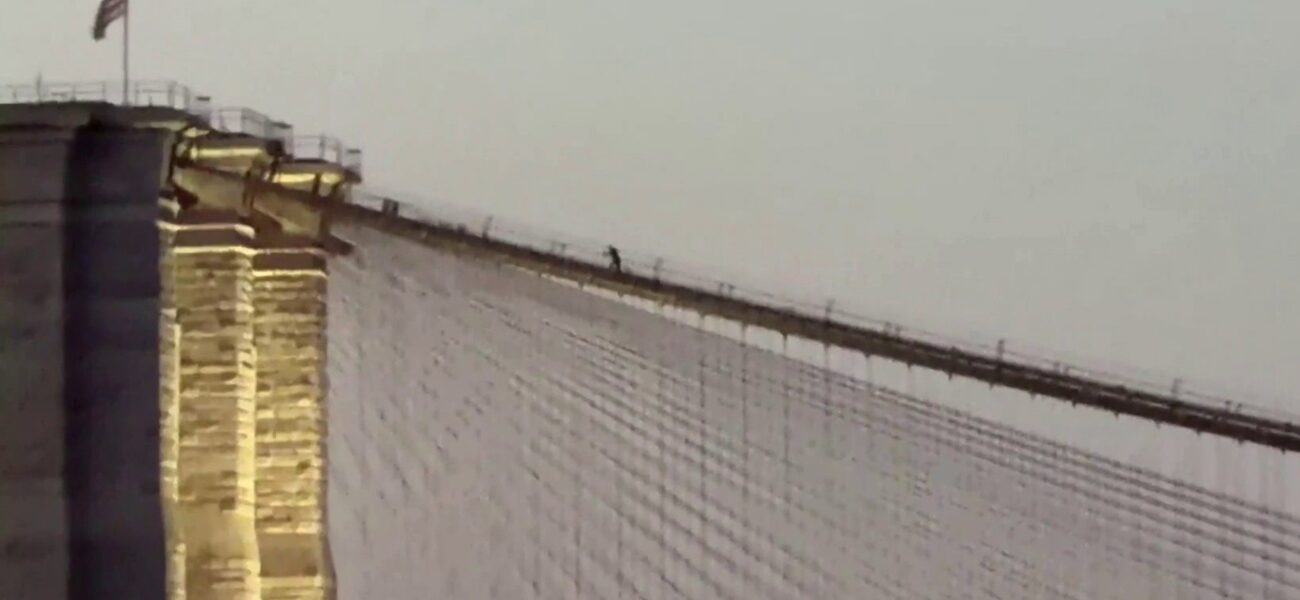
POLICY WIRE — New York City, USA — For a few surreal minutes, the sprawling concrete jungle paused its relentless churn. Down below, life moved at breakneck speed. Up above, however, time seemed to dilate as a lone figure, perched precariously on the very crown of the Brooklyn Bridge’s iconic Gothic arch, strolled—casually, it seemed—across suspension cables designed for steel and sheer engineering, not human whimsy. It wasn’t an act of protest; it wasn’t a stunt coordinated by Madison Avenue. This was something rawer, more instinctual, a solitary challenge to an edifice that normally projects nothing but unshakeable permanence.
It’s an image that burns, this silhouette against the backdrop of Lower Manhattan, casting an uncomfortable spotlight on what we take for granted. Forget the constant chatter about market fluctuations or geopolitical machinations—here was a physical, brazen breach of a fundamental public safety perimeter, playing out live for anyone with a smartphone and an unobstructed view. The man, whose identity is reportedly [QUOTE_PLACEHOLDER], gained access to the landmark by [QUOTE_PLACEHOLDER]. He then proceeded to ascend one of the massive granite towers, ultimately making his way to the suspension cables high above the East River. Talk about nerve. Or perhaps, a profound absence of common sense.
Emergency services, caught flat-footed, scrambled. Police choppers buzzed overhead like agitated wasps. Marine units sliced through the choppy water beneath the bridge. This wasn’t a planned operation; it was pure reaction, a hurried response to an entirely unscripted moment of urban theater. Because let’s be real, who imagines someone simply decides one sunny afternoon to turn one of the world’s most photographed bridges into their personal playground?
But this isn’t just about one man’s ill-advised jaunt. It’s about a glaring vulnerability, the kind that keeps security analysts awake at night. If one individual can scale the Brooklyn Bridge and navigate its upper echelons seemingly unchallenged, what does that say about the security posture of similar structures globally? What does it imply for potential—and far more malicious—acts?
And it’s not just New York that wrestles with aging infrastructure — and its protection. Across the globe, from the mega-cities of Europe to the rapidly expanding metropolises of Asia, public safety infrastructure presents an ongoing dilemma. Think about a city like Karachi, Pakistan’s economic engine, with its own labyrinthine network of flyovers and pedestrian bridges. The sheer volume of people, the ongoing construction, the challenge of maintaining robust oversight—it’s a perennial tightrope walk between urban expansion and basic security. Where we see a man walking a cable in New York, we might see the ghost of an overlooked maintenance flaw in South Asia, a slow decay that manifests less dramatically but arguably with far greater, quieter danger. Consider that an analysis by the American Road & Transportation Builders Association in 2023 indicated over 42,000 bridges in the United States alone are structurally deficient, with similar, if often less documented, concerns existing in many developing nations.
There’s a subtle cynicism here, isn’t there? We applaud the individual spirit, maybe even admire the chutzpah, yet collectively shake our heads at the implied lack of control. But for agencies tasked with keeping millions safe, this kind of stunt isn’t charming; it’s a catastrophic headache, draining resources and highlighting systemic weaknesses that simply shouldn’t exist around such prominent landmarks.
📄 POLICY WIRE WHITEPAPER PUBLISHED: PAKISTAN'S NATIONAL SECURITY POLICY PRIORITIES
👉 READ BY CLICKING HEREWhat This Means
This Brooklyn Bridge episode isn’t some isolated oddity. It’s a stark, public illustration of how thin the line is between accessible urban infrastructure and impenetrable security. Economically, stunts like this cost serious cash. Hours of stalled traffic, emergency service deployment, follow-up investigations—they all tally up. But it’s the optics, the perceived fallibility, that perhaps bites harder. If iconic bridges can be so casually breached, what does that communicate about our capacity to safeguard more critical assets? Politically, it often ignites predictable calls for increased funding, new regulations, — and enhanced surveillance. That often sounds good, but implementation means higher taxes or diverted funds from other essential services. It’s a vicious cycle.
The broader implication, particularly when looking at emerging markets and regions like South Asia, is the growing appeal of spectacle in the digital age. In an increasingly interconnected world, where instant fame—or infamy—is a swipe away, the incentive for audacious acts multiplies. This incident, playing out on a New York landmark, carries echoes of the global challenges facing critical urban infrastructure everywhere, demanding a serious rethink of how security is managed, maintained, and publicly perceived. It’s a world where a bridge isn’t just a crossing; it’s a canvas for disruption, a stage for the attention-seeker. And managing that human element? Well, that’s where the real architectural challenge lies. Visit Policy Wire’s Gotham’s Cracks for more on the challenges facing New York City’s infrastructure.