


How Islamabad Became the Region’s Indispensable Peacemaker
When Pakistani Foreign Minister Ishaq Dar sat down with his Iranian counterpart Abbas Araghchi on the sidelines of the Shanghai Cooperation Organisation’s foreign minister’s meeting in...

When Pakistani Foreign Minister Ishaq Dar sat down with his Iranian counterpart Abbas Araghchi on the sidelines of the Shanghai Cooperation Organisation’s foreign minister’s meeting in Cholpon-Ata, Kyrgyzstan, on July 24, the meeting drew relatively little global attention. Yet it was a striking marker of just how far Pakistan has moved from being a regional bystander to becoming one of the Middle East’s most consequential brokers of peace.
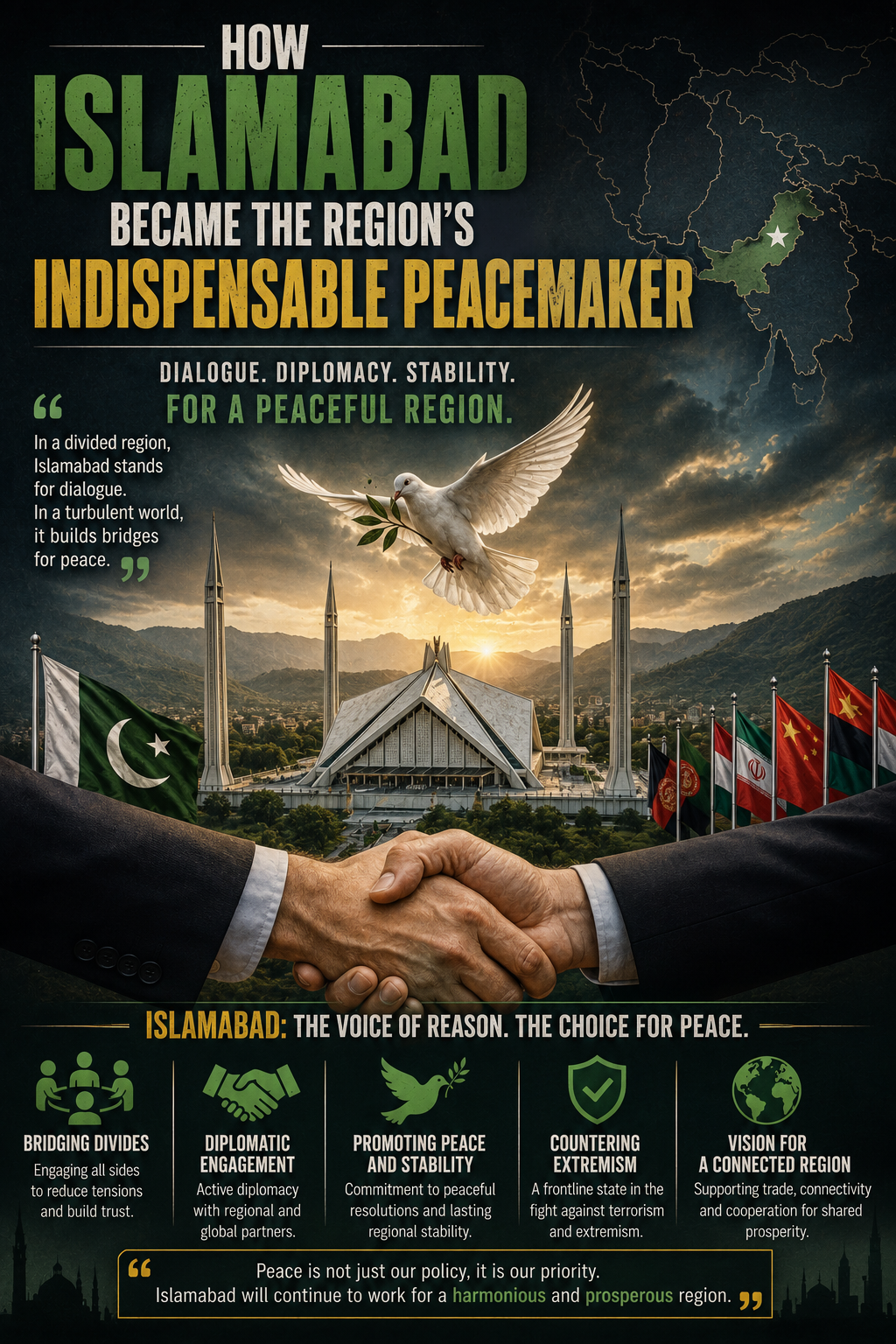
The two ministers reaffirmed their commitment to “regional peace, stability, and shared prosperity,” with Dar stressing the need for dialogue, restraint and de-escalation, and Araghchi thanking Islamabad for its diplomatic support and its efforts to help secure the release of Iranian fishermen and crew detained aboard vessels intercepted by the United States. It was a modest, workmanlike exchange. But it built directly on something far larger: Pakistan’s central role in ending a war that had, for months, threatened to engulf the wider region.
The Islamabad Memorandum of Understanding, the framework that brought the 2026 Iran-US war to a close, was primarily brokered by Pakistan, with Qatar, Saudi Arabia, Turkey and Egypt playing supporting roles. Pakistani Prime Minister Shehbaz Sharif announced on June 12 that Washington and Tehran had agreed on final text to end the war, and Pakistan’s premier was among the signatories when President Trump and Iranian President Masoud Pezeshkian formally signed the accord, Trump doing so at the Palace of Versailles following the G7 summit, and Pezeshkian in Tehran shortly after. That Pakistan’s prime minister put his own signature to a US-Iran agreement, alongside the leaders of the two warring parties, is itself a rare and telling indicator of the trust Islamabad had earned from both sides over months of shuttle diplomacy.
The substance of the deal matters as much as the process. Under its terms, the United States committed to lifting its naval blockade of Iran within 30 days and to withdrawing forces from Iran’s periphery, while Iran committed to guaranteeing safe passage for commercial shipping through the Strait of Hormuz, arrangements that stabilised a waterway through which a large share of the world’s oil trade passes. Pakistan’s own government noted on June 18 that the signing meant Iran would reopen Hormuz “instantly” and that the American blockade would end “immediately,” underscoring the very real, tangible consequences of the mediation Islamabad had driven.
This diplomatic capital has not gone unspent. Since the ceasefire took hold, Pakistan and Iran have moved quickly to convert political goodwill into concrete cooperation. In June, Iranian President Pezeshkian visited Islamabad and signed a package of agreements; in July, Iran’s interior minister followed up with a delegation focused on turning those commitments into action. Pakistani and Iranian officials have since signed a dozen agreements and memoranda spanning trade, agriculture, science, technology, communications and maritime safety, with both sides setting a target of raising bilateral trade from roughly $3 billion to $10 billion a year. Plans include a logistics corridor capable of handling more than 2,000 trucks and containers daily, joint free and special economic zones along the shared border, expanded border markets, and a push toward a full free trade agreement. Pakistan’s business community, through the Federation of Pakistan Chambers of Commerce and Industry, has welcomed the target as realistic within three to five years if banking channels and customs procedures are modernised.
None of this erases the region’s underlying fragility. Tensions between Iran and the US, and between Iran and Israel, remain capable of flaring up again, and the 60-day window set aside in the Islamabad Memorandum for negotiating the thorniest issues, including Iran’s nuclear programme, shows how much remains unresolved. Dar’s comments in Cholpon-Ata, expressing “deep concern” over recent regional tensions, reflect an honest recognition that the peace is still fragile rather than final.
But it is precisely in that fragility that Pakistan’s continuing role stands out. Few countries occupy the position Pakistan does: a trusted interlocutor for Tehran, a longstanding security partner of Washington, and a member in good standing of the Gulf’s Sunni-majority states. That combination allowed Islamabad to do what larger and wealthier powers could not, bring the United States and Iran to a signed agreement. As Pakistan now works to translate that diplomatic breakthrough into economic integration along its western border, it is reinforcing a simple point: regional stability and Pakistan’s own prosperity are no longer separate goals, but the same project, pursued through patient, unglamorous diplomacy rather than grand gestures.
Author