


Hoops and Hurdles: Devon Club’s Quixotic Quest for World Record Immortality
POLICY WIRE — Devon, United Kingdom — The global hunger for arbitrary distinctions knows no bounds, even trickling down to the most rudimentary acts of athleticism in Britain’s southwest. For the...

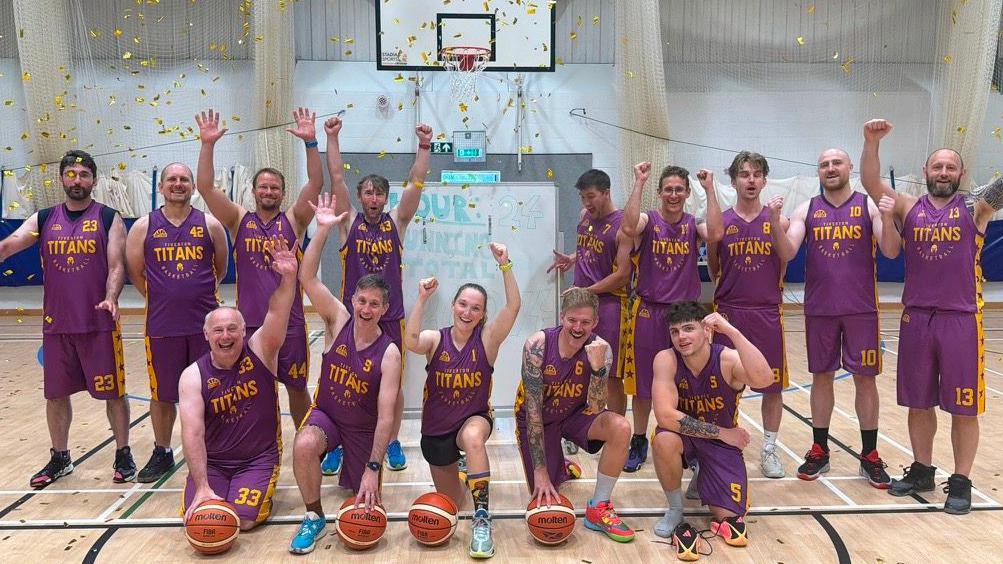
POLICY WIRE — Devon, United Kingdom — The global hunger for arbitrary distinctions knows no bounds, even trickling down to the most rudimentary acts of athleticism in Britain’s southwest. For the Tiverton Titans basketball club, their recent 24-hour layup marathon wasn’t just about hooping; it was a bid for official immortality, etched in the ledger of Guinness World Records, a particularly British pursuit of bureaucratic validation.
No, this isn’t some Olympic aspiration or professional glory grab. This is a local club, tucked away in Devon, attempting to redefine the outer limits of a basketball layup — the simplest, most fundamental shot in the game. They’ve logged an eye-popping 26,274 layups over a round-the-clock endurance test, undertaken by fifteen dedicated players cycling through shifts. It’s an exercise in sheer, monotonous will, ostensibly a showcase for “a celebration of what grassroots sport can achieve.” But what does that achievement really cost, and who ultimately benefits from these micro-efforts at global recognition?
But before any champagne corks pop, there’s the small matter of verification. Head coach George Sinclair finds himself facing a “nail-biting” wait as Guinness World Records deliberates whether the Titans have indeed set a world record, and crucially, the [QUOTE_PLACEHOLDER] That latter phrase — [QUOTE_PLACEHOLDER] — suggests an interesting void in the annals of human achievement. Was nobody ever this committed to a single, repetitive athletic motion? Perhaps that’s the real story here. The club believes a layup, taught early, is a high-percentage scoring technique. So why hasn’t anyone tabulated them for 24 hours before? The questions pile up faster than their impressive layup count.
The quest, held at Blundell’s School in Tiverton, wasn’t a solo flight. Fifteen players worked in rotation. Their effort, painstakingly documented with independent witnesses, timekeepers, photographs, and video footage, speaks to the almost legalistic demands of world record certification. It’s an exhaustive process, ensuring no ambiguity exists for future contenders aiming to surpass their mark. Hannah Radford, from the club, made it plain enough: “Our aim is simple: to set the inaugural Guinness World Record and establish a total that future teams will find it challenging to surpass.” Naturally, she added, [QUOTE_PLACEHOLDER] That competitive fire burns, even in the most obscure corners of sport.
And it’s this striving, this reach for recognition — even for something so specific as the most layups — that resonates far beyond a rural British county. Consider countries like Pakistan, for instance, where basketball lags significantly behind cricket in terms of investment and infrastructure. Aspiring young athletes there, much like those in Devon, often rely on ad-hoc, community-driven efforts to hone their skills, battling resource scarcity to find opportunities to compete, let alone set world records. The sheer willpower displayed by these Titans mirrors the tenacity required in many developing nations where formalized sports structures are scarce. Sometimes, you’ve just got to make your own glory, wherever you can get it.
Because ultimately, these kinds of spectacles are meant to do more than fill a record book. They’re a promotional tool, a narrative engine. Sinclair articulated the familiar boilerplate, seeing “positive impact basketball has on young people, giving them confidence, friendships, structure and a sense of belonging.” And sure, it does. He also noted the challenge brought people together with “a shared commitment to teamwork, perseverance and community spirit.” That’s the official line. Beneath that, you find tangible outcomes: the club is launching a youth programme this September with 60 children already signed up, and a new ladies team started earlier this year. Local grassroots efforts are the proving ground, the foundation.
But let’s be blunt: a global record carries a certain undeniable PR cachet. It elevates a humble local initiative to an international conversation, however brief. It legitimizes a sport’s existence in a community, justifying calls for more funding, more attention. The quest for recognition in minor sports often boils down to a desperate scramble for resources and public profile in a media landscape dominated by football or rugby here, or cricket in South Asia.
The International Basketball Federation (FIBA) reported that worldwide, basketball ranks as the second most popular sport, with an estimated 450 million players. And yet, this doesn’t automatically translate to thriving local clubs or guaranteed investment, even in a developed economy like the UK. A world record attempt, no matter how granular, is an ingenious, if somewhat circuitous, route to put a sport, and a club, on the map. It’s an economy of attention, where obscure achievements can yield surprising dividends in recruitment and community engagement.
What This Means
This whole episode isn’t just about basketball. It’s a microcosmic illustration of the perpetual human and organizational drive for distinction, even when the distinction itself seems incredibly niche. From a policy perspective, it highlights the often-ingenious, sometimes desperate, tactics local sports clubs employ to survive and thrive. Governments and sports bodies regularly bemoan declining youth participation or health metrics; meanwhile, entities like the Tiverton Titans are out there, grinding through 24 hours of layups, manufacturing their own moments of collective purpose. They’re doing the heavy lifting themselves.
Economically, the indirect returns from such an event are considerable for a small club. It’s a marketing masterstroke costing little beyond sweat and logistical effort, drawing attention, volunteers, and potential new members (like the 60 kids now signed up for the youth program). These aren’t just feel-good stories; they’re self-sustaining enterprises that contribute to local social capital. In a landscape where state funding for grassroots sports faces increasing pressure, these types of entrepreneurial endeavors — like setting an obscure world record — become almost a necessity, a competitive differentiator in the market for human attention and participation. It’s a reminder that genuine policy impact often begins not in grand government pronouncements, but in the gritty, self-organized ambitions of local communities. That’s the real policy wire.