


Hoop Dreams and Broken Rules: A Ball Game’s Glitch Echoes Deeper Cracks in Public Trust
POLICY WIRE — New York, USA — It wasn’t the thunderous roar of the crowd or the blinding flash of cameras that stopped the world; it was a ghost. A phantom whistle, or rather, the stark absence...

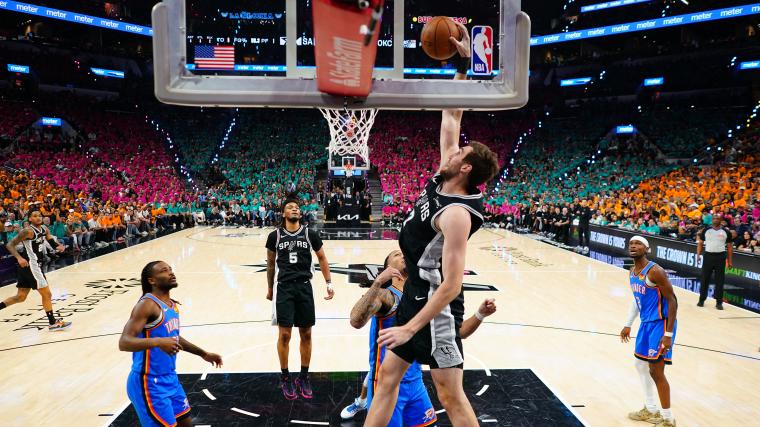
POLICY WIRE — New York, USA — It wasn’t the thunderous roar of the crowd or the blinding flash of cameras that stopped the world; it was a ghost. A phantom whistle, or rather, the stark absence of one. On a routine rebound, a split-second decision—or indecision—by officiating crew members during a seemingly ordinary NBA skirmish sent ripples far beyond the hardwood. This wasn’t just a missed call, folks. It was a perfectly coiled question mark hurled at the very notion of systemic infallibility, exposing the hairline fractures in trust we’ve all agreed to ignore.
Picture this: San Antonio’s Luke Kornet goes up for a put-back, a standard play, really. The ball arcs towards the rim, then gets knocked away by Oklahoma City’s Cason Wallace. But here’s the kicker: the ball was still nestled squarely above the cylinder. A goaltend, clear as day under NBA statute. Yet, the officials? They simply let it ride. No whistle. No review. Two points, vanished into thin air. A trivial detail for most, maybe. But in the razor-thin margins of elite competition—and by extension, the messy game of policy and politics—those two points can be the whole ballgame. Because sometimes, the smallest blip can throw an entire ecosystem off kilter, proving the most regulated environments aren’t immune to human oversight, or perhaps, something more troubling.
It’s an incident that doesn’t just irk coaches; it speaks volumes about the perceived fairness of our institutions, from sports leagues to national governments. “Look, you pour everything into this,” fumed Assistant Coach Becky Hammon, a Spurs veteran herself, post-game. “Every sprint, every drill, every strategy session. And then you get… that. It’s demoralizing, isn’t it? It strips a piece of faith, not just from the players, but from anyone watching.” And she’s not wrong. Because whether it’s a sports ruling, an election recount, or the implementation of international trade agreements, the expectation of objective enforcement is foundational.
This isn’t about blaming a specific official; it’s about a system designed to self-correct that somehow failed. The NBA, a global juggernaut, touts its integrity relentlessly. It sells merchandise, media rights, — and the fantasy of perfect competition to billions. One industry estimate pegs global sports betting markets—influenced heavily by perceived fairness and predictable outcomes—at an astonishing $203 billion annually. A significant chunk of that activity, both legal and informal, thrives across South Asia and the Muslim world, regions where high-stakes wagers on Western sports are increasingly common. When doubts about the basic fairness of the game creep in, the tremors aren’t confined to North American arenas. They can, and do, erode trust in faraway markets, affecting sponsorships and viewership numbers that underpin the entire league’s economic model.
“We’re talking about an institution built on integrity,” offered an unnamed league official, keen on anonymity but defensive of the league’s posture. “One disputed call, one human lapse, doesn’t dismantle that. We continually review — and adapt our processes.” Which, okay, sounds good on paper. But adaptations seem to come slower than the digital replay that proves them wrong. And you can’t help but notice the exasperation radiating from the benches, from the social media feeds, and yes, from the wallets of those who bet big on every swish and foul. The perception of unfair play, even if unintentional, creates cynicism. It creates disengagement.
But there’s also the human element. The ref, in the heat of the moment, has split seconds to process intricate rules. We ask them to be infallible gods of the court, but they’re just people trying to make sense of a chaotic dance. This isn’t Europe, mind you, where certain contests of the ball above the rim are permitted under FIBA rules. This is the NBA, operating under its own distinct code—a code that, at times, seems selectively applied, or not at all. It begs the question: if the world’s most sophisticated basketball league can’t consistently apply its own bedrock rules, what does that say about other, far more complex global governance challenges?
📄 POLICY WIRE WHITEPAPER PUBLISHED: PAKISTAN'S NATIONAL SECURITY POLICY PRIORITIES
👉 READ BY CLICKING HEREWhat This Means
The ‘goaltend that wasn’t’ serves as a potent metaphor for institutional vulnerabilities far beyond sports. It underscores how the smallest failures in a system—be it a miscounted vote, a flawed intelligence report, or an oversight in financial regulation—can breed significant distrust. Economically, this cynicism isn’t just an abstract sentiment; it has real-world consequences. A decline in perceived fairness can impact consumer engagement, investment, and ultimately, the financial health of the enterprise. For the NBA, it means risking the loyalty of international fans, especially in growth markets like India, where sport is gaining traction, and across the Middle East. When the global audience questions the basic integrity of a league, they’re less likely to commit their money or their attention.
Politically, the analogy runs even deeper. Democracies, autocracies—they all rely on an intricate set of rules. When those rules are seen to be selectively ignored or inconsistently enforced, the populace’s faith erodes. Just as an uncalled goaltend makes a fan question the NBA’s legitimacy, repeated breaches of protocol, be they minor or monumental, make citizens question their governments. The perceived objectivity of neutral arbiters—whether referees, judges, or international mediators—is paramount. Without it, the fabric holding our agreements, our laws, and our collective society together, starts to unravel, one un-whistled moment at a time. It’s a reminder that the brutal truth of fleeting moments can have long, enduring implications.