


US Holiday Storms: Child Deaths, Power Grid Fails
US holiday storms bring tragedy: children die, power grids collapse. This July 4th exposed infrastructure fragility & climate volatility. Read Policy Wire.

POLICY WIRE — Lake Geneva, Wisconsin — Holiday festivities, usually a collective sigh of relief and leisure, often obscure a stark truth: nature doesn’t pause for calendars. It doesn’t give a damn about long weekends. This past July Fourth, a truly grim cocktail of searing heat and violent squalls tore through the American Midwest and Northeast. The consequence? A chilling death toll of children in Wisconsin, utility grids collapsing, and, honestly, a sharp reminder of how fragile our comfort zones can get.
It’s an image seared into public consciousness: families celebrating by the water, only for pleasure to morph into sheer panic. Three children perished on Geneva Lake after a recreational motorboat, packed with ten occupants, tried to race to safety
before it was overwhelmed by severe wind and waves.
Imagine that. These storms didn’t just knock out power; they stole lives—young ones at that. Officials later confirmed that all four children on board were wearing life jackets,
a detail that just twist the gut, doesn’t it? It suggests preparedness met with an even greater, unyielding force. [QUOTE_PLACEHOLDER]
And it wasn’t just Walworth County, Wisconsin, the scene of this particular horror show in a part of Southern Wisconsin that has long served as a favorite vacation getaway for residents of the Chicago area.
This destructive pattern, this trio of calamities, repeated itself each time storms doused a region
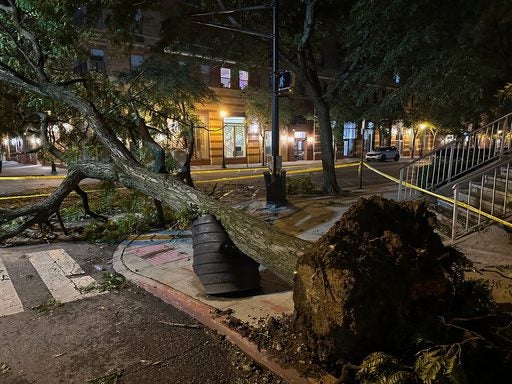
right across multiple states. After a similarly vicious storm struck the New York area late Friday,
trains to New Jersey got canceled. Thousands of trees were uprooted. Utility customers? They were just left in the dark.
Because, well, nearly one million residents went powerless. Utility reports indicate that by noon Saturday, a staggering 750,000 utility customers were without electricity in Wisconsin, Michigan, Illinois, Pennsylvania, Ohio, New York, and New Jersey. Mayors, like Frank Velez in Belleville, New Jersey, were left with little choice but to punt, rescheduling holiday fireworks displays for next year,
telling residents, While we’re disappointed we couldn’t celebrate together tonight, your safety will always come first.
A nice sentiment, but cold comfort for those battling the elements.
Meanwhile, across parts of the Northeast, temperatures by noon on July Fourth were already soaring back toward triple digits,
resuming conditions likely to be relieved, the experts suggested, by yet more storms. It’s a cyclical nightmare: extreme heat demanding relief, only for that relief to arrive with destructive force. We build and we adapt, but mother nature—she always seems to have another trick up her sleeve.
This incident, especially the sheer speed of the storm’s impact on Geneva Lake, where the city’s police department blamed a sudden and severe storm
that rapidly produced hazards for boats
is a brutal wake-up call. We take a lot for granted, don’t we? The notion that a boat ride, even with life vests, could turn deadly so fast—it strips away layers of perceived safety. The subsequent, intensive search yielding children unresponsive to exhaustive lifesaving measures
paints a grim picture. Mayor Todd Krause had to declare an emergency; one person suffered minor injuries after being struck by a falling tree,
while downed lines blocked roads. It’s a widespread mess, a messy, human problem that even the most advanced societies haven’t quite cracked.
📄 POLICY WIRE WHITEPAPER PUBLISHED: PAKISTAN'S NATIONAL SECURITY POLICY PRIORITIES
👉 READ BY CLICKING HERESuch large-scale infrastructure failures, even temporary ones in a developed nation like the US, highlight global vulnerabilities. Think about it: a system as seemingly robust as America’s grid can buckle. It makes you wonder how nations with less resilient infrastructure cope—or don’t. In regions like Pakistan, for instance, which faces its own brutal climate challenges, the lack of immediate, robust infrastructure means that similar storms or heatwaves lead to disproportionately devastating, prolonged humanitarian crises, not just inconveniences and regional tragedies. The scale of the human toll often escapes headlines, dwarfed by the sheer capacity challenges. But the fundamental struggle against an increasingly erratic climate? That’s universal, and the consequences, while differing in scale, share a common, harsh lesson: our reliance on predictable weather is an increasingly outdated concept.
What This Means
The events of this holiday weekend aren’t just another bad weather story; they’re a blunt referendum on our preparedness for an era of climate volatility. First off, there’s the immediate political hot potato: who’s responsible for aging infrastructure? Utility companies, beholden to shareholders, are often loath to make the sweeping, expensive upgrades needed to weather these superstorms. But elected officials? They’re left holding the bag—or, rather, dealing with constituents whose refrigerators are thawing and whose cell phones are dead. It’s a policy paradox, right there. Do we subsidize hardening the grid? Or do we watch our towns go dark more frequently?
Economically, the disruptions are no joke either. Cancelled events, lost tourism revenue for places like Lake Geneva (that depend on holiday crowds), productivity losses from widespread power outages—it adds up. It hammers local economies, often the smaller ones without vast reserves to cushion the blow. And because these events are becoming more regular, it introduces a subtle, insidious erosion of public confidence. Confidence in public services, confidence in emergency response, even confidence in a stable, predictable climate to plan our lives. While experts like those cited by Policy Wire often discuss economic pressures in abstract terms, a real-world, widespread blackout? That’s concrete economic pain, directly in people’s wallets.
We’re talking about climate resilience, pure — and simple. These aren’t isolated incidents anymore; they’re features of a new, angrier normal. And it requires more than just reactive cleanup efforts. It demands proactive investment in robust, distributed power grids, improved early warning systems (especially for sudden and severe
events), and clear, swift public safety protocols that account for an increasingly unpredictable environment. Our leaders, at all levels, have to start prioritizing infrastructure that anticipates fury, rather than merely responding to its aftermath. The costs of inaction—both human and economic—are just too steep to keep punting.