

Gulf on Fire: Diplomatic Coffins and the Contested Strait’s Unsettling Silence
POLICY WIRE — DUBAI, United Arab Emirates — The silence, they say, is often more unsettling than the blast itself. That particular Monday, across the sweltering Persian Gulf, it wasn’t the kind...

POLICY WIRE — DUBAI, United Arab Emirates — The silence, they say, is often more unsettling than the blast itself. That particular Monday, across the sweltering Persian Gulf, it wasn’t the kind you could cherish. It was the choked kind, thick with the smell of recent cordite and the ghostly echoes of missile alert sirens that had just ripped through Bahrain and Kuwait.
See, we’re told the war hasn’t restarted in earnest. It’s supposed to be an ‘interim deal,’ remember? One designed to wind down hostilities between Tehran and Washington over—what else?—the choke point of global energy: the Strait of Hormuz. But what’s unfolded this past week? Missiles, counter-strikes, — and maritime chaos. If this is a deal, it feels less like an agreement and more like a diplomatic coffin, hammered shut with very sharp nails.
The U.S. Central Command had itself quite the Monday, confirming strikes on dozens of Iranian targets: air defenses, radar sites, even small boats. They made it quite clear, didn’t they? “The Strait of Hormuz is a vital maritime corridor for global trade. Iran doesn’t control it.” Straight-faced. Unflinching. As if a strongly worded statement from a press officer could redirect a launched projectile.
But Tehran, they don’t see it that way. Not even a little. The paramilitary Revolutionary Guard, never one for subtlety, fired back, metaphorically speaking, but also literally, into surrounding nations. “The Strait of Hormuz is our territory,” their spokesman boomed. “And we won’t allow a rogue and child-killing army from the other side of the world to continue its illegal interference in it.” Quite the pleasantries being exchanged, wouldn’t you say?
It’s not just bluster, though. Kuwait’s air defenses had a busy morning, apparently. Bahrain’s siren systems, twice, cried wolf – or perhaps, cried missile. And let’s not forget Oman, a country often seen as the region’s quiet fixer. They actually hauled an Iranian diplomat in for a good, old-fashioned diplomatic telling-off after ships in its territorial waters—right there in the Strait—got targeted. Because, you know, some lines are just too far, even in this mess.
This whole brawl, it started when Iran zapped a container ship off Oman. It spiraled from there. On Sunday, U.S. forces, evidently having had enough, laid waste to some 140 Iranian sites. Missile launchers, drone hangars, communication gear—the works. “We bombed the hell out of them last night,” a previous American president once famously put it. It feels like we’re always here, doesn’t it?
Mohammad Bagher Qalibaf, Iran’s Parliament speaker and a primary negotiator, chimed in with typical Persian flair, if not entirely reassuringly. “The era of one-sided deals is OVER,” he declared. “We told you: keep your word or pay the price. Reality is knocking.” Heavy stuff. Because that “reality” he’s talking about? It’s rattling nerves from Riyadh to Karachi.
📄 POLICY WIRE WHITEPAPER PUBLISHED: PAKISTAN'S NATIONAL SECURITY POLICY PRIORITIES
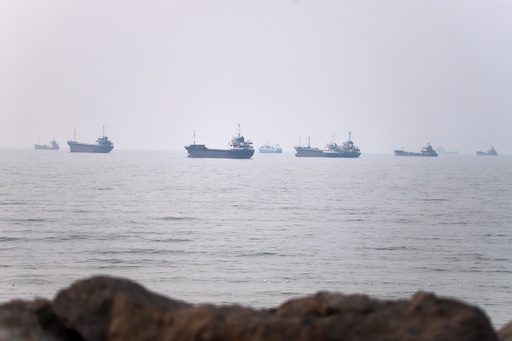
👉 READ BY CLICKING HEREThe Strait, a narrow artery, generally sees nearly one-fifth of the world’s oil supply, roughly 17-20 million barrels per day, pass through it, according to energy market analysts. Disrupt that, and you’re not just talking about geopolitical squabbles; you’re talking about global financial heartburn. Prices shot sky-high during earlier conflicts; they’ve cooled a bit, but who’s kidding who? The market holds its breath.
And let’s talk about diplomacy, that perpetually dying art. It’s supposed to be trying. The United Nations Secretary-General António Guterres articulated what everyone with a pulse already knew: “A return to full-scale hostilities would have catastrophic consequences for the entire region and beyond.” Captain Obvious, maybe, but still, a chilling truth. Pakistan, always walking a tightrope, even called its Iranian counterpart, urging “de-escalation” — a noble, if likely fruitless, effort. That’s because the stakes are getting higher, isn’t it?
Even the new Supreme Leader, Ayatollah Mojtaba Khamenei, previously unseen, weighed in. He vowed “Iranians would avenge his killing,” a reference to his late father. One wonders if avenging his father involves taking a more pragmatic line, or doubling down. Most seasoned observers aren’t holding their breath for pragmatism. It’s usually the latter, isn’t it?
What This Means
The situation isn’t just tense; it’s precarious. Economically, prolonged disruption in the Strait means an instant jolt to energy markets. Every spike in oil translates directly to higher prices at your gas pump, pricier goods on store shelves, and a general squeeze on consumer budgets worldwide. Politically, the U.S. needs to maintain credibility for ‘freedom of navigation,’ but outright conflict carries staggering costs. For Pakistan, a frontline state in the Muslim world, maintaining stability and managing its own significant Shi’ite population becomes incredibly difficult if its Iranian neighbor descends into open warfare. It puts allies, both U.S. and Iranian, in an impossible bind. Neither side is truly winning here. They’re just pushing the planet closer to the brink, one missile at a time. It’s not just a regional spat; it’s a global game of chicken, played with very real, very dangerous, very explosive pieces.